Everyone's, so no one's: The tragedy of the commons happens when a commons is used without limits. Each user takes a little more for themselves, and together they ruin it for everyone.
The points to remember
- The tragedy of the commons: a shared resource with unrestricted use gets overused.
- No one owns it, so no one is responsible for protecting it.
- Each user acts in self-interest: they gain all of what they take, but share the cost with everyone.
- Each takes only a little, but the combined effect is huge: the resource is depleted or ruined.
- Short-term gain wins over the long-term sustainable use that would benefit everyone.
Remember it as: If everyone takes a little too much, the whole system collapses.
A shared field
In 1968 the ecologist Garrett Hardin described a village pasture that every herder may graze.
Self-interest
Each herder adds one more cow: they get all the extra milk and money for themselves.
Shared cost
The extra grazing damages the grass, but that cost is split between all the herders.
Tragedy
Every herder does the same, the pasture is overgrazed, and all the herds go hungry.
The tension: The tension is between what is best for each user now and what is best for everyone over time: the shared benefit of sustainable use.
Free preview
This is the free notes preview
You're reading the free notes. Aimnova Pro unlocks the full study experience — and you can try it with your first topic free to keep:
- FlashcardsLock in vocabulary and key terms with spaced repetition.
- Practice questionsAnswer exam-style questions and get instant AI marking.
- Mock exams & past-paper vaultSit full mocks and see exactly how examiners award marks.
- Personalised study planA daily plan built around your exam date and weak areas.
The first kind of tragedy is overharvesting: too many users take a living resource from the commons.
The points to remember
- Overharvesting: taking a living resource faster than it can replace itself.
- Every boat catches more to earn more, because a fish left in the sea may be caught by a rival.
- Catches rise, then the stock collapses: too few adults are left to breed.
- Everyone loses: the food, the jobs and the species.
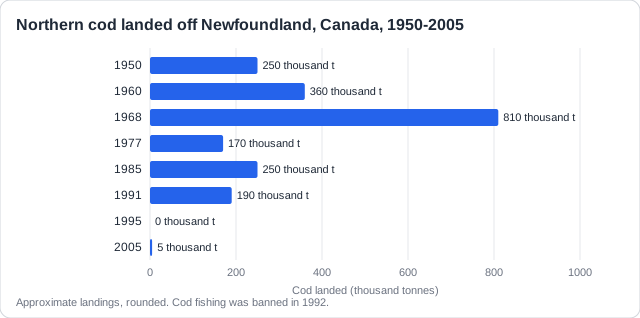
Real example: the Grand Banks off Newfoundland, Canada, held one of the world's richest cod stocks. Factory trawlers from many countries, then Canadian boats, landed up to 810,000 tonnes a year. In 1992 the stock collapsed, fishing was banned, and about 30,000 people lost their jobs. Decades later the cod have still not fully recovered.
Read the graph for the story: Quote the rise, the peak and the fall with numbers: 'from 810,000 tonnes in 1968 to almost nothing by 1995'.
Never wonder what to study next
Get a personalized daily plan based on your exam date, progress, and weak areas. We'll tell you exactly what to review each day.
The second kind is contamination: many users treat a shared place as a free place to dump their waste.
The points to remember
- Contamination: using a shared place as a free dump for waste.
- Each person, firm or country adds only a small amount, and no one owns the ocean or air.
- The waste builds up from all of them together, far from where it was made: 'out of sight, out of mind'.
- It harms natural systems and human food sources that everyone shares.
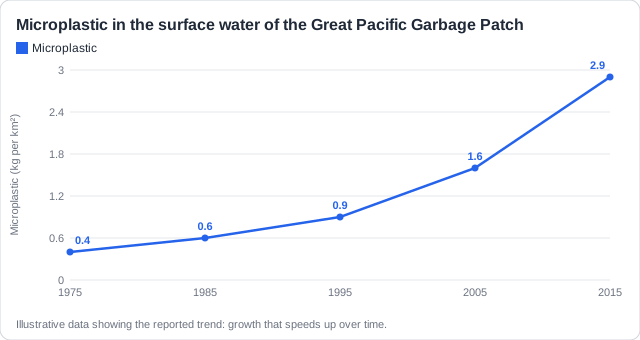
Real example: the Great Pacific Garbage Patch is an area of floating plastic, twice the size of Texas, held by a gyre between California and Hawaii. The plastic comes from many countries and fishing fleets. No one owns the open ocean, so no one is responsible for cleaning it. Fish and seabirds swallow the pieces, and toxins pass up the food chain towards people.
Name the case every time: In a question about a named place, mention it in your points. An answer about the tragedy of the commons in general, with no link to the case, gets at most half the marks.
The tragedy of the commons matters for two big ideas: sustainability and biodiversity.
The points to remember
- Sustainability: the resource is used faster than it renews, so future users lose it.
- Biodiversity: target species crash, and food webs lose their prey or predators.
- Bycatch and pollution kill species that were never the target.
- Unmanaged commons are overused; pollution rises without rules.
- Damaged ecosystems lose resilience; well-managed ones can stay sustainable.
Sustainability
- Cod were taken faster than they could breed, so the fishery could not go on.
- Future generations lost a food source and a way of life.
Biodiversity
- Seabirds, turtles and fish swallow plastic, which blocks their gut or poisons them.
- With cod gone, their prey such as shrimp and crab boomed: the food web changed.
Why management matters: Biodiversity loss is not only about how much is used, but how it is managed. The same sea can be fished for centuries under limits, or emptied in decades without them.
Stop wasting time on topics you know
Our AI identifies your weak areas and focuses your study time where it matters. No more overstudying easy topics.
The tragedy is not certain. Users can avoid it by agreeing limits and enforcing them, from the top or from the community.
The points to remember
- Agreements between countries sharing the resource, and laws with fines.
- Quotas, licences, limits on boats, closed seasons and bans keep catches below the maximum sustainable yield.
- Monitoring of the stock, so limits follow the science.
- Gear rules: bigger mesh and minimum sizes so young fish escape; less bycatch; no poison, explosives or trawling.
- No lost or dumped nets, which keep catching fish for years (ghost fishing).
- No-take zones and marine protected areas where stocks can breed.
- Other incomes for fishers, fish farming, and eco-labels; local rules agreed by the users themselves.
Remember it as: Agree it, limit it, watch it, enforce it.
The problem
By the 1980s Iceland's own cod stock was shrinking as too many boats chased it.
Quotas
From 1984, each boat was given a share of a total catch set by scientists each year.
Enforcement
Every catch is weighed at the port, and fishing grounds are closed when too many young fish are caught.
Result
The cod stock has grown since the 2000s, and Icelandic cod is sold with a sustainable eco-label.
Tie each way to fishing: 'Educate people' alone is too general. Say what is taught and to whom: 'teach fishers to release young fish and use bigger mesh'.
How this comes up: Paper 2, Section A: a graph of a shared resource, then explain how it demonstrates the tragedy of the commons [4].
Figure 1 shows the northern cod landed off Newfoundland, Canada, between 1950 and 2005. Boats from many countries fished the Grand Banks until 1977.
Explain how the collapse of the northern cod demonstrates the concept of the tragedy of the commons.
Model answer plan
See the mark-by-mark plan — for / against / judgement, with marking guidance — in study mode.