Moved by people, then out of control: An alien species lives outside its natural range because people moved it. Most never spread. The ones that do, and harm native species, are invasive.
The points to remember
- An alien (non-native) species is one moved by people outside its natural range.
- It becomes invasive when it spreads fast and harms native species, ecosystems or people.
- Deliberate arrivals: hunting, farming, fur farms, pets, garden plants, pest control.
- Accidental arrivals: ballast water, stowaways in cargo, seeds in grain, hitchhikers on travellers.
- People bring them, the species do the damage: an indirect human impact.
Remember it as: People carry them in; the invader does the damage.
On purpose
- Rabbits: 24 released in Australia in 1859 for hunting.
- Cane toads: brought to Australia in 1935 to eat beetles in sugar cane.
By accident
- Zebra mussels: carried to the Great Lakes of North America in ballast water, found in 1988.
- They filter out the plankton native animals eat and block water pipes.
- Rats and insects: stowaways in cargo and luggage.
Other routes to know: Trade, travel, the pet trade and farming move species every day: aquarium fish released into rivers, seeds stuck to boots, insects in timber.
Free preview
This is the free notes preview
You're reading the free notes. Aimnova Pro unlocks the full study experience — and you can try it with your first topic free to keep:
- FlashcardsLock in vocabulary and key terms with spaced repetition.
- Practice questionsAnswer exam-style questions and get instant AI marking.
- Mock exams & past-paper vaultSit full mocks and see exactly how examiners award marks.
- Personalised study planA daily plan built around your exam date and weak areas.
Most alien species die out or stay rare. An invader is different: its numbers grow faster and faster, an exponential increase.
The points to remember
- No natural predators, diseases or parasites in the new place: nothing keeps numbers down.
- Plenty of resources and few competitors, so food and space do not run out at first.
- They breed fast: many young, early breeding, several litters or broods a year.
- They are generalists: they eat many foods and tolerate a wide range of conditions.
- Native prey have no defences against a new predator, and native plants none against a new grazer.
- So numbers grow exponentially (a J-shaped curve) until limiting factors finally catch up.
Remember it as: No enemies, lots of food, fast breeding: boom.
No enemies
- Australia had none of the foxes, stoats or diseases that kill rabbits in Europe.
Food
- Vast grasslands and farm pasture gave them food everywhere.
Breeding
- A female can have five litters a year, and young breed at four months.
Boom
- From 24 rabbits in 1859 to about 10 billion by the 1920s.
Why the growth stops: Exponential growth cannot go on for ever. Food runs short, disease spreads in crowded populations or predators adapt, so growth slows. By then the damage is usually done.
Study smarter, not longer
Most students waste 40% of study time on topics they already know. Our AI tracks your progress and optimizes every minute.
An invader lowers local biodiversity in three main ways. Learn one real example for each.
The points to remember
- Competition: the invader uses the same limited resources (food, space, nest sites) and wins.
- Predation: it eats native animals that have never met it and have no defence.
- Disease or parasites: it carries them in, often without harm to itself, and natives die.
- Each one lowers native populations; some natives die out locally, so biodiversity falls.
Remember it as: Compete, eat, infect.
Competition
- Grey squirrels (about 2.7 million) eat the acorns and hazelnuts red squirrels need.
- Red squirrels have fallen to about 290,000, mostly in Scotland.
Predation
- Burmese pythons in Florida's Everglades.
- 1997-2011: raccoon and opossum sightings fell by about 99%.
Disease
- Grey squirrels carry squirrelpox without getting ill.
- Where greys arrive with it, reds vanish far faster.
Name the resource: In a competition point, say what they compete for: food, space, light, water or nest sites.
The damage spreads beyond the species an invader eats or beats. It passes along the food web, and can strip the ground bare.
The points to remember
- An invasive herbivore eats plants: fewer plant species and lower productivity.
- Native herbivores lose food through competition, so carnivores above them lose prey.
- Species diversity falls and the ecosystem may shift towards a tipping point.
- Eating seedlings and digging burrows can change succession, collapse riverbanks and muddy the water.
- Bare ground means soil erosion: no plant cover or roots binding the soil.
- Invasive plants can cause erosion too: hotter fires, heavy water use, changed soil nutrients.
- Some effects are positive: extra food for native predators.
An invasive animal
- Rabbits in Australia ate grass and shrub seedlings down to bare earth.
- Bilbies lost food and burrows to rabbits.
- Bare, loose soil blew and washed away in droughts.
An invasive plant
- Pines, eucalyptus and acacias in South Africa's fynbos.
- They burn hotter and longer, so fires kill roots and leave soil bare to erode.
- They use more water and change soil nutrients, so native plants die.
Other routes from an invader to erosion
- A smaller leaf canopy lets rain hit the soil: more runoff carries it away.
- Changed soil organisms weaken the soil's structure, so it breaks up and erodes.
- Trampling kills roots and compacts the soil, so rain runs off instead of soaking in.
- A disease brought by the invader kills native plants, leaving soil bare.
- Farming an invasive crop with heavy irrigation can wash the topsoil away.
Link every point to erosion: In an erosion answer, finish each point with 'so the soil is exposed and eroded'. 'It damages the soil' is not enough, and removing the invader is not a cause of erosion.
Practice with exam-style questions
Answer exam-style questions and get AI feedback that shows you exactly what examiners want to see in a full-marks response.
Papers often give a fact file on an invader and ask how it affects the ecosystem, sometimes both positively and negatively. Read it fact by fact.
The points to remember
- Sort each fact into helps or harms native species, then write one linked point per fact.
- Positive: food for native predators, easing pressure on their other prey; eats another invader or a spreading plant.
- Negative: competes for food or nest sites; eats eggs or young; attacks natives; brings disease; natives may die out.
- Shared predators may switch to the invader (fewer natives eaten) or multiply on it (more natives eaten).
- Culling the invader can kill look-alike natives by mistake; publicity can bring conservation help.
- Say what it competes for: 'outcompetes native species' alone is not enough.
- Use only what the figure gives you, and end each point with the change in the native population.
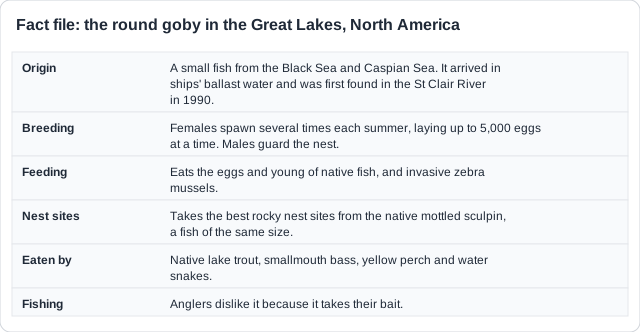
Positive
- Food for native lake trout, bass and perch.
- Eats zebra mussels, another invasive species.
Negative
- Eats the eggs of native fish, so their numbers fall.
- Takes the best nest sites, so the mottled sculpin breeds less.
Two traps: 'Anglers dislike it' is not an effect on the ecosystem. And 'it aggressively takes the habitat of native species' is too vague: say which native species loses what.
Learn one local example of an invader and the strategy used against it. Stopping an invader early is cheaper than fighting it later.
The points to remember
- Prevention first: check cargo, treat ballast water, ban the sale of risky species.
- Early detection: find new arrivals while numbers are still small.
- Eradication: remove every one, by trapping, culling, pulling up or herbicide.
- Control: keep numbers low for good, by the same methods or biological control.
- Laws back this up, and native habitats are restored afterwards.
Remember it as: Stop it, spot it, remove it, keep it down.
Arrival
Coypu were farmed for fur in England from 1929; some escaped to the Norfolk Broads.
Spread
By the early 1960s there were about 200,000, eating reedbeds and crops and burrowing into riverbanks and flood banks.
Strategy
From 1981 a team of 24 trappers caught coypu in cage traps across East Anglia, paid a bonus to finish the job.
Result
The last coypu was caught around 1989: one of the few mammal eradications on a mainland.
Name it, date it, judge it: Give the species, the place, what was done and how well it worked. Old cases are real cases: say what happened, step by step, and why each step worked.
Feeling unprepared for exams?
Get a clear study plan, practice with real questions, and know exactly where you stand before exam day. No more guessing.
Biological control uses a natural enemy from the invader's home range. It can work brilliantly, or create a new invader.
The points to remember
- Biological control: releasing a natural enemy (herbivore, predator, disease) of the invader.
- Strength: it targets the invader, so fewer pesticides and herbicides: less pollution and bioaccumulation.
- Strength: cheap and lasting, because the enemy breeds by itself; some are useful to people too (goats give milk).
- Strength: it adds food-web links: food for native predators, and negative feedback keeps the invader low.
- Limit: it may eat native species (fewer plants, nest sites and refuges) or compete with native herbivores.
- Limit: with no predators it may grow exponentially into a pest, spread to farmland or carry disease.
- Limit: it is slow, weather or local predators may kill it, and it needs years of testing first.
It worked
- Prickly pear covered about 24 million hectares of Queensland by the 1920s.
- The cactus moth was released in 1926.
- By the early 1930s most of the cactus was gone, with no herbicide.
It went wrong
- Cane toads were released in 1935 to eat beetles in sugar cane.
- They ate little of the beetle but many native animals, and had no predators.
- Native predators such as quolls died from their poison; toads now number over 200 million.
The test before release: Today a control agent is tested for years to check that it eats only the target, the lesson of the cane toad.
How this comes up: Paper 1: a fact file on an invader, then outline its effect on the ecosystem [3].
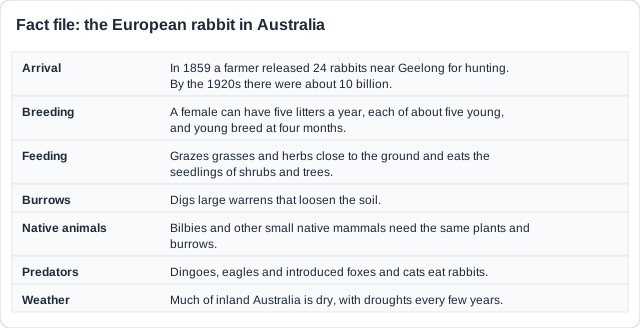
Figure 1 is a fact file on the European rabbit in Australia.
Using Figure 1, outline the effect of rabbits on the ecosystems of Australia.
Model answer plan
See the mark-by-mark plan — for / against / judgement, with marking guidance — in study mode.