A pair of opposite processes: Two processes change both energy and matter in every ecosystem: photosynthesis and cellular respiration. A word equation sums up each one.
The points to remember
- Photosynthesis: carbon dioxide + water → glucose + oxygen, using light energy.
- Cellular respiration: glucose + oxygen → carbon dioxide + water, releasing energy.
- Each is the reverse of the other: the outputs of one are the inputs of the other.
- Photosynthesis happens only in producers; respiration happens in every living thing, producers too.
Remember it as: Photosynthesis builds sugar; respiration breaks it down.
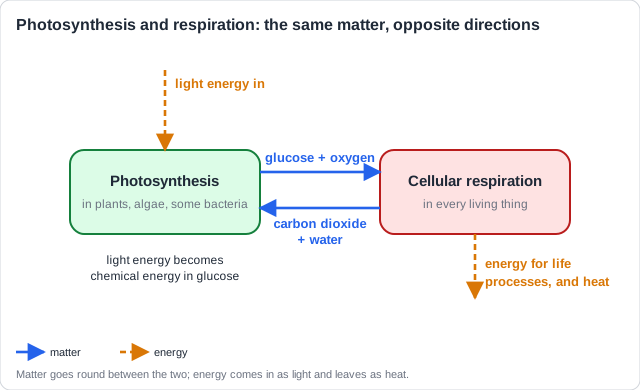
Real example: put pondweed in a jar of water in sunlight and bubbles of oxygen rise from its leaves: photosynthesis at work. In the dark the bubbles stop, but the pondweed keeps respiring.
Plants respire too: Never write that plants only photosynthesise and animals only respire. Producers do both, all the time.
Free preview
This is the free notes preview
You're reading the free notes. Aimnova Pro unlocks the full study experience — and you can try it with your first topic free to keep:
- FlashcardsLock in vocabulary and key terms with spaced repetition.
- Practice questionsAnswer exam-style questions and get instant AI marking.
- Mock exams & past-paper vaultSit full mocks and see exactly how examiners award marks.
- Personalised study planA daily plan built around your exam date and weak areas.
Both processes are transformations: they change energy into a new form and matter into new substances. Inorganic matter becomes organic matter, and back again.
What each one transforms
- Energy: photosynthesis turns light energy into chemical energy in glucose.
- Energy: respiration turns that chemical energy into a form cells can use, and some into heat.
- Matter: photosynthesis turns inorganic carbon dioxide and water into organic glucose.
- Matter: respiration turns glucose back into carbon dioxide and water.
- So living things exchange gases with the air: photosynthesis takes in carbon dioxide and gives out oxygen; respiration does the opposite.
Photosynthesis
- Energy: light to chemical
- Takes in carbon dioxide and water
- Gives out oxygen and glucose
Cellular respiration
- Energy: chemical to usable energy and heat
- Takes in glucose and oxygen
- Gives out carbon dioxide and water
Real example: at Mauna Loa in Hawaii, carbon dioxide in the air falls every northern summer, when the forests of the north photosynthesise, and rises again in winter, when respiration wins.
Energy and matter, both: For each process, say what happens to the energy and what happens to the matter. How respiration makes energy usable is on 2.2.6, and why it gives off heat on 2.2.7.
Feeling unprepared for exams?
Get a clear study plan, practice with real questions, and know exactly where you stand before exam day. No more guessing.
Energy and matter move through an ecosystem in two ways. A transfer moves them; a transformation changes them (1.2.4).
Transfers and transformations in an ecosystem
- Transfer: biomass passes up a food chain by feeding.
- Transfer: dead organisms and waste pass to the decomposers.
- Transfer: energy and matter move in or out by migration, wind and erosion.
- Transformation: light becomes chemical energy in photosynthesis.
- Transformation: eaten biomass becomes the consumer's new biomass.
- Transformation: biomass is respired for work, and chemical energy becomes heat.
Remember it as: Transfer = it moves. Transformation = it changes.
Heat moves too: when water evaporates it carries latent heat away, and gives it out where the vapour condenses.
A diagram can earn the marks: A clear, labelled system diagram can show every transfer and transformation. Real example: each year about 1.5 million wildebeest leave Tanzania's Serengeti for Kenya: a transfer of energy and matter out of one ecosystem and into another.
You may be given data about an ecosystem and asked to draw it as a system diagram. Follow the same steps every time.
From data to diagram, step by step
- Draw each storage (a group of organisms, or a pool such as soil or air) as a box.
- Draw each flow as an arrow pointing the way it goes.
- Label every arrow with its process (feeding, respiration) and its value from the data.
- Show energy in (light) and energy out (heat) crossing the boundary.
- Keep energy and matter apart: two colours or two kinds of arrow, with a key.
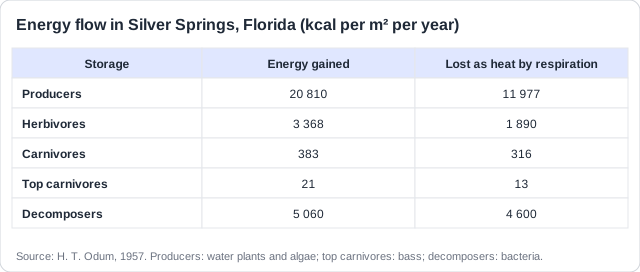
Real example: in the 1950s the ecologist H. T. Odum measured every flow of energy in Silver Springs, a clear spring in Florida. Turn his table into boxes and arrows:
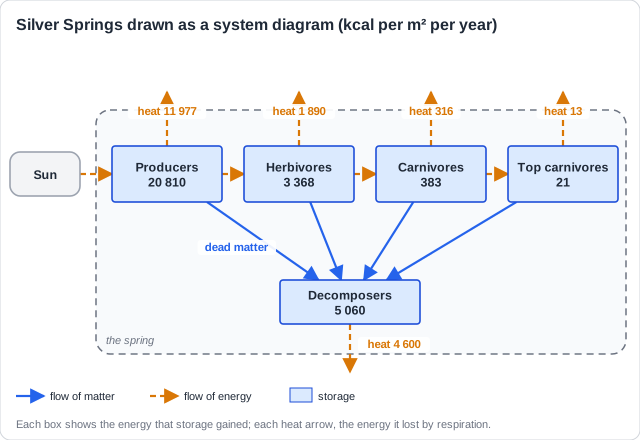
Energy never goes round: No energy arrow may point back to the producers. Matter arrows, such as carbon dioxide, can form a loop.
Memorize terms 3x faster
Smart flashcards show you cards right before you forget them. Perfect for definitions and key concepts.
How this comes up: Paper 2, Section B (a): outline how energy is transferred and transformed in an ecosystem [4].
In the Serengeti, grass is grazed by wildebeest, which are hunted by lions, and dung beetles bury the dung.
Outline how energy is transferred and transformed in the Serengeti grassland ecosystem.
Model answer plan
See the mark-by-mark plan — for / against / judgement, with marking guidance — in study mode.