How energy gets into living things: Photosynthesis is how the Sun's energy gets into an ecosystem. Only autotrophs can do it.
The points to remember
- Almost all the energy in ecosystems comes from the Sun.
- Photosynthesis converts light energy into chemical energy in glucose.
- It happens in chloroplasts, where the green pigment chlorophyll absorbs light.
- It uses carbon dioxide and water, and gives out oxygen (the word equation is on 2.2.3).
- Only autotrophs (plants, algae, some bacteria) can do it: it is the main way energy enters ecosystems.
- The chemical energy is then passed along food chains when the producer is eaten.
Remember it as: Light goes in, sugar comes out.
Real example: every slice of bread starts as sunlight. Wheat leaves in Kansas, USA, trap light and store its energy as chemical energy in the grain.
What to learn, and what not to: The green chloroplasts hold chlorophyll. You do not need the chemical steps inside them: learn what goes in, what comes out, and the energy change.
Free preview
This is the free notes preview
You're reading the free notes. Aimnova Pro unlocks the full study experience — and you can try it with your first topic free to keep:
- FlashcardsLock in vocabulary and key terms with spaced repetition.
- Practice questionsAnswer exam-style questions and get instant AI marking.
- Mock exams & past-paper vaultSit full mocks and see exactly how examiners award marks.
- Personalised study planA daily plan built around your exam date and weak areas.
A plant does not keep all its glucose as glucose. Some is used straight away; the rest is built into its body, its biomass.
From glucose to biomass
- Some glucose is respired at once, to give the plant energy (2.2.6): it is not stored.
- The rest is converted into other carbon compounds.
- Starch stores energy, as in potatoes and rice grains; cellulose builds cell walls and wood.
- With nitrogen from the soil, glucose becomes proteins; plants also make fats and oils, often in seeds.
- These compounds make up the plant's biomass: stored chemical energy that consumers can eat.
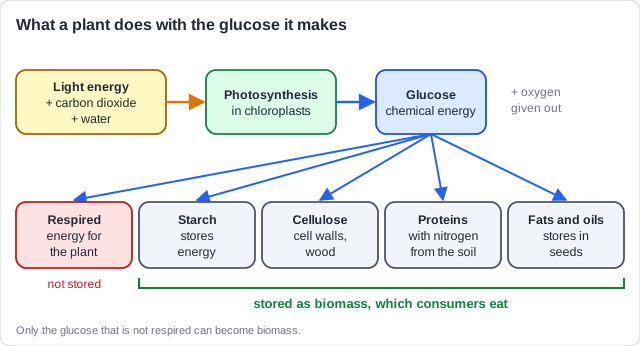
Real example: a potato is mostly starch, the plant's store of energy for next year; the trunk of an oak tree is mostly cellulose, built from glucose over hundreds of years.
Not all of it is stored: Say 'some of the glucose is stored as biomass'. The plant respires the rest to stay alive, so it never becomes biomass.
Never wonder what to study next
Get a personalized daily plan based on your exam date, progress, and weak areas. We'll tell you exactly what to review each day.
How fast producers make new biomass is their primary productivity. Climate limits it by limiting photosynthesis. Insolation is one of the factors.
What limits photosynthesis
- Photosynthesis needs light, water, carbon dioxide and warmth.
- Low rainfall or drought: too little water for photosynthesis.
- Low temperature: photosynthesis slows, and frozen water cannot be taken up by roots.
- Low insolation: too little light energy for photosynthesis.
- Very high temperature: the rate of photosynthesis falls, and more water evaporates.
Name the factor AND link it: 'Low rainfall' alone scores nothing. Write 'low rainfall means too little water for photosynthesis'.
Real example: in the Siberian tundra, the ground is frozen for most of the year and winter days are dark, so plants can photosynthesise only in a short summer.
Tropical rainforests have the highest primary productivity of any land biome. The reason is the climate: it suits photosynthesis all year.
Why rainforests are so productive
- Primary productivity mainly comes from photosynthesis: link every point to it.
- High temperatures speed up the rate of photosynthesis.
- High rainfall gives the water photosynthesis needs.
- High insolation and stable temperatures all year: photosynthesis and growth go on continuously.
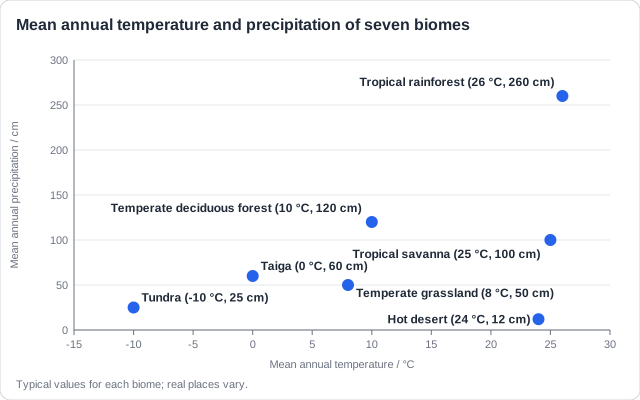
Use only what the figure shows: If the figure shows climate, answer with climate. A point about how many species live in a rainforest does not count.
Real example: Manaus, in the heart of the Amazon, averages about 27 °C and 230 cm of rain a year, with no cold season, so the forest photosynthesises all year round.
Stop wasting time on topics you know
Our AI identifies your weak areas and focuses your study time where it matters. No more overstudying easy topics.
How this comes up: Paper 2, Section A: a biome climate chart. Outline why primary productivity is highest in one biome [2].
Figure 1 shows the mean annual temperature and precipitation of seven biomes.
With reference to Figure 1, outline why primary productivity is highest in the tropical rainforest.
Model answer plan
See the mark-by-mark plan — for / against / judgement, with marking guidance — in study mode.