Energy is never made or destroyed: The first law of thermodynamics is a rule that holds everywhere. As energy flows through an ecosystem it changes form, but the total amount stays the same: energy is conserved.
The points to remember
- The first law of thermodynamics: energy cannot be created or destroyed.
- It can only be transformed into another form, or transferred to another place.
- So all the energy that enters an ecosystem is either stored there or leaves it.
- Energy is never 'used up': in the end it becomes heat, which spreads out and leaves.
Remember it as: Energy in = energy stored + energy out.
Real example: when a lion in the Serengeti eats a zebra, none of the energy in the meat is destroyed. Part of it builds the lion's body; the rest becomes the movement of the hunt and the heat of its body.
Not 'used up': Never write that energy is 'used up' or 'lost' and stop there. Say what it became: usually heat.
The second law, that every change wastes some energy as heat, has its own page (2.2.8).
Free preview
This is the free notes preview
You're reading the free notes. Aimnova Pro unlocks the full study experience — and you can try it with your first topic free to keep:
- FlashcardsLock in vocabulary and key terms with spaced repetition.
- Practice questionsAnswer exam-style questions and get instant AI marking.
- Mock exams & past-paper vaultSit full mocks and see exactly how examiners award marks.
- Personalised study planA daily plan built around your exam date and weak areas.
As energy moves along a food chain it keeps changing form. Each change of form is a transformation.
The transformations to know
- Light to chemical: photosynthesis in producers stores light energy in glucose.
- Chemical to chemical: an animal turns the food it eats into its own body tissue.
- Chemical to kinetic: muscles turn the energy in food into movement.
- Chemical to heat: respiration in every living thing releases heat.
- A transfer moves energy without changing its form, such as food passing from zebra to lion (see 1.2.4).
Remember it as: Light, chemical, movement, heat: it changes form, it never disappears.
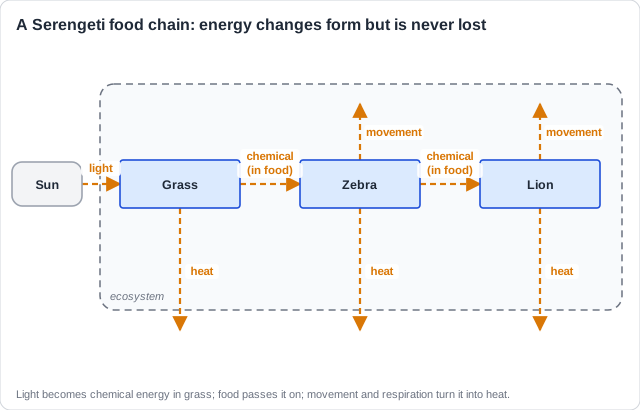
Real example: Serengeti grass turns sunlight into chemical energy; a zebra eats it and turns it into movement as it runs, and into body heat.
Name both forms: For each transformation, name the form before and after: 'light energy to chemical energy', not just 'photosynthesis'.
Practice with real exam questions
Answer exam-style questions and get AI feedback that shows you exactly what examiners want to see in a full-marks response.
The first law also holds in the air above us. A question may ask you to compare how energy moves through the atmosphere and through an ecosystem.
The same in both
- In both, the Sun is the source of the energy.
- In both, energy is not created or destroyed, only transformed.
- In both, sunlight is reflected, absorbed or passed on.
- In both, energy finally leaves as radiated heat.
| What happens to sunlight | In the atmosphere | In an ecosystem |
|---|---|---|
| Reflected by | clouds | light surfaces such as ice and snow |
| Absorbed by | clouds and greenhouse gases | the ground, water, soil and living things |
| Turned into chemical energy | never | by photosynthesis in producers |
| Lost as heat by | greenhouse gases radiating it | respiration all along the food chains |
| Passes through living things | no | yes |
Greenhouse gases absorb heat and radiate it again, some back to the ground and some out to space.
Pair each contrast: Write each difference as a pair: 'in the atmosphere, sunlight is reflected by clouds, whereas in an ecosystem it is reflected by ice'. Real example: fresh snow on the Greenland ice sheet reflects most of the sunlight that reaches it.
How this comes up: Paper 2, Section B (b): compare and contrast the pathways of energy through the atmosphere and through an ecosystem [7].
In the Arctic, sunlight passes through the atmosphere and reaches the sea ice, the tundra and the animals that live there.
Compare and contrast the pathways of energy through the atmosphere and through the Arctic tundra ecosystem.
Model answer plan
See the mark-by-mark plan — for / against / judgement, with marking guidance — in study mode.