Which species is it?: Taxonomists use a variety of tools to identify an organism: to find out which species it belongs to.
The points to remember
- Identification means finding out which species one organism belongs to.
- Dichotomous keys: pairs of statements about visible features.
- Reference collections: compare the specimen with ones already named by experts.
- DNA surveys: compare its DNA with known species.
- Apps and databases: match a photo or a sound with named records.
Remember it as: Key, collection, DNA, app: four ways to put a name on it.
A dichotomous key works from what you can see. A reference collection and DNA are used by experts when looks are not enough.
Real example: London's Natural History Museum holds about 80 million named specimens, which scientists use to check new finds.
Free preview
This is the free notes preview
You're reading the free notes. Aimnova Pro unlocks the full study experience — and you can try it with your first topic free to keep:
- FlashcardsLock in vocabulary and key terms with spaced repetition.
- Practice questionsAnswer exam-style questions and get instant AI marking.
- Mock exams & past-paper vaultSit full mocks and see exactly how examiners award marks.
- Personalised study planA daily plan built around your exam date and weak areas.
A dichotomous key offers two choices at each step. 'Dichotomous' means cut in two.
How to use a key
- Start at couplet 1 and read both statements.
- Choose the one that fits the specimen.
- Follow 'go to' to the next couplet...
- ...until you reach a species name.
- Give one name per specimen: only the first name counts.
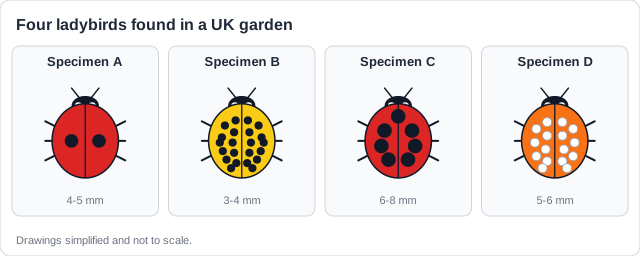
Worked example: Specimen C is red, so 1a sends you to 2. It has seven black spots, so 2b: it is a seven-spot ladybird.
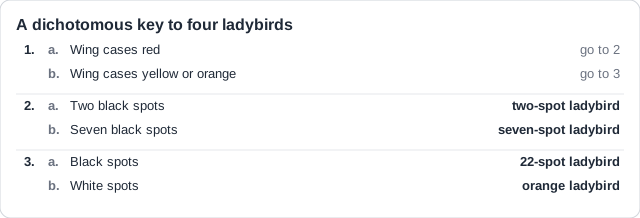
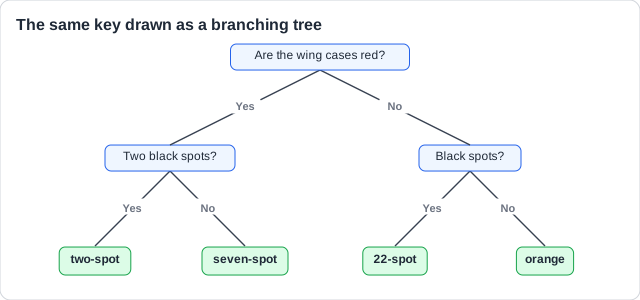
Try the other three yourself, then check the tree.
Get feedback like a real examiner
Submit your answers and get instant feedback — what you did well, what's missing, and exactly what to write to score full marks.
To build a key, you choose features that split the species into two groups, again and again.
How to build a key
- Choose visible, fixed features: spots, fins, number of tails, leaf edges.
- Each question splits the group into two.
- Keep splitting until each species is alone at an end point.
- Write it as numbered pairs with 'go to', or yes/no questions.
- Do not use size, behaviour, diet or where it lives.
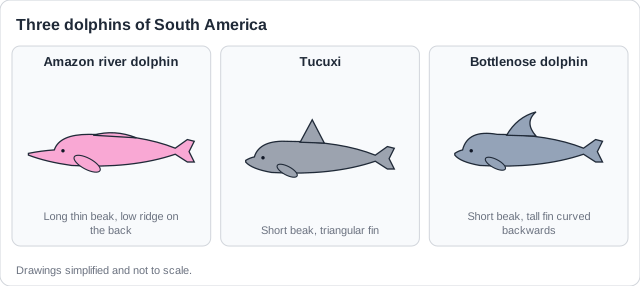
Here, a fin on the back splits one dolphin from two; fin shape splits the last two.
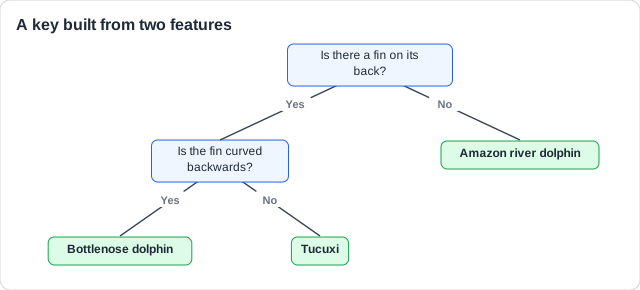
Features that do not count: Size changes with age, and behaviour, diet and location cannot be seen on the specimen. 'The colour is different' is not enough: say which colour, such as 'red wing cases'.
Real example: these three dolphins all live off South America. A key that asked 'Is it large?' would fail: a young bottlenose dolphin is smaller than an adult tucuxi.
Each tool has strengths and limits, so taxonomists often use more than one.
Strengths and limits of the tools
- Keys: cheap and quick in the field, and no expert needed...
- ...but damaged or young specimens and look-alike species cause errors.
- Reference collections: accurate, named by experts, but kept in museums.
- DNA: separates species that look the same, but needs a laboratory and money.
- Apps: fast, from a photo or a sound, but can be wrong and need a signal.
In the field
- Dichotomous keys.
- Apps: photo or sound.
In the laboratory or museum
- Reference collections.
- DNA surveys.
Real example: two British bats, the common and the soprano pipistrelle, look almost the same. Their calls and their DNA showed in the 1990s that they are two species.
Apps: iNaturalist lets anyone upload a photo; experts and the app suggest the species.
Learn what examiners really want
See exactly what to write to score full marks. Our AI shows you model answers and the key phrases examiners look for.
How this comes up: Every few sessions: use a key to name species [2], build a key [3], or state features for a key [1-2].
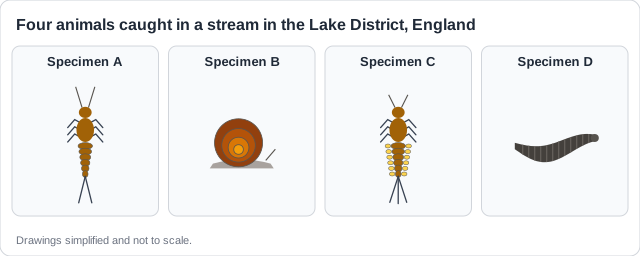
Figure 1 shows four animals caught by students in a stream in the Lake District, England.
State three structural features that could be used to construct a dichotomous key for the animals in Figure 1.
Model answer plan
See the mark-by-mark plan — for / against / judgement, with marking guidance — in study mode.