aımnova
DashboardMy LearningCrash CoursesStudy Plan

Aimnova site navigation

Stay in the loop

Get the latest study resources and updates

New features, study tips and exam insights — straight to your inbox.

IB Diploma

  • IB Past Papers
  • IB Study Notes
  • IB Question Bank
  • IB Mock Exams
  • IB Revision

IB Subjects

  • IB Math AA
  • IB Math AI
  • IB Economics
  • IB Business Management
  • IB Physics
  • IB Biology
  • View all IB subjects→

IB Past Papers

  • IB Math AA HL Past Papers
  • IB Math AA SL Past Papers
  • IB Math AI HL Past Papers
  • IB Math AI SL Past Papers
  • IB Economics HL Past Papers
  • IB Economics SL Past Papers
  • IB ESS Past Papers
  • View all past papers→

Study Resources

  • Study Notes
  • Question Bank
  • Mock Exams
  • Crash Courses
  • Flashcards
  • Revision Guide
  • Exam Skills
  • Command Terms
  • Grade Calculator
  • Exam Timetable 2027

Aimnova

  • Features
  • Pricing
  • For Teachers
  • For Schools
  • For Parents
  • About Us
  • Blog
  • Contact
aımnova

IB study, practice and feedback built around the real exam.

TermsPrivacyCookies·© 2026 Aimnova. All rights reserved.d9e1c61

Aimnova is not affiliated with or endorsed by the International Baccalaureate Organization (IB).

NotesESSTopic 1.3Doughnut economics
Back to ESS Topics
1.3.204 min read

Doughnut economics

IB Environmental Systems and Societies · Unit 1

Exam preparation

Practice the questions examiners actually ask

Our question bank mirrors real IB exam papers. Practice under timed conditions and track your progress across topics.

Start Practicing

Contents

  1. 1The doughnut: two rings
  2. 2Regenerative and distributive design
  3. 3Uses and limitations of the doughnut
  4. 4Exam-style question
Meet everyone’s needs within nature’s limits: Doughnut economics aims for a safe and just space where people thrive without putting excessive pressure on Earth.

Read the doughnut from the middle out

Hole · Too little

  • People fall below the social foundation.
  • Some people lack food, housing, health care or education.

Ring · The aim

  • The space between both limits is safe and just.
  • People’s needs are met within environmental limits.

Outside · Too much

  • Pressure exceeds the ecological ceiling.
  • Resource use or pollution crosses planetary limits.
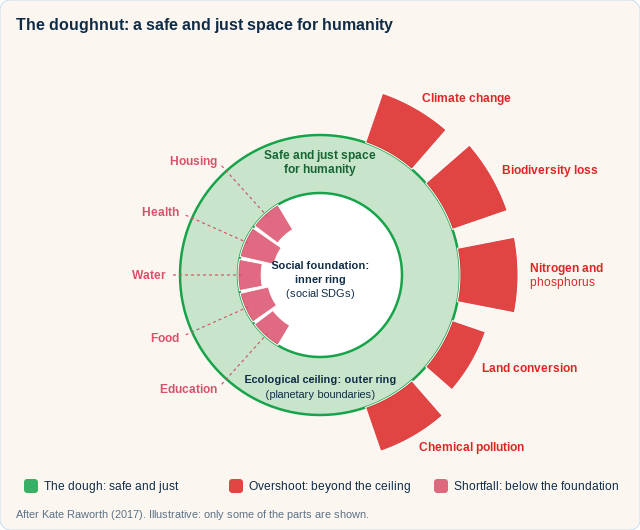
A green ring, the doughnut. Red wedges stick out past the outer ring for climate change, biodiversity loss, nitrogen and phosphorus, land conversion and chemical pollution. Brown wedges point into the hole for education, food, water, health and housingA green ring, the doughnut. Red wedges stick out past the outer ring for climate change, biodiversity loss, nitrogen and phosphorus, land conversion and chemical pollution. Brown wedges point into the hole for education, food, water, health and housing
Red: overshoot beyond the ecological ceiling. Brown: shortfall below the social foundation.

Inside My Learning

Turn these notes into practice

Try each question, reveal a clear model answer, and learn how to build your response.

  • 1.Where do the two limits come from?
  • 2.Picture a housing project
Claim your free topic

Free preview

This is the free notes preview

You're reading the free notes. Aimnova Pro unlocks the full study experience — and you can try it with your first topic free to keep:

  • FlashcardsLock in vocabulary and key terms with spaced repetition.
  • Practice questionsAnswer exam-style questions and get instant AI marking.
  • Mock exams & past-paper vaultSit full mocks and see exactly how examiners award marks.
  • Personalised study planA daily plan built around your exam date and weak areas.
Start Studying Free Full access to Aimnova Pro · cancel anytime
A doughnut approach needs two kinds of design: Help nature renew while sharing opportunities and benefits fairly.

Regenerative: support renewal

  • Compost appropriate food waste to return nutrients.
  • Restore habitats and reuse building materials.

Distributive: share value fairly

  • Provide fair wages and affordable homes.
  • Use community ownership to share benefits.
Picture community solar power: Lower-emission electricity can reduce environmental pressure. Community ownership can share income and decision-making. Check the actual impacts and who benefits.

Inside My Learning

Turn these notes into practice

Try each question, reveal a clear model answer, and learn how to build your response.

  • 1.How does this move us towards the doughnut?
Claim your free topic

Practice with exam-style questions

Answer exam-style questions and get AI feedback that shows you exactly what examiners want to see in a full-marks response.

Try Practice FreeYour first topic is free to keep • No credit card required
The doughnut connects people’s needs with nature’s limits: Use the model to answer a specific question. Then check what it leaves out.

How it helps

  • Considers social and environmental conditions together.
  • Highlights shortfalls and excessive ecological pressure.
  • Can guide discussion at city, business or national scales.

What to check

  • It does not prescribe a complete set of policies.
  • Local application needs data and community participation.
  • Different choices may involve difficult trade-offs.
Example: The framework says housing should be adequate and environmental pressure limited. A city must still decide where to build, how to fund homes and which materials to use.

Environmental justice connection

Ask who lacks basic needs, who uses resources and who bears the environmental harm.

How to answer: Give the main point and a short reason. Use the named example or figure when asked.
IB-style questionOutline[4 marks]

A city council plans to use the doughnut economics model to guide its next ten-year plan.

Outline the doughnut economics model.

Model answer plan

See the answer broken into clear points, with guidance on how each point earns marks.

Claim your free topic

IB Exam Questions on Doughnut economics

Practice with IB-style questions filtered to Topic 1.3.20. Get instant AI feedback on every answer.

Practice Topic 1.3.20 QuestionsBrowse All ESS Topics

How Doughnut economics Appears in IB Exams

Examiners use specific command terms when asking about this topic. Here's what to expect:

  • Define

    Say exactly what the key terms in Doughnut economics mean.

    AO1
  • Describe

    Say what the processes or features in Doughnut economics are like, with the details that matter.

    AO2
  • Explain

    Give reasons WHY — cause and effect within Doughnut economics.

    AO3
  • Evaluate

    Weigh strengths AND limitations of approaches in Doughnut economics.

    AO3
  • Discuss

    Present arguments FOR and AGAINST with a balanced conclusion.

    AO3

See the full IB Command Terms guide

Related ESS Topics

Continue learning with these related topics from the same unit:

1.1.1Perspectives1.1.2What shapes a perspective1.1.3Values1.1.4Where values show
View all ESS topics
Practice with flashcardsSpaced repetition flashcards for Doughnut economicsImprove your exam techniqueCommand terms, paper structure, and mark-scheme tips for ESS
Previous1.3.19Planetary boundariesNextCircular economy1.3.21

3 questions to test your understanding

Reading is just the start. Students who tested themselves scored 82% on average — try IB-style questions with AI feedback.

Start FreeView All ESS Topics