aımnova
DashboardMy LearningCrash CoursesStudy Plan

Aimnova site navigation

Stay in the loop

Get the latest study resources and updates

New features, study tips and exam insights — straight to your inbox.

IB Diploma

  • IB Past Papers
  • IB Study Notes
  • IB Question Bank
  • IB Mock Exams
  • IB Revision

IB Subjects

  • IB Math AA
  • IB Math AI
  • IB Economics
  • IB Business Management
  • IB Physics
  • IB Biology
  • View all IB subjects→

IB Past Papers

  • IB Math AA HL Past Papers
  • IB Math AA SL Past Papers
  • IB Math AI HL Past Papers
  • IB Math AI SL Past Papers
  • IB Economics HL Past Papers
  • IB Economics SL Past Papers
  • IB ESS Past Papers
  • View all past papers→

Study Resources

  • Study Notes
  • Question Bank
  • Mock Exams
  • Crash Courses
  • Flashcards
  • Revision Guide
  • Exam Skills
  • Command Terms
  • Grade Calculator
  • Exam Timetable 2027

Aimnova

  • Features
  • Pricing
  • For Teachers
  • For Schools
  • For Parents
  • About Us
  • Blog
  • Contact
aımnova

IB study, practice and feedback built around the real exam.

TermsPrivacyCookies·© 2026 Aimnova. All rights reserved.d9e1c61

Aimnova is not affiliated with or endorsed by the International Baccalaureate Organization (IB).

NotesESSTopic 1.3Circular economy
Back to ESS Topics
1.3.214 min read

Circular economy

IB Environmental Systems and Societies · Unit 1

Your first topic is free to keep

Know exactly what to write for full marks

Practice with exam questions and get AI feedback that shows you the perfect answer — what examiners want to see.

Start Free

Contents

  1. 1Linear and circular economies
  2. 2Three principles and the butterfly diagram
  3. 3Uses and limitations of the circular economy
  4. 4Exam-style question
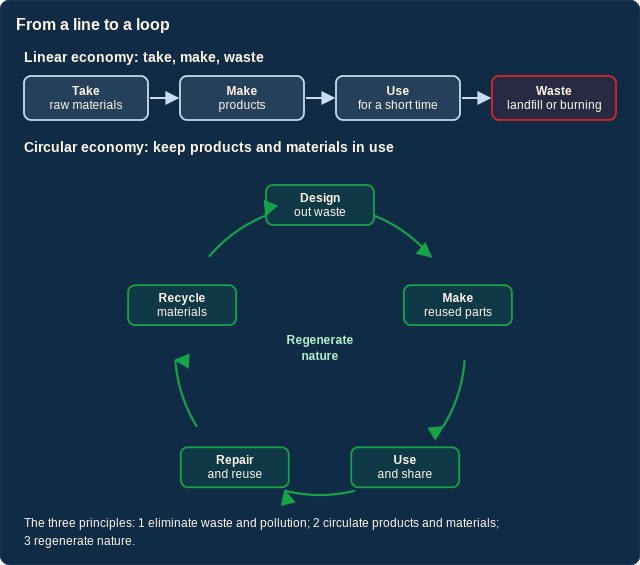
Keep products and materials useful for longer: A circular economy replaces the take–make–waste pattern with systems that keep value in use.

Picture a phone with a worn-out battery

Linear: throw it away

  • Extract materials → make a phone → use it → discard it.
  • A replacement needs more materials and manufacturing.

Circular: keep it useful

  • Replace the battery → keep using the phone.
  • Reuse working parts and recover materials when repair is no longer possible.

Design · Prevent waste

  • Design out waste and pollution.
  • Make the battery easy to replace.

Circulate · Keep using

  • Repair, reuse and circulate materials.
  • Repair the phone before recycling its materials.

Regenerate · Restore nature

  • Support the renewal of natural systems.
  • In biological cycles, compost can return nutrients to soil.
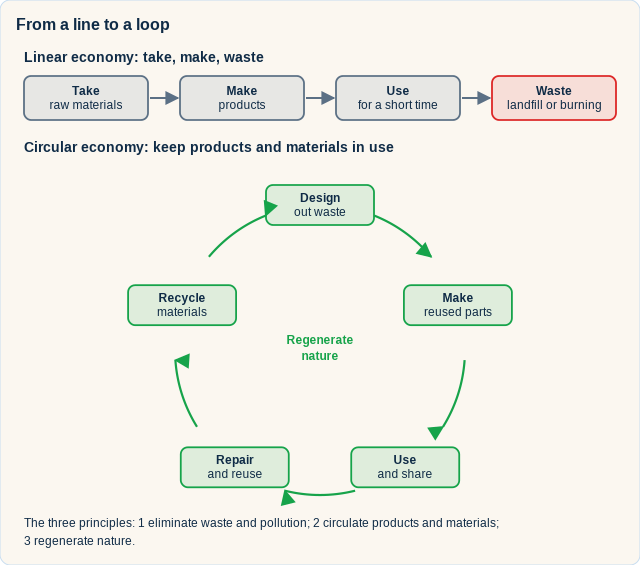
Top: a line of boxes, take, make, use and waste. Bottom: a loop of boxes, design out waste, make from reused parts, use and share, repair and reuse, recycle, with 'regenerate nature' in the middleTop: a line of boxes, take, make, use and waste. Bottom: a loop of boxes, design out waste, make from reused parts, use and share, repair and reuse, recycle, with 'regenerate nature' in the middle
The linear economy ends in waste; the circular economy loops back.

Inside My Learning

Turn these notes into practice

Try each question, reveal a clear model answer, and learn how to build your response.

  • 1.What does decoupling mean?
Claim your free topic

Free preview

This is the free notes preview

You're reading the free notes. Aimnova Pro unlocks the full study experience — and you can try it with your first topic free to keep:

  • FlashcardsLock in vocabulary and key terms with spaced repetition.
  • Practice questionsAnswer exam-style questions and get instant AI marking.
  • Mock exams & past-paper vaultSit full mocks and see exactly how examiners award marks.
  • Personalised study planA daily plan built around your exam date and weak areas.
Start Studying Free Full access to Aimnova Pro · cancel anytime
Three principles guide a circular economy: Prevent waste, keep materials useful and support nature’s renewal.

Eliminate · Prevent waste

  • Design out waste and pollution.
  • Make products durable and repairable.

Circulate · Keep value

  • Keep products and materials in use.
  • Share, repair, reuse, remanufacture and recycle.

Regenerate · Renew nature

  • Support healthy natural cycles.
  • Return appropriate biological nutrients to soil.
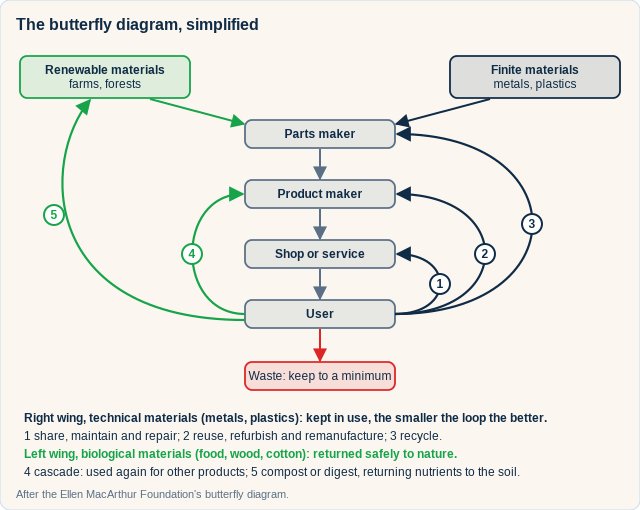
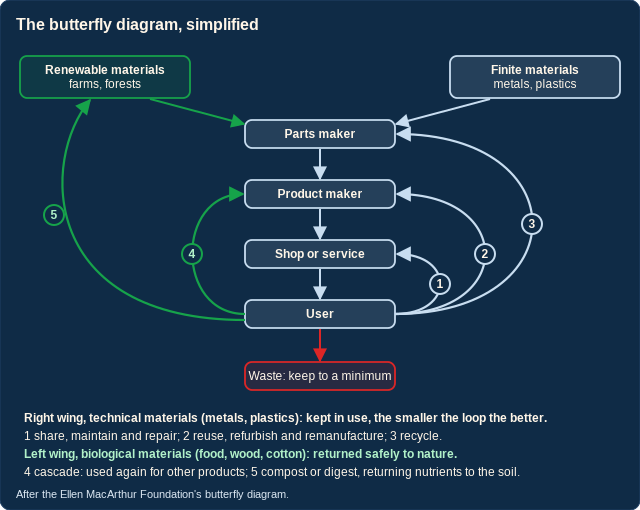
A simplified butterfly diagram. A central column runs from parts maker to product maker to shop to user, with a small waste box below. On the right, blue loops return technical materials from the user: 1 share and repair, 2 reuse and remanufacture, 3 recycle. On the left, green loops return biological materials: 4 cascade, 5 compost to renewable materialsA simplified butterfly diagram. A central column runs from parts maker to product maker to shop to user, with a small waste box below. On the right, blue loops return technical materials from the user: 1 share and repair, 2 reuse and remanufacture, 3 recycle. On the left, green loops return biological materials: 4 cascade, 5 compost to renewable materials
Right wing: technical materials kept in use. Left wing: biological materials returned to nature.

Technical cycles

  • Products and materials such as metals stay in use.
  • Repair a device before recovering its materials.

Biological cycles

  • Suitable biological materials return safely to natural cycles.
  • Compost food scraps to return nutrients.
Why prioritise repair and reuse?: They can preserve more of the product’s value than breaking it down for recycling. Check suitability and environmental costs in each case.

See how examiners mark answers

Answer exam-style questions with model answers. Learn exactly what earns marks and what doesn't.

Try Exam Vault FreeYour first topic is free to keep • No credit card required
Circular strategies can reduce waste and resource demand: Use the model to answer a specific question. Then check what it leaves out.

How it helps

  • Longer product life can reduce new manufacturing.
  • Reusing materials can reduce extraction and emissions.
  • Repair and reuse can support local jobs.

What to check

  • Products may be difficult to repair or separate.
  • Some materials cannot be recycled effectively.
  • Finance, infrastructure, markets and regulations may be missing.
Example: A repaired phone can avoid a new purchase. Recycling it still needs energy and a market for recovered materials.

Recycling is one part of the approach

Consider repair and reuse first where suitable. Circular systems still need energy and are not impact-free.

How to answer: State the main features or pattern, using data where available.
IB-style questionDescribe[2 marks]

Plastic waste from a coastal town is washing into the sea, harming turtles and seabirds.

Describe how the concept of eco-economic decoupling might help reduce plastic pollution in the sea.

Model answer plan

See the answer broken into clear points, with guidance on how each point earns marks.

Claim your free topic

Try an IB Exam Question — Free AI Feedback

Test yourself on Circular economy. Write your answer and get instant AI feedback — just like a real IB examiner.

A lake downstream of farmland turns green with algae every summer, because fertiliser washes off the fields.

how the concept of eco-economic decoupling might help reduce the growth of algae in the lake.
[2 marks]

Related ESS Topics

Continue learning with these related topics from the same unit:

1.1.1Perspectives1.1.2What shapes a perspective1.1.3Values1.1.4Where values show
View all ESS topics
Practice with flashcardsSpaced repetition flashcards for Circular economyImprove your exam techniqueCommand terms, paper structure, and mark-scheme tips for ESS
Previous1.3.20Doughnut economicsNextThe biosphere2.1.1

6 questions to test your understanding

Reading is just the start. Students who tested themselves scored 82% on average — try IB-style questions with AI feedback.

Start FreeView All ESS Topics