Indirect impacts of ozone at Higher Level: This statement is Higher Level only. It follows ozone's damage into money: the cost to health-care systems, the work that is lost, the smaller harvests, and why poorer communities carry more of the cost.
Practise this as you read
- Explain how ozone leads to societal costs and lost economic output.
- Outline why poorer communities carry a larger share of the impacts.
- Use real figures: deaths, lost working days, crop losses.
Free preview
This is the free notes preview
You're reading the free notes. Aimnova Pro unlocks the full study experience — and you can try it with your first topic free to keep:
- FlashcardsLock in vocabulary and key terms with spaced repetition.
- Practice questionsAnswer exam-style questions and get instant AI marking.
- Mock exams & past-paper vaultSit full mocks and see exactly how examiners award marks.
- Personalised study planA daily plan built around your exam date and weak areas.
No one gets a bill, yet everyone pays: The direct impacts are the damage itself: sore lungs, flecked leaves. Its indirect impacts are what that damage costs: money for hospitals, and days of work and school lost.
Societal costs
- Ozone's direct harm (sick lungs, damaged crops) has indirect costs for society.
- Health-care systems pay for hospital visits, emergency care, asthma medicines and treatment.
- The workforce shrinks: sick days, parents staying home with sick children, and early deaths.
- Children miss school on bad days, and people stop outdoor activities.
- These are societal costs: paid by everyone, through taxes, insurance and lost income.
Ozone breathed in
- Inflamed airways, asthma attacks, bronchitis
Sick people
- Ozone was linked to about 490,000 deaths worldwide in 2021, after years of lung disease
Health care
- Emergency visits, hospital stays and medicines, paid by taxes or insurance
Lost work
- The OECD expects air pollution to cause 3.75 billion lost working days a year by 2060
Link the chain: Never stop at 'people get ill'. Add the cost: 'so hospitals treat more asthma attacks and workers take sick days'.
Study smarter, not longer
Most students waste 40% of study time on topics they already know. Our AI tracks your progress and optimizes every minute.
Ozone also makes the whole economy produce less. The guide calls this lost economic output.
Lost economic output
- Workers are less productive on high-ozone days, even when they come to work.
- Crop yields fall, so farmers earn less and food costs more.
- Forests grow more slowly, so less timber is produced.
- Smog keeps tourists and shoppers away, and visibility delays traffic.
- Cracked rubber and faded fabrics must be replaced sooner.
- All of this is lost economic output: a smaller economy than there would be without ozone.
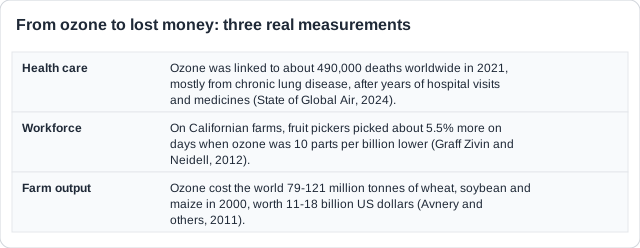
Real example: a 2012 study of fruit pickers in California, paid by how much they picked, found that their productivity rose by about 5.5% when ozone fell by 10 parts per billion. They were at work every day; the ozone simply slowed them down. The OECD expects air pollution, including ozone, to cut world GDP by about 1% by 2060.
The guide adds that these impacts are differential. The same smog does not cost everyone the same.
Who pays most
- The impacts are differential: poorer communities often carry a larger share.
- Cheaper homes are often near motorways, ports and factories, or downwind of city centres.
- Poorer people more often work outdoors, in the afternoon, when ozone peaks.
- They have less access to health care, and less money for air conditioning or air filters.
- Many already have illnesses such as asthma, so ozone hits them harder.
- Globally, low- and middle-income countries suffer most of the deaths from outdoor air pollution.
Real example: the afternoon sea breeze carries Los Angeles' smog inland, so the valleys east of the city, around San Bernardino and Riverside, get some of the worst ozone in the USA. Homes there are cheaper than on the coast, and many people work outdoors or in warehouses.
Better-off household
- Office job, indoors with air conditioning
- Health insurance and a family doctor
- Can stay indoors or leave on smog days
Poorer household
- Outdoor job through the afternoon peak
- Fewer visits to a doctor; illness found late
- Loses pay for every sick day, shrinking the workforce
Remember it as: Sick lungs, empty desks, smaller harvests: and the poor pay most.
Practice with exam-style questions
Answer exam-style questions and get AI feedback that shows you exactly what examiners want to see in a full-marks response.
How this comes up: This statement has not been asked on its own yet. Its points earn marks inside smog questions: 'impacts on health-care systems and the workforce' and 'effects on outdoor activities, tourism and the economy' in a [7] essay part. Practise both shapes below.
Ozone levels in the Los Angeles region exceed safe limits on many summer days, although no one receives a bill for the damage.
Explain the indirect impacts of tropospheric ozone on society and the economy.
Model answer plan
See the mark-by-mark plan — for / against / judgement, with marking guidance — in study mode.
A shorter data shape asks why the poor pay most. Give two different reasons.
A report on air pollution in Delhi finds that street vendors and construction workers suffer far more from ozone than office workers do.
Outline two reasons why poorer communities often carry a larger share of the impacts of tropospheric ozone.
Model answer plan
See the mark-by-mark plan — for / against / judgement, with marking guidance — in study mode.