Photochemical smog at Higher Level: This statement is Higher Level only. It explains how sunlight turns the exhaust of a busy city into ozone and PANs, the brownish smog that hangs over places like Los Angeles and Mexico City.
Practise this as you read
- State the factors needed for tropospheric ozone to form.
- Explain a graph of the pollutants over one day.
- Evaluate two strategies to prevent smog from forming.
Free preview
This is the free notes preview
You're reading the free notes. Aimnova Pro unlocks the full study experience — and you can try it with your first topic free to keep:
- FlashcardsLock in vocabulary and key terms with spaced repetition.
- Practice questionsAnswer exam-style questions and get instant AI marking.
- Mock exams & past-paper vaultSit full mocks and see exactly how examiners award marks.
- Personalised study planA daily plan built around your exam date and weak areas.
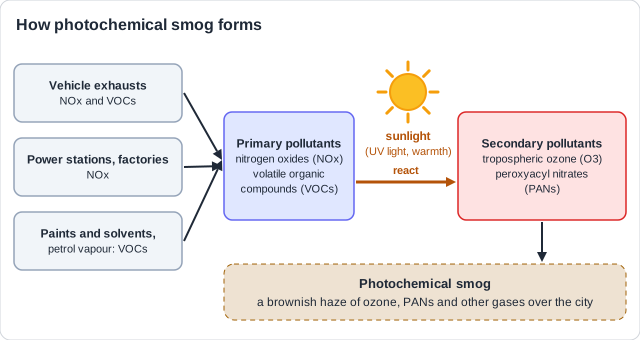
Sunlight cooks the exhaust: Photochemical smog is a photochemical haze. Sunlight acts on primary pollutants from traffic and changes them into new, secondary pollutants.
The points to remember
- Photochemical smog forms when sunlight acts on primary pollutants.
- The primary pollutants are nitrogen oxides (NOx) and VOCs, released straight from exhausts and chimneys.
- Sunlight changes them chemically into secondary pollutants: tropospheric ozone and PANs.
- Ozone and PANs are the main parts of the smog, a brownish haze over the city.
- To form ozone you need sunlight plus NOx and VOCs (with oxygen from the air).
- It is worst on sunny, still days, in valleys and basins, and in dense cities, where the pollutants are trapped.
Remember it as: Sun + NOx + VOCs = ozone and PANs.
Real example: on 26 July 1943 a smog so thick fell on Los Angeles that people thought the city was under a gas attack. In 1952 the chemist Arie Haagen-Smit showed the cause: strong Californian sunshine acting on car exhaust and oil-refinery vapours, making tropospheric ozone.
Factors, not sources: Asked for the factors necessary for ozone to form? Give sunlight and NOx or VOCs. 'Cars' or 'burning fossil fuels' are sources of those pollutants, not the factors themselves.
Feeling unprepared for exams?
Get a clear study plan, practice with real questions, and know exactly where you stand before exam day. No more guessing.
Two groups of primary pollutants start the smog: nitrogen oxides and VOCs.
The primary pollutants
- A primary pollutant is active as soon as it is emitted: it needs no chemical change to do harm.
- NOx (NO and NO2) forms when fuel burns very hot: nitrogen and oxygen from the air join.
- Its main sources are vehicle engines, power stations, factories and heating boilers.
- VOCs evaporate from petrol, paints, solvents and unburnt fuel in exhausts.
- Burning forests and crop waste also releases NOx and VOCs.
- Both peak in the morning rush hour, when traffic is heaviest.
| Primary pollutant | Main sources in a city | Real example |
|---|---|---|
| NOx: NO and NO2 | Hot engines, power stations, factories, boilers | Los Angeles' millions of cars |
| VOCs | Petrol vapour, paints, solvents, unburnt fuel | Cooking-gas leaks in Mexico City |
Real example: in 1995 scientists found that leaks of LPG from millions of household cylinders were one of the biggest sources of VOCs in Mexico City's air, alongside its traffic.
Why 'primary'?: A primary pollutant is harmful straight out of the exhaust. NO2 stings the lungs at once; ozone has to be made first, so it is secondary.
Ozone and PANs are secondary pollutants: nothing releases them. Sunlight builds them in the air, step by step.
Sunlight splits NO2
NO2 + sunlight → NO + O (a single, very reactive oxygen atom).
Ozone forms
O + O2 → O3. The oxygen atom joins ordinary oxygen.
VOCs keep it going
VOCs turn NO back into NO2 without using ozone, so more ozone builds up.
PANs form
VOCs + NOx + sunlight → PANs, which sting the eyes.
At night
No sunlight: NO + O3 → NO2 + O2, so ozone is used up.
The secondary pollutants
- Ozone and PANs are not released by anything: they form in the air.
- Sunlight (UV light) splits NO2; the free oxygen atom joins O2 to make ozone (O3).
- VOCs keep the reactions going, so ozone builds up instead of being used up.
- VOCs, NOx and sunlight also make PANs, which sting the eyes.
- The reactions take a few hours, and stop at night, when NO uses ozone up.
Two kinds of ozone: This is ozone near the ground, where we breathe it. The ozone layer, 20-30 km up in the stratosphere, is the same gas in the wrong place to hurt us: it shields us from UV light.
Memorize terms 3x faster
Smart flashcards show you cards right before you forget them. Perfect for definitions and key concepts.
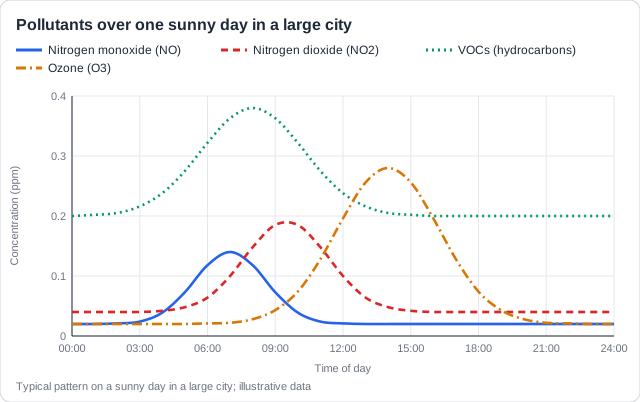
Papers often show a graph of the pollutants over one day. Each line follows the chemistry you have just learned.
Reading the day
- NO and VOCs peak first, in the morning rush hour.
- NO2 peaks next, as NO reacts in the air.
- Ozone peaks in the early afternoon: the sun is strongest and the reactions take a few hours (a time lag).
- Ozone falls in the evening: less sunlight, and evening traffic NO uses it up.
- Less NOx usually means less ozone: a positive correlation, because NOx is what ozone forms from.
Real example: in the 2020 COVID-19 lockdowns, traffic and factories stopped, and NOx fell sharply around the world. Ozone fell in many regions too. But in some city centres it rose, because less NO was left to use it up, and sunny spring weather kept the reactions going.
Explain a relationship: Name the pattern (both fell together: a positive correlation), then give the reason (NOx is the primary pollutant that sunlight turns into ozone).
To find a range, subtract the lowest value from the highest, and give the unit.
If sunlight cannot be switched off, the only way to stop the smog forming is to cut the NOx and VOCs.
Ways to stop smog forming
- Stop the source: burn less fossil fuel (renewable energy, electric vehicles, public transport).
- Clean at the exhaust or chimney: catalytic converters on cars, scrubbers on chimneys.
- Change behaviour: car-sharing, driving bans, fewer solvents and paints.
- Evaluate each one: say what it does well, what it does badly, then judge it.
Cut fossil fuel use
- Strength: tackles the cause, so no NOx is made
- Strength: also cuts CO2 and acid rain
- Limit: new power plants and transport cost a lot
- Limit: people must change habits; batteries and panels have impacts
Catalytic converters
- Strength: turn NOx, CO and unburnt fuel into less harmful gases
- Strength: proven, and people keep their cars
- Limit: CO2 is still released; fuel is still non-renewable
- Limit: they wear out, and are stolen for their metals
Real examples: California required catalytic converters on new cars from 1975, and Los Angeles now has far fewer smog days than in the 1970s, despite many more cars. Mexico City's 'Hoy No Circula' (1989) banned each car one weekday, but many families bought a second, older car.
Judge it: End with a judgement: converters work fast, but only cutting fossil fuel removes the cause.
Know your predicted grade
Take timed mock exams and get detailed feedback on every answer. See exactly where you're losing marks.
How this comes up: Short data questions: the factors needed for ozone, reading a day of ozone, or explaining how NOx and ozone change together [1-2]. Essay parts: explain the causes of smog, or evaluate two ways to prevent it [7].
During the 2020 lockdowns in Delhi, traffic fell sharply. Monitoring stations recorded that NOx levels fell, and so did tropospheric ozone in many parts of the region.
Explain the relationship between the NOx emissions and the tropospheric ozone levels.
Model answer plan
See the mark-by-mark plan — for / against / judgement, with marking guidance — in study mode.
The essay shape needs two strategies, both sides of each, and a judgement.
Los Angeles once had some of the worst photochemical smog in the world.
Evaluate two strategies for preventing the formation of photochemical smog.
Model answer plan
See the mark-by-mark plan — for / against / judgement, with marking guidance — in study mode.