Population outputs at Higher Level: The same two outputs as SL, through different real cases: Ukraine, which lost millions of people to emigration in 2022, and China, where deaths now outnumber births.
Practise this as you read
- Calculate a crude death rate and an emigration rate, formula first.
- Explain a gap between a growth rate and a natural increase rate.
Free preview
This is the free notes preview
You're reading the free notes. Aimnova Pro unlocks the full study experience — and you can try it with your first topic free to keep:
- FlashcardsLock in vocabulary and key terms with spaced repetition.
- Practice questionsAnswer exam-style questions and get instant AI marking.
- Mock exams & past-paper vaultSit full mocks and see exactly how examiners award marks.
- Personalised study planA daily plan built around your exam date and weak areas.
What removes people from a population: The population tank has two drains: people dying, and people moving away, called emigration.
The points to remember
- The outputs remove people from a population: deaths and emigration.
- Emigration = people moving out of a place to live somewhere else.
- One person's emigration is another place's immigration.
- More deaths or more emigrants make the population shrink, unless inputs rise as much.
- Emigrants are often young adults, so a place can lose its workers and future parents.
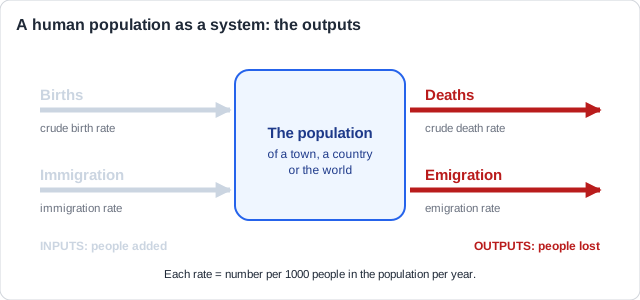
Remember it as: Died here or moved away: both are outputs.
Real example: after war began in Ukraine in 2022, about 5.7 million more people left the country than arrived that year, one of the largest outputs of people in modern times.
Get feedback like a real examiner
Submit your answers and get instant feedback — what you did well, what's missing, and exactly what to write to score full marks.
Deaths are turned into a rate so that places of any size can be compared: the crude death rate.
Crude death rate
- Crude death rate (CDR) = the number of deaths per 1000 people in a population per year.
- Formula: CDR = deaths ÷ total population × 1000.
- Give the unit: per 1000 (per thousand) people per year.
- It is crude: it counts the whole population, whatever their age.
- So an old population has a high CDR even when people live long lives.
Worked example: China, 2023: about 11.1 million people died in a population of about 1.41 billion.
CDR = deaths ÷ population × 1000 = 11,100,000 ÷ 1,410,000,000 × 1000 = 7.9 per 1000 per year.
Real example: China's deaths (11.1 million) outnumbered its births (9.02 million) in 2023, as its large 1960s generation grows old.
High death rate does not mean short lives: A rich country with many old people can have a higher crude death rate than a poor country with many young people. 'Crude' means age is ignored.
People moving away are measured with the emigration rate. An emigrant}} is counted in the place they leave.
Emigration rate
- Emigration rate = the number of emigrants per 1000 people in the population per year.
- Formula: emigration rate = emigrants ÷ total population × 1000.
- Emigrants are counted in the place they leave: they are an output there.
- People leave to escape war or disasters, or because there are few jobs.
- Net migration = immigrants − emigrants: positive means more arrive than leave.
Worked example: Kilbane has 140,200 people. In 2023, 2,524 of them moved away and 1,402 moved in.
Emigration rate = 2,524 ÷ 140,200 × 1000 = 18.0 per 1000; net migration = 1,402 − 2,524 = −1,122 people.
War
- Ukraine, 2022: about 5.7 million more people left than arrived.
Few jobs
- Rural towns everywhere: young people leave for city or foreign jobs.
Disasters
- A hurricane or earthquake destroys homes and work, so families move away.
Real example: most of Ukraine's emigrants were women and children, as most men aged 18 to 60 could not leave.
Learn what examiners really want
See exactly what to write to score full marks. Our AI shows you model answers and the key phrases examiners look for.
Put the inputs and outputs together and you get the change in a population. Births minus deaths is the natural increase; migration is the rest.
Inputs minus outputs
- Population change = (births − deaths) + (immigrants − emigrants).
- Natural increase = births − deaths only: it leaves out migration.
- If the growth rate is lower than the natural increase rate, more people left than arrived: emigration.
- If the growth rate is higher, more people arrived: immigration.
- A population can grow with more deaths than births, if immigration is large enough.
| China, 2023 | Millions |
|---|---|
| Births (input) | 9.02 |
| Deaths (output) | 11.1 |
| Natural change | −2.08 |
| Change in population | −2.08 |
Which migration?: If a country's growth rate is LOWER than its natural increase rate, the answer is emigration (people leaving). Writing only 'immigration' is wrong there.
Real example: China, 2023: almost no migration, so the whole fall of 2.08 million was natural: deaths outnumbered births.
Some countries are shrinking. Every reason comes back to an output going up, or an input going down.
Why a population can fall
- More emigration: people flee war or disasters, or leave because there are few jobs.
- More deaths: war, disasters, disease, or an ageing population.
- Fewer births: women educated and in work, easy access to contraception.
- Good healthcare means parents expect children to survive, so they have fewer.
- Anti-natalist policies, which push families to have fewer children.
Outputs go up
- Emigration: war, disasters, few jobs
- Deaths: war, disease, an old population
Inputs go down
- Fewer births: education, careers, contraception
- Few immigrants arrive
Real example: Ukraine lost people in three ways at once after 2022: refugees left, the war killed many, and births fell sharply.
Remember it as: Leave, die, or never born: the three ways a population falls.
Never wonder what to study next
Get a personalized daily plan based on your exam date, progress, and weak areas. We'll tell you exactly what to review each day.
How this comes up: Identify or suggest why a growth rate differs from the natural increase rate [1]; read which places lost people from a chart [1]; outline factors that reduce a population [2]; calculate a crude death rate [1].
Ukraine's population fell sharply in 2022, the year Russia's full-scale invasion began.
Suggest two reasons why Ukraine's population fell in 2022.
Model answer plan
See the mark-by-mark plan — for / against / judgement, with marking guidance — in study mode.