Direct impacts of ozone at Higher Level: This statement is Higher Level only. It lists what ground-level ozone does directly: to the eyes and lungs of people and other mammals, to the leaves of plants, and to rubber and fabrics.
Practise this as you read
- State a health impact of ground-level ozone.
- Outline why ozone harms us down here but protects us high up.
- Explain why photochemical smog harms the environment of a city.
Free preview
This is the free notes preview
You're reading the free notes. Aimnova Pro unlocks the full study experience — and you can try it with your first topic free to keep:
- FlashcardsLock in vocabulary and key terms with spaced repetition.
- Practice questionsAnswer exam-style questions and get instant AI marking.
- Mock exams & past-paper vaultSit full mocks and see exactly how examiners award marks.
- Personalised study planA daily plan built around your exam date and weak areas.
Good up high, bad nearby: Ozone is a strong oxidant: it attacks the surface of whatever it touches. Near the ground it touches our eyes, lungs, leaves and tyres. In the stratosphere it does a useful job.
Two kinds of ozone
- Same gas, two places: tropospheric ozone is near the ground, the ozone layer is 20-30 km up.
- Down here we breathe it in: it irritates the eyes and damages the lungs.
- Up there it absorbs harmful UV light, protecting us from skin cancer and cataracts.
- So skin cancer and cataracts are not effects of ground-level ozone: they come from too little ozone high up.
- Ozone is also a greenhouse gas, but say what warming does to living things, not just 'warming'.
Tropospheric ozone (harmful)
- Near the ground, where we breathe
- Made by smog: NOx + VOCs + sunlight
- Damages eyes, lungs, plants and materials
Stratospheric ozone (helpful)
- 20-30 km up, the ozone layer
- Made naturally by UV light acting on oxygen
- Absorbs UV that causes skin cancer and cataracts
A common slip: Asked for a health impact of ground-level ozone? Do not write skin cancer or cataracts: those come from the thinning of the ozone layer, a different problem.
Know your predicted grade
Take timed mock exams and get detailed feedback on every answer. See exactly where you're losing marks.
The guide calls these the biological impacts: what ozone does to living bodies.
Impacts on people and other mammals
- Eye irritation: ozone and PANs make the eyes sting and water, in humans and other mammals.
- Respiratory illness: ozone inflames the airways (nose, throat, lungs): coughing, chest pain, short breath.
- It reduces lung function and damages lung tissue.
- It triggers asthma attacks and worsens bronchitis and emphysema.
- Long exposure is linked to heart disease and weaker immune systems.
- Children, old people and people who work or exercise outdoors suffer most.
Eyes
- Stinging, watering eyes
- From ozone and PANs
Lungs
- Inflamed airways, coughing
- Lower lung function
Disease
- Asthma attacks
- Bronchitis, emphysema
Real example: the WHO says ozone should stay below 100 micrograms per cubic metre over 8 hours. In March 2016 ozone in Mexico City rose to its highest level in over a decade; the city declared an environmental emergency, told people to stay indoors and kept many cars off the roads. Worldwide, ozone was linked to about 490,000 deaths in 2021, mostly from lung disease.
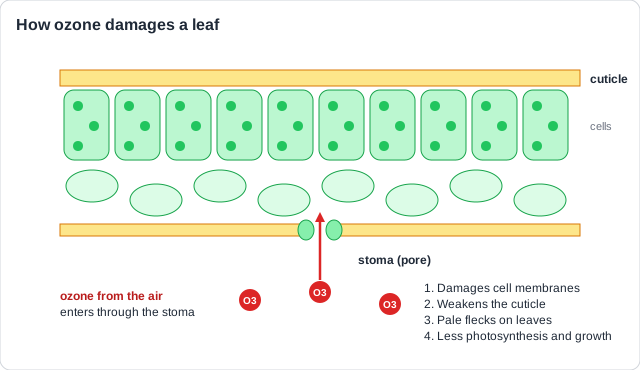
Plants cannot hide from ozone: they must open their stomata to take in carbon dioxide.
Impacts on plants and ecosystems
- Ozone enters leaves through the stomata.
- It damages the cuticles and cell membranes: leaves show pale flecks and die early.
- Photosynthesis and growth fall, so crop yields drop.
- Weakened plants resist disease, pests and drought less well.
- Less plant growth means less food and habitat for animals: biodiversity can fall.
- Sensitive species, such as some lichens, disappear first.
- Damaged plants take up less water and nutrients, changing water and nutrient cycles.
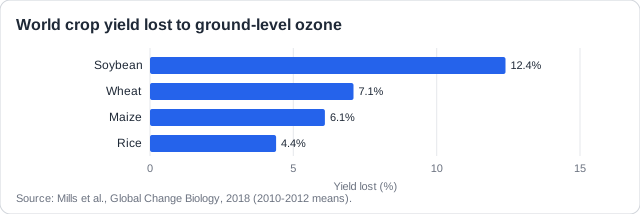
Real examples: ozone damages the cuticle and the cell membranes of leaves. It cuts the world yield of soybean by about 12% and wheat by about 7%. From the 1950s, ozone blown from Los Angeles turned the needles of pine trees in the San Bernardino Mountains yellow and killed many of them.
Get feedback like a real examiner
Submit your answers and get instant feedback — what you did well, what's missing, and exactly what to write to score full marks.
The guide calls these the physical impacts: what ozone does to materials.
Impacts on materials
- Rubber (and some plastics) cracks and hardens: tyres, seals, wiper blades and elastic.
- Fabrics fade and weaken: dyes lose their colour, and cotton and nylon fibres break.
- These are physical impacts: on materials, not living things.
- The smog haze also reduces visibility, a hazard for drivers and planes.
| Material | What ozone does | Real sign |
|---|---|---|
| Rubber | Cracks and hardens it | Tyre makers add antiozonants |
| Fabrics and dyes | Fades colours, weakens fibres | Faded cotton and nylon |
| Air (haze) | Lowers visibility | Brown haze hides the mountains |
Real example: ozone cracks rubber so reliably that tyre makers mix antiozonants into every tyre, and the cracks once appeared so fast in Los Angeles that scientists used strips of rubber to measure smog.
Remember it as: Eyes, lungs, leaves, tyres and T-shirts.
How this comes up: One-mark parts: state a health or environmental impact of ground-level ozone [1]. Short parts: two impacts on living systems, or why ozone harms us down here but helps us up there [2]. Longer: explain why smog harms a city [4].
On summer afternoons ozone levels in Athens, Greece, often rise above the WHO guideline, while high above the city the ozone layer stays in place.
Outline why a high concentration of ozone in the troposphere is a direct problem for humans, while in the stratosphere it is a benefit to humans.
Model answer plan
See the mark-by-mark plan — for / against / judgement, with marking guidance — in study mode.
For the [4] shape, give four different harms: people, eyes, plants and materials work well.
Seoul, South Korea, is ringed by hills, and on hot summer days a layer of photochemical smog often sits over the city.
Explain why the formation of photochemical smog may have harmful effects on the environment of cities such as Seoul.
Model answer plan
See the mark-by-mark plan — for / against / judgement, with marking guidance — in study mode.