Urban expansion and the environment at Higher Level: The same impacts as SL, told through Shanghai, where Pudong grew from farmland into a city of millions in thirty years. At HL, expect to link these impacts to law and economics: who pays for flooding and polluted air?
Practise this as you read
- Link each impact to its cause in the expansion.
- Describe impacts on land, water and air separately.
Free preview
This is the free notes preview
You're reading the free notes. Aimnova Pro unlocks the full study experience — and you can try it with your first topic free to keep:
- FlashcardsLock in vocabulary and key terms with spaced repetition.
- Practice questionsAnswer exam-style questions and get instant AI marking.
- Mock exams & past-paper vaultSit full mocks and see exactly how examiners award marks.
- Personalised study planA daily plan built around your exam date and weak areas.
Every new estate is built on something: When a city spreads, farmland, forest and wetland are covered by buildings and roads. The ecosystems that are left are split up and cut off. Each change follows from a part of the expansion: roads, concrete, fences, lights.
What expansion does to land and wildlife
- Building covers farmland, forests and wetlands: habitats and food sources are lost.
- Roads and estates fragment what is left into small patches, so edge effects reach further in.
- Roads and fences block wildlife corridors: animals cannot roam, find mates or migrate.
- Small, cut-off populations lose genetic diversity, so species decline or die out locally.
- Concrete seals the soil; gardens bring invasive species; light and noise change animal behaviour.
Remember it as: Cover it, cut it up, cut it off.
Real example: in 1990 most of Pudong, across the river from central Shanghai, was farmland, villages and canals. By 2020 about 5.7 million people lived there, among skyscrapers, motorways and housing estates.
Link each impact to the expansion: Write 'new roads split the woodland into small patches, so species that need a large territory decline'. 'Sprawl reduces biodiversity' on its own does not count, and nor do costs to people such as house prices. Only one positive impact, such as gardens giving habitat, can count.
Practice with exam-style questions
Answer exam-style questions and get AI feedback that shows you exactly what examiners want to see in a full-marks response.
Covering the ground changes where the rain goes. Less of it soaks in and more of it rushes over the surface into the rivers, carrying dirt with it.
What expansion does to water
- Roofs, roads and car parks are impermeable: rain cannot soak in.
- More runoff, reaching rivers faster, so rivers peak sooner and higher: flash floods.
- Less infiltration means less groundwater, so rivers run lower in dry weather.
- Rivers are straightened or put in concrete channels: flows and river habitats change.
- Water quality falls: sewage from too few or faulty sewers, oil and metals from roads, silt from building sites.
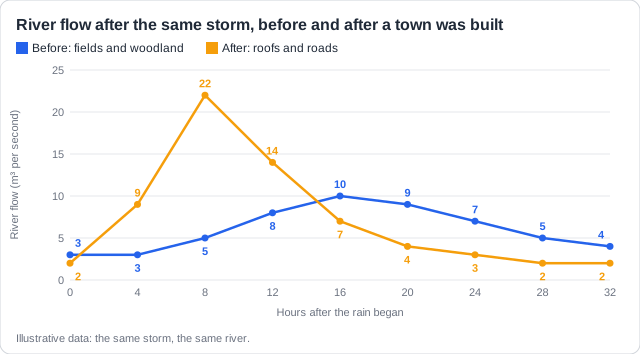
Read the figure with numbers: The peak rises from 10 to 22 m³ per second and comes after 8 hours instead of 16.
Real example: as Shanghai grew, many creeks and canals were filled in or lined. By the 1990s the Suzhou Creek was black and smelly with sewage and factory waste; a large clean-up began in 1998.
A bigger city means more journeys, more building and more hard surfaces, and the air around it changes.
What expansion does to air and climate
- More cars and longer commutes: more exhaust (nitrogen oxides, particulates) and smog.
- Construction dust, factories and burning fuel or waste add particulates.
- Concrete stores heat and fewer plants cool the air: an urban heat island.
- Cleared forests and soils release carbon, and less carbon is taken up afterwards.
- Light and noise spread into the countryside around the city.
Spread out
- New districts far from the old centre.
Drive more
- Heavy traffic on new motorways.
Dirtier air
- Particulates and smog.
Real example: in December 2013 fine-particle pollution in Shanghai passed 600 micrograms per cubic metre, many times the safe level; schools kept children indoors and flights were delayed.
Name the pollutant and its source: 'More traffic on longer commutes releases nitrogen oxides' scores. 'Pollution increases' does not.
Feeling unprepared for exams?
Get a clear study plan, practice with real questions, and know exactly where you stand before exam day. No more guessing.
How this comes up: Paper 2, Section A (May 2026 HL): two photos of a city in 1990 and 2020; describe two ways such urban development could affect the environment [2].
In 1990 most of Pudong, Shanghai, was farmland, villages and canals. By 2020 about 5.7 million people lived there among skyscrapers, motorways and housing estates.
Describe two ways in which urban development, such as that in Pudong, could affect the environment.
Model answer plan
See the mark-by-mark plan — for / against / judgement, with marking guidance — in study mode.