Suburbanization at Higher Level: The same ideas as SL, told through Atlanta, one of the most spread-out cities in the world, set against compact Barcelona. At HL, sprawl is the problem that urban compactness and mixed land use (8.2.11) try to solve.
Practise this as you read
- Quote density and land area to show sprawl.
- Link sprawl to car use and its costs.
Free preview
This is the free notes preview
You're reading the free notes. Aimnova Pro unlocks the full study experience — and you can try it with your first topic free to keep:
- FlashcardsLock in vocabulary and key terms with spaced repetition.
- Practice questionsAnswer exam-style questions and get instant AI marking.
- Mock exams & past-paper vaultSit full mocks and see exactly how examiners award marks.
- Personalised study planA daily plan built around your exam date and weak areas.
Out of the centre, onto more land: Suburbanization spreads a city outwards. The new suburbs use far more land for each person.
The points to remember
- Suburbanization = people moving out of dense central areas to lower-density areas at the city edge (the periphery).
- Suburbs have fewer people per hectare: houses with gardens instead of flats.
- So the same number of people needs much more land.
- That is why suburbanization is also called urban sprawl.
- Not the same as urbanization (country to city): here people move within the urban area.
Remember it as: Out of the crowded centre, onto the fields at the edge: the city sprawls.
Real example: Atlanta, USA, grew mainly outwards in the late 20th century. By about 1990 its 2.5 million people were spread over about 4,280 km² of built-up land, one of the most spread-out cities in the world.
Three moves, three names: Country to city is urbanization. Centre to edge of the same city is suburbanization. Out of the city altogether, to small towns and villages, is counter-urbanization.
Feeling unprepared for exams?
Get a clear study plan, practice with real questions, and know exactly where you stand before exam day. No more guessing.
People move out because the suburbs pull them and the centre pushes them. Neither would work without fast transport into the city.
The points to remember
- Pull of the suburbs: more space, a house with a garden, cheaper land.
- Seen as better for families: quieter, cleaner air, less crime, good schools.
- Push from the centre: crowding, noise, pollution, high rents.
- Made possible by cars, new roads and commuter railways: live far from work, travel in.
- Helped by cheap loans, fast building methods and, lately, working from home.
Pull of the suburbs
- More space, a garden
- Cheaper land and houses
- Quieter, safer, good schools
Push from the centre
- Crowded flats
- Noise, traffic, dirty air
- High rents
Made possible by
- Cars and new roads
- Commuter trains
- Cheap loans; home working
Real example: in Atlanta, new motorways and cheap land at the edge drew families and businesses out of the centre. Between 1990 and 2020 the population of the metropolitan area roughly doubled, and most of the growth was in the suburbs.
Give the reason, not just the word: Write 'land is cheaper at the edge, so families can afford a bigger house', not just 'land'. Each reason needs its effect.
Lower density means more land for the same number of people. A suburb of houses with gardens can need ten times the land of the same people living in flats.
What sprawl looks like
- Low density: spread-out, single-family houses, each on its own plot.
- Car dependency: built for driving, not for walking or buses.
- Separate land uses: homes, shops and work in different zones, far apart.
- Leapfrog building: estates jump over fields, leaving patchy farmland between.
- Commercial strips: big shops with car parks along the main roads.
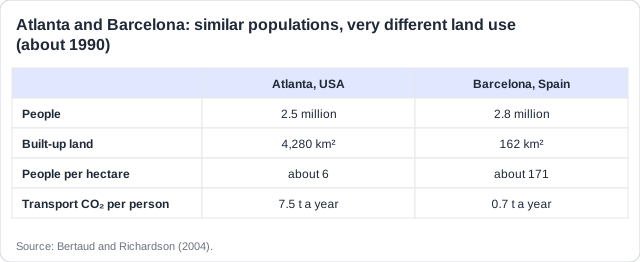
Use the numbers: Quote the land: 'Atlanta housed fewer people than Barcelona on about 26 times the land'.
Real example: Barcelona's flats house 2.8 million people on 162 km²; Atlanta's suburbs house 2.5 million on about 4,280 km².
Memorize terms 3x faster
Smart flashcards show you cards right before you forget them. Perfect for definitions and key concepts.
Sprawl changes how people live. These are its social and economic costs; what it does to the land, water and air is the next page.
The costs for people
- Transport costs: households spend more on cars and fuel.
- Time and isolation: long commutes; less contact with neighbours.
- Inequality: poorer people left in declining inner areas; suburbs can shut out low incomes.
- Service costs: roads, pipes and buses must stretch over a large area.
- Health: less walking, more time sitting in cars, more road accidents.
Gains for those who move
- More space and a garden
- Quieter streets
- Cheaper land
Costs of sprawl
- Long, costly car commutes
- Lonely streets, few services
- Inner areas left behind
Real example: Atlanta's sprawl means long drives: transport there produced about 7.5 tonnes of carbon dioxide per person a year, against 0.7 tonnes in compact Barcelona.
Read what the question asks for: If a question asks for environmental impacts, costs to people such as fuel bills or loneliness do not count. Keep social, economic and environmental points apart.
How this can come up: Paper 1 or Paper 2 Section A: a short data question on the land a city uses [2].
Figure 1 compares Atlanta, USA, with Barcelona, Spain.
With reference to Figure 1, outline why suburbanization is sometimes referred to as urban sprawl.
Model answer plan
See the mark-by-mark plan — for / against / judgement, with marking guidance — in study mode.