The urban system at Higher Level: The same systems ideas as SL, with a different city: Cape Town and its 2018 water crisis. At HL, use the systems view to judge a city: how efficient, how sustainable and how resilient it is.
Practise this as you read
- Draw a city as a systems flow diagram.
- Judge a city's resilience from its inputs and storages.
Free preview
This is the free notes preview
You're reading the free notes. Aimnova Pro unlocks the full study experience — and you can try it with your first topic free to keep:
- FlashcardsLock in vocabulary and key terms with spaced repetition.
- Practice questionsAnswer exam-style questions and get instant AI marking.
- Mock exams & past-paper vaultSit full mocks and see exactly how examiners award marks.
- Personalised study planA daily plan built around your exam date and weak areas.
A city works like a machine with many parts: An urban system takes things in, changes them, and sends things out.
The points to remember
- A city's components are its storages: people, buildings, transport, power, water and sewage, plants and animals.
- The components are interrelated: change one and the others change.
- Flows of matter and energy link them: inputs, outputs, transfers, transformations.
- A city is an open system: it exchanges matter and energy with its surroundings.
- It has feedback: responses that push it back towards balance, or further away.
- Its microclimate (warmth, wind, shade) is part of the system too.
Storages
- People, buildings
- Roads, power, water
Flows
- Inputs and outputs
- Transfers, transformations
Behaviour
- Open system
- Feedback
Real example: Cape Town, South Africa, has about 4.8 million people. When its dams ran low in 2018, homes, farms, factories and hospitals all had to change: the parts are interrelated.
Remember it as: Stores, flows, open, feedback.
Know your predicted grade
Take timed mock exams and get detailed feedback on every answer. See exactly where you're losing marks.
Everything a city uses comes in across its boundary, and everything it throws away goes out. That is why it is an open system.
Inputs and outputs
- Inputs of matter: food, water, building materials, goods, people moving in.
- Inputs of energy: electricity, gas and fuel; sunlight.
- Outputs of matter: solid waste, sewage, polluted air and CO₂, exported goods, people leaving.
- Outputs of energy: heat lost from buildings, engines and roads.
- A city takes in far more than it can make: it depends on land far beyond its boundary.
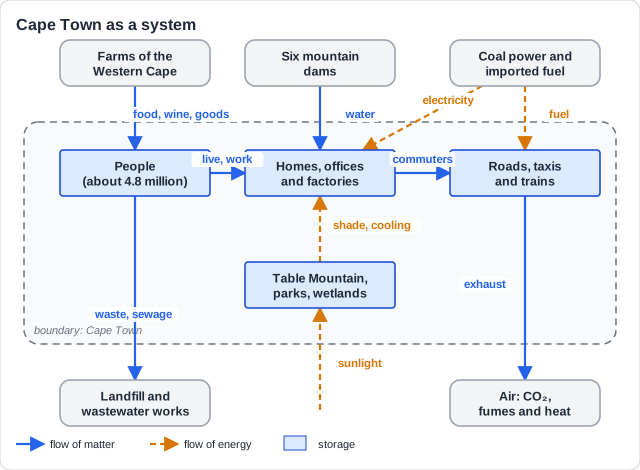
Real example: almost all of Cape Town's water comes from six large dams in the mountains outside the city, fed by winter rain. The water is an input; the treated wastewater that flows to the sea is an output.
Inside the boundary, matter and energy keep moving and changing. The papers call these processes.
Transfers and transformations
- A transfer moves something without changing it: commuters by train, water through pipes, goods by lorry.
- A transformation changes it: burning fuel turns chemical energy into heat and CO₂.
- Food becomes waste and sewage; sewage works turn sewage into cleaner water and sludge.
- Parks and trees: photosynthesis, and evapotranspiration that cools the air.
- Say which kind each process is: transfer or transformation.
Transfer (moves)
- Commuters on a train
- Water in pipes
- Rubbish in a lorry
Transformation (changes)
- Fuel burned in an engine
- Sewage treated
- Food into waste
Real example: in Cape Town, water is transferred from the dams through pipes, then transformed at treatment works; parks on the slopes of Table Mountain lose water to the air by evapotranspiration.
Get feedback like a real examiner
Submit your answers and get instant feedback — what you did well, what's missing, and exactly what to write to score full marks.
When something changes in a city, the city responds. That response is feedback.
Feedback in a city
- Negative feedback opposes a change and brings the system back towards balance.
- Example pattern: too many people for the resources, so the birth rate falls and the population falls back.
- Positive feedback pushes the change further: growth attracts jobs, which attract more people.
- Feedback is often a human response: a charge, a limit, a new law.
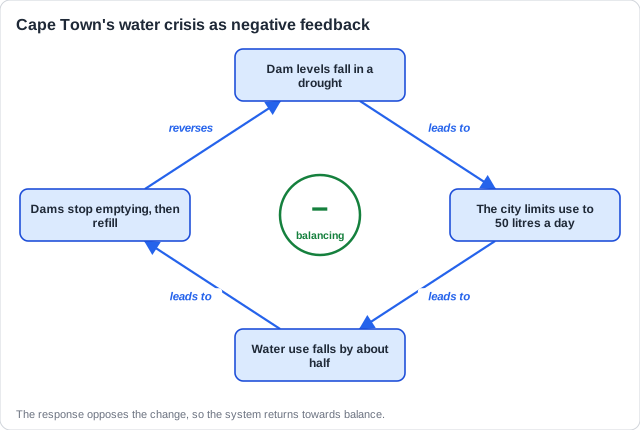
Real example: in 2017-2018 Cape Town's dams fell to about a fifth full. From February 2018 each person was limited to 50 litres a day; use fell by about half, and 'Day Zero', when taps would be turned off, never came.
The guide asks you to draw an urban system as a systems flow diagram. Build it in five steps.
Drawing a city as a systems diagram
- Draw a dashed boundary round the city.
- Draw storages as boxes inside it: people, homes, roads, green space.
- Draw inputs as arrows into the boundary and outputs as arrows out of it.
- Draw transfers as arrows between boxes; label every arrow with what flows.
- Show matter and energy flows differently, for example energy as dashed arrows.
Boundary
- Draw a dashed line round the City of Cape Town.
Storages
- Boxes inside: people, homes and factories, roads, Table Mountain and parks.
Inputs
- Arrows in: water from six dams, food from Western Cape farms, electricity.
Outputs
- Arrows out: wastewater to the sea, waste to landfill, exhaust and heat.
Transfers
- Arrows between boxes: water piped from treatment works to homes.
Label every arrow: An arrow with no label shows nothing. Write what flows ('food', 'sewage', 'heat'), and keep storages in boxes, not floating words.
Learn what examiners really want
See exactly what to write to score full marks. Our AI shows you model answers and the key phrases examiners look for.
Seeing a city as a system helps to judge it: what it wastes, how well it uses its inputs, whether it can last, and whether it can survive a shock.
Waste, efficiency, sustainability, resilience
- Waste and pollution are the city's outputs: rubbish, sewage, fumes, CO₂, heat.
- Efficiency: more done for each unit of input; dense housing and public transport use less per person.
- Sustainability: inputs taken no faster than they can be replaced; outputs no faster than they can be absorbed.
- Resilience: the ability to keep working, and recover, after a shock such as a flood or drought.
- More varied inputs and storages (reservoirs, defences) make a city more resilient.
Efficient
- Less input per person
- Dense, shared services
Sustainable
- Inputs replaced
- Outputs absorbed
Resilient
- Survives shocks
- Many sources, big stores
Real example: after the crisis, Cape Town added groundwater, small desalination plants and water recycling, so it no longer depends on rain-fed dams alone: more varied inputs make it more resilient.
How this comes up: Paper 2, Section B (a): outline how a city can be considered as a system [4] (May 2026).
Cape Town takes in food, water and energy and sends out waste and heat.
Outline how a city such as Cape Town can be considered as a system.
Model answer plan
See the mark-by-mark plan — for / against / judgement, with marking guidance — in study mode.