What an urban area is at Higher Level: The same ideas as SL, with different places: Tokyo and Hokkaido, and Japan's merged towns. At HL, be ready to question urban data: who decided what counts as urban, and would another definition change the answer?
Practise this as you read
- Calculate a population density from data.
- Question how 'urban' was defined before comparing places.
Free preview
This is the free notes preview
You're reading the free notes. Aimnova Pro unlocks the full study experience — and you can try it with your first topic free to keep:
- FlashcardsLock in vocabulary and key terms with spaced repetition.
- Practice questionsAnswer exam-style questions and get instant AI marking.
- Mock exams & past-paper vaultSit full mocks and see exactly how examiners award marks.
- Personalised study planA daily plan built around your exam date and weak areas.
Built-up and crowded: An urban area is where land is mostly covered by buildings and many people live in a small space.
The points to remember
- An urban area is a built-up area: land mostly covered by buildings and hard surfaces.
- It has a high population density: many people per square kilometre.
- It has many buildings close together: homes, offices, shops, factories.
- It has infrastructure: roads, railways, water and sewage pipes, power lines.
- Population density = number of people ÷ area (people per km²).
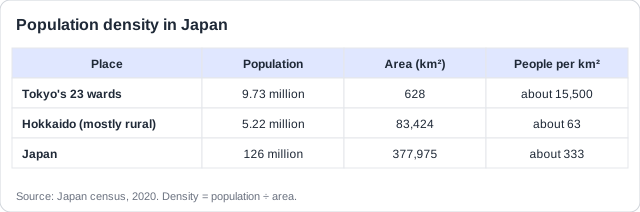
Calculate density: Density = people ÷ area. Tokyo's 23 wards: 9,733,276 ÷ 627.5 = about 15,500 people per km². Divide people by area, never area by people.
Real example: Tokyo's 23 central wards hold 9.7 million people in 628 km². Under and above the streets run infrastructure: one of the world's busiest rail networks, water mains and power lines.
Know your predicted grade
Take timed mock exams and get detailed feedback on every answer. See exactly where you're losing marks.
Why do people crowd together? Because being close makes many things easier: getting to work, buying and selling, meeting other people.
Five reasons to live close together
- Residential: homes, close to work and services.
- Productive: factories and offices, so jobs.
- Trade: markets, shops and ports, where goods are bought and sold.
- Cultural: museums, theatres, places of worship.
- Social: meeting friends and family, sport, leisure.
Residential
- Flats for millions, many in tall blocks.
Cultural
- Shrines, temples, museums and kabuki theatre.
Productive
- The offices of Marunouchi and Shinjuku.
Trade
- Shops, and Toyosu, the city's huge fish market.
Social
- Busy streets such as Shibuya, parks, stadiums.
Remember it as: Live, make, trade, enjoy, meet.
A rural area is the opposite of an urban one: few people spread over a large area.
Rural areas
- A rural area has a low population density.
- Its settlements are dispersed: farms, hamlets and villages spread out, with fields between.
- Much of the land is farmland, forest or wild land, not buildings.
- There is less infrastructure: fewer roads, pipes and services.
- Compare the two in one sentence: 'whereas'.
Urban area
- High population density
- Dense, built-up settlement
- Much infrastructure
Rural area
- Low population density
- Dispersed settlements
- Little infrastructure
Real example: Hokkaido, Japan's northern island, has about 63 people per km² outside its cities. Dairy farms and small towns are dispersed across a land of forest and fields.
Get feedback like a real examiner
Submit your answers and get instant feedback — what you did well, what's missing, and exactly what to write to score full marks.
Small or large, a town, a city or a suburb counts as urban. But where does 'urban' begin? Each country decides.
Cities, towns, suburbs, and who counts them
- Cities, towns and suburbs are all classed as urban areas.
- A suburb is a lower-density area of homes at the edge of a city.
- Each country sets its own definition of urban: a minimum population, density or type of work.
- So urban figures from different countries are not always comparable.
- If a definition changes, a place can become 'urban' without anyone moving.
Sweden
- Urban: any built-up area
- of at least 200 people
India
- 5,000+ people, 400+ per km²
- and most men in non-farm work
Japan
- Urban: cities ('shi')
- of usually 50,000+ people
Real example: between 1999 and 2010 Japan merged many small towns and villages into larger cities. The share of Japanese people counted as urban jumped from about 79% to 91%, with almost no one moving house: the definition changed, not the people.
How this comes up: Paper 2, Section B (a): outline the features of an urban area, with a named city [4].
More than half of the world's people now live in urban areas.
Outline the features of an urban area, with reference to a named city.
Model answer plan
See the mark-by-mark plan — for / against / judgement, with marking guidance — in study mode.