Urban ecosystems at Higher Level: The same ideas as SL, with a different city: Singapore. At HL, use the city as a case to judge how far an urban ecosystem is like a natural one, and what it depends on beyond its borders.
Practise this as you read
- Sort a city's components into biotic and abiotic.
- Compare an urban ecosystem with a natural one.
Free preview
This is the free notes preview
You're reading the free notes. Aimnova Pro unlocks the full study experience — and you can try it with your first topic free to keep:
- FlashcardsLock in vocabulary and key terms with spaced repetition.
- Practice questionsAnswer exam-style questions and get instant AI marking.
- Mock exams & past-paper vaultSit full mocks and see exactly how examiners award marks.
- Personalised study planA daily plan built around your exam date and weak areas.
A city is an ecosystem too: An urban ecosystem is made of biotic and abiotic parts, like a forest or a lake.
The points to remember
- An urban area (a city or town) contains an urban ecosystem.
- Like every ecosystem it has biotic (living) and abiotic (non-living) components.
- Biotic: plants, animals and other forms of life such as fungi and bacteria.
- Abiotic: soil, water, air, climate and topography (the shape of the land).
- The components interact: trees shade and cool the air; polluted air slows plant growth.
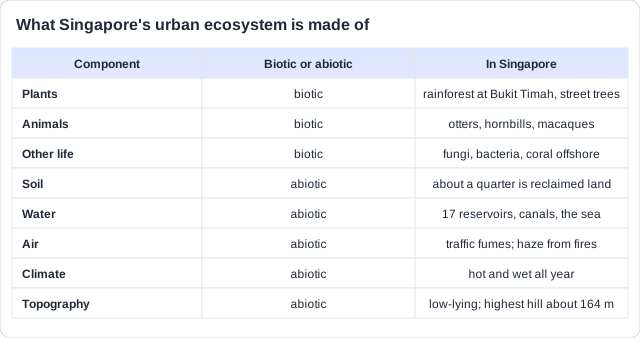
Real example: Singapore calls itself a 'City in Nature': about 6 million people live among rainforest, reservoirs and mangroves on an island about half the size of London.
Remember it as: Living things plus soil, water, air, climate, land.
See how examiners mark answers
Answer exam-style questions with model answers. Learn exactly what earns marks and what doesn't.
The living part of a city is more than people. Plants, animals and tiny decomposers live in every gap the city leaves.
Biotic components
- Plants: street trees, parks, gardens, green roofs, weeds in cracks.
- Animals: birds, foxes, bats, insects; many live close to people.
- Other life: fungi and bacteria break down waste in soil and water.
- Humans are the main species and decide what else can live there.
- Many species are generalists that eat almost anything; many are introduced from elsewhere.
Plants
- Street trees
- Parks and gardens
- Green roofs
Animals
- Foxes, birds, bats
- Insects
- Fish in rivers
Other life
- Fungi
- Bacteria
- Algae in ponds
Real example: smooth-coated otters came back to Singapore's rivers and canals in the late 1990s, once the water was cleaned. Oriental pied hornbills, large fruit-eating birds, now nest in the city again.
The non-living part of a city is changed by buildings and roads. Each abiotic component is different from the countryside around it.
Abiotic components
- Soil: packed hard, sealed under roads, often polluted.
- Water: rivers in channels, fast runoff from roofs and roads, reservoirs.
- Air: fumes from traffic and industry; air pollution limits photosynthesis.
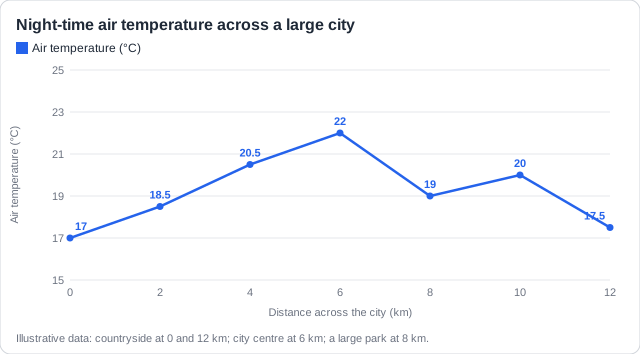
- Climate: warmer than the countryside, an urban heat island; parks and lakes are cooler.
- Topography: hills, valleys and coasts, often flattened or built up by people.
Real example: about a quarter of Singapore's land was reclaimed from the sea, so its soil and coastline are human-made. In 2015 and 2019, smoke from fires in Indonesia blew over the city as a thick haze.
Link it to the plants: Asked what limits plant growth in a city? 'Air pollution limits photosynthesis' scores. 'It lowers productivity' alone does not: say it slows photosynthesis or plant growth.
Study smarter, not longer
Most students waste 40% of study time on topics they already know. Our AI tracks your progress and optimizes every minute.
A city is not one ecosystem but a patchwork of many. Each patch is a habitat with its own mix of living and non-living parts.
Ecosystems inside the city
- A city holds many ecosystem types: woodland, grassland, rivers, lakes, wetlands, parks, gardens.
- Name the type: 'woodland' or 'wetland', not just 'terrestrial' or 'freshwater'.
- Green spaces are often fragmented: small patches between buildings.
- A green belt of countryside may ring the city edge; rivers form green corridors.
- Corridors link patches, so plants and animals can move through the city.
Land ecosystems
- Woodland
- Grassland and meadow
- Parks and gardens
Water ecosystems
- Rivers and canals
- Lakes and ponds
- Wetlands and marsh
Real example: at Bishan-Ang Mo Kio Park in Singapore, a straight concrete canal was turned into a winding river with planted banks in 2012. Kingfishers, dragonflies and otters now live in a park in the middle of housing estates.
Name the type: 'Terrestrial ecosystem' or 'freshwater ecosystem' is too vague. Write 'woodland', 'grassland', 'river' or 'wetland'.
How like a natural ecosystem is a city? It has the same parts, but people bring in most of what keeps it going.
Urban and natural ecosystems compared
- Same as natural ecosystems: biotic and abiotic parts, food chains, energy flows, nutrient cycles.
- Different: most energy and food are imported from outside, not made by local producers.
- Different: few producers for the number of consumers, so food webs are simple.
- Different: humans control it: what grows, where water goes, what is removed.
- Different: many introduced species and much more waste and pollution.
Natural ecosystem
- Energy from local plants
- Many producers
- Wastes recycled on site
Urban ecosystem
- Energy and food imported
- Few producers
- Wastes exported or piled up
Real example: Singapore imports more than 90% of its food. Its own producers, from rainforest to rooftop farms, could never feed 6 million people, so the city depends on ecosystems far beyond its borders.
Remember it as: Same parts as nature; the fuel comes from outside.
Practice with exam-style questions
Answer exam-style questions and get AI feedback that shows you exactly what examiners want to see in a full-marks response.
How this comes up: Paper 2, Section B (a): outline the components of a named urban ecosystem [4], with two of each kind.
Cities are often thought of as places without nature, yet they contain ecosystems.
Outline the biotic and abiotic components of a named urban ecosystem, such as Singapore.
Model answer plan
See the mark-by-mark plan — for / against / judgement, with marking guidance — in study mode.