Models of urban sustainability at Higher Level: This statement is Higher Level only. It shows how cities use two models, the circular economy and doughnut economics, to plan for sustainability, with Amsterdam as the main example.
Practise this as you read
- Outline how a circular economy works in a city.
- Describe the doughnut model and its four lenses for a city.
- Evaluate how far these models make a named city more sustainable.
Free preview
This is the free notes preview
You're reading the free notes. Aimnova Pro unlocks the full study experience — and you can try it with your first topic free to keep:
- FlashcardsLock in vocabulary and key terms with spaced repetition.
- Practice questionsAnswer exam-style questions and get instant AI marking.
- Mock exams & past-paper vaultSit full mocks and see exactly how examiners award marks.
- Personalised study planA daily plan built around your exam date and weak areas.
Cities run on models: To plan for sustainability, cities borrow models from economics. The two named here are the circular economy and doughnut economics.
Why cities need these models
- Cities cover under 2% of Earth's land but use about 78% of its energy.
- They make over 60% of the world's greenhouse gas emissions.
- So how a city is run matters for the whole planet.
- Two models guide it: the circular economy and doughnut economics.
- Both treat the city as a system of inputs, outputs and people, not just buildings.
Real example: Amsterdam uses both: a plan to cut the raw materials it uses, and a picture of how its people can thrive without harming the planet.
Stop wasting time on topics you know
Our AI identifies your weak areas and focuses your study time where it matters. No more overstudying easy topics.
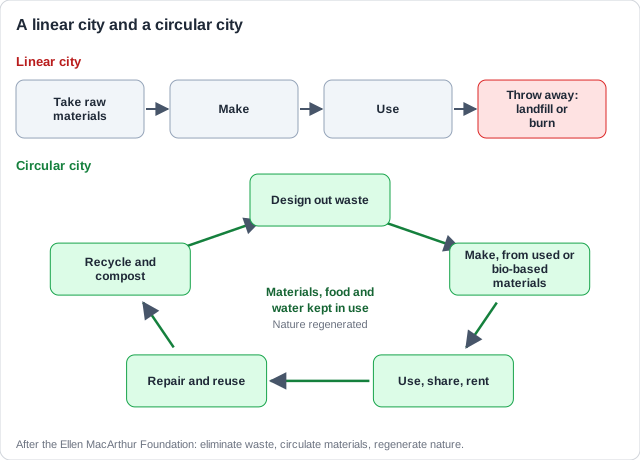
Most cities still run as a linear economy: goods come in, are used once and leave as rubbish. A circular city keeps materials, food and water going round.
The circular city
- Linear city: take, make, use, throw away.
- Design out waste and pollution from the start.
- Keep products and materials in use: share, repair, reuse, recycle.
- Regenerate nature: compost food waste back to soil, clean water, plant green space.
- In a city: reuse building materials, use waste heat, collect rainwater, compost food.
Remember it as: Design it out, keep it in, give it back.
Some places already close their loops. In Kalundborg, Denmark, industrial symbiosis has grown since 1972.
Power station
- Its surplus heat is piped to warm homes in the town.
Gypsum
- Gypsum from cleaning its smoke is used to make plasterboard.
Yeast
- Leftover yeast from making insulin becomes pig feed and fertiliser.
Result
- Less waste, fewer new raw materials, lower costs.
Amsterdam: a circular strategy
Circular Strategy 2020-2025: halve the use of new raw materials by 2030, fully circular by 2050. Three areas: food and organic waste, consumer goods, buildings.
Copenhagen: waste to heat
CopenHill (2019) burns rubbish to make electricity and district heating, with a ski slope on its roof. Burning is a last resort: the materials are lost.
See how examiners mark answers
Answer exam-style questions with model answers. Learn exactly what earns marks and what doesn't.
The doughnut has two rings: the social foundation and the ecological ceiling. A city fits it to its own streets with a city portrait.
The doughnut for a city
- The doughnut: a safe and just space between two rings.
- Inside: the social foundation, everyone's basic needs.
- Outside: the ecological ceiling, Earth's planetary boundaries.
- A city version, the city portrait, asks four questions: local and global, social and ecological.
- Amsterdam was the first city to adopt it, in April 2020.
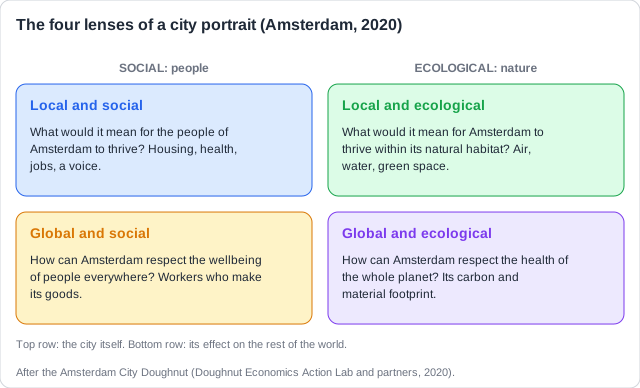
Real example: Amsterdam's portrait found that about 20% of its tenants could not meet their basic needs after paying rent: a shortfall below the social foundation.
Amsterdam now asks builders who buy or lease city land to show how they will use recycled or bio-based materials. Its floating Schoonschip neighbourhood shares solar power through its own grid.
Using the models: strengths and limits
- Holistic: links people's needs and nature's limits in one picture.
- Global responsibility: counts the city's footprint abroad, not only at home.
- Long-term targets: Amsterdam's halve-by-2030, fully circular by 2050.
- Limits: hard to measure; many causes lie outside the city's control.
- Limits: costly; goods are still imported; risk of greenwashing.
Strengths
- Social and ecological goals in one plan
- Counts the city's effect abroad
- Clear long-term targets
Limits
- National laws and global trade lie outside city control
- Hard to measure progress
- Housing shortfalls remain
Other cities: Portland and Philadelphia in the USA drew city portraits in the same 2019-2020 project as Amsterdam. Naming more than one city shows breadth in an essay.
Study smarter, not longer
Most students waste 40% of study time on topics they already know. Our AI tracks your progress and optimizes every minute.
How this could come up: No paper has asked this statement directly. May 2026 HL Paper 2 asked how far economic models make communities more sustainable [9]. Expect Section B (a) outline [4], (b) evaluate [7], or Paper 1 parts on a city fact file.
Amsterdam's Circular Strategy aims to halve the city's use of new raw materials by 2030.
Outline how a circular economy model can make a city more sustainable.
Model answer plan
See the mark-by-mark plan — for / against / judgement, with marking guidance — in study mode.