Principles of ecological urban planning at Higher Level: This statement is Higher Level only. It takes ecological urban planning further, with three principles: compactness, mixed land use and social mix. It also asks who gets the green space: a question of environmental justice, law and ethics.
Practise this as you read
- Outline the sustainable advantages of compactness and mixed land use.
- Explain how a social mix and fair access to green space support social equality.
- Evaluate a named example, such as Vauban in Freiburg.
Free preview
This is the free notes preview
You're reading the free notes. Aimnova Pro unlocks the full study experience — and you can try it with your first topic free to keep:
- FlashcardsLock in vocabulary and key terms with spaced repetition.
- Practice questionsAnswer exam-style questions and get instant AI marking.
- Mock exams & past-paper vaultSit full mocks and see exactly how examiners award marks.
- Personalised study planA daily plan built around your exam date and weak areas.
Plan the city so it needs less: At HL, ecological urban planning follows three principles: urban compactness, mixed land use and social mix. Together they stop urban sprawl and let people live well with fewer car trips.
The points to remember
- Urban compactness: build densely and upwards, on land already used, not outwards.
- Mixed land use: homes, shops, jobs, schools and parks side by side.
- Social mix: people of different incomes and ages in the same neighbourhood.
- The aim: less sprawl, fewer car trips, less energy and fair access for everyone.
Remember it as: Close together, mixed together, living together.
Compact
- About 5,500 people live on 38 hectares of an old army base.
Mixed
- Shops, a school, offices and a market are a short walk from every home.
Social mix
- Student flats, co-operative homes and family-built homes stand side by side.
Result
- In 2009 about 7 in 10 households had no car.
Practice with exam-style questions
Answer exam-style questions and get AI feedback that shows you exactly what examiners want to see in a full-marks response.
A compact city fits more people on less land. It builds upwards, fills gaps, reuses brownfield land and may draw an urban growth boundary.
Advantages of urban compactness
- Reduced urban sprawl: farmland, forests and wetlands at the edge are protected.
- Shorter trips: places are closer, so more people walk and cycle.
- Better public transport: enough riders live near each stop for frequent services.
- Reduced energy consumption: flats share walls and lose less heat; short trips burn less fuel.
- Cheaper services: shorter pipes, cables and roads for each home.
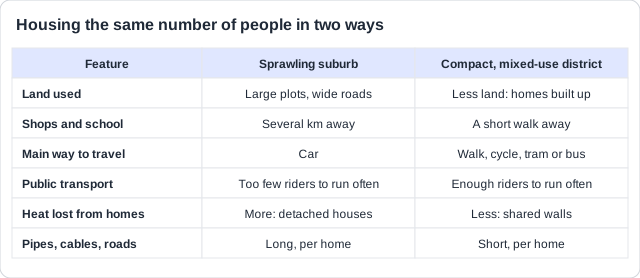
Real example: since 1979 Portland, Oregon, has had an urban growth boundary. New homes go inside the line, many as flats near tram and light-rail stops, while the farms and forests outside are protected.
Limits of compactness: Dense cities can push up house prices, give people less private garden space and trap more heat. Good plans add parks and trees as they build upwards.
Many 20th-century plans used zoning to keep homes, offices and shops apart, so most trips needed a car. Mixed land use puts them side by side, so daily needs are a short walk away.
Advantages of mixed land use
- Less car dependency: shops, school and work are within walking or cycling distance.
- Increased accessibility: children, older people and people without cars reach what they need.
- Less energy and pollution: fewer, shorter car trips mean less fuel, carbon dioxide and smog.
- Lively, safer streets: people are around all day, not only at rush hour.
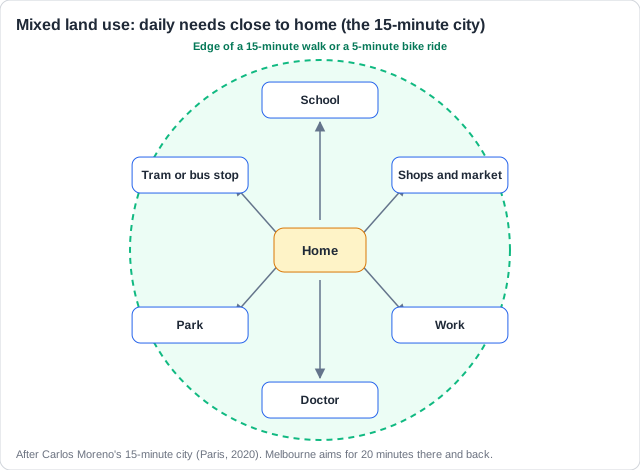
Paris: the 15-minute city
Mayor Anne Hidalgo made Carlos Moreno's idea part of her 2020 campaign: shops, schools, doctors and parks within 15 minutes on foot or by bike.
Melbourne: 20-minute neighbourhoods
Plan Melbourne 2017-2050 aims for most daily needs within a 20-minute walk there and back, about 800 m each way.
Copenhagen: a 5-minute city
Nordhavn, a new district on the old docks, is planned so that shops, schools and public transport are about five minutes' walk from every home.
Feeling unprepared for exams?
Get a clear study plan, practice with real questions, and know exactly where you stand before exam day. No more guessing.
A social mix means homes for different incomes, ages and family sizes in the same area, instead of segregation.
Social mix: advantages and risks
- Social equality: everyone shares the same schools, parks, transport and services.
- Workers on low pay can live near their jobs: shorter trips, less traffic.
- Less segregation: no poor districts left with the worst housing and pollution.
- Tools: a share of affordable housing in every new development, council housing, rent rules.
- The risk: gentrification pushes long-standing residents out.
France: a law
- SRU law, 2000: most towns must make 20% of their homes social housing
- Raised to 25% for most towns in 2013
- Towns that fall short pay a penalty
Vienna: council homes
- The city owns about 220,000 council flats
- They stand in every district, rich and poor
- About half of residents live in council or subsidised homes
Name the law and the ethics: A law such as France's SRU law is the legal tool (environmental law). The reason behind it, that everyone deserves a decent home in a good area, is an ethical one.
Who gets the parks?: In many cities the richest districts have the most trees and parks. Avoiding this social inequality in access to green areas is a matter of environmental justice.
Green space and environmental justice
- Green space cools streets, cleans the air and is good for physical and mental health.
- Poorer districts often have fewer trees and parks, and higher cooling costs in heatwaves.
- Environmental justice: benefits and harms shared fairly between all groups.
- A target: the 3-30-300 rule: 3 trees seen from home, 30% tree cover, a park within 300 m.
- Laws and ethics: plans can give every home a park within walking distance, as a right.
Real example: since 2018 Paris has turned school playgrounds into 'oasis' yards, replacing asphalt with trees, plants and water points, and opening some to local families at weekends. Every district has schools, so the cooler, greener space reaches poorer districts too.
Green gentrification: A new park can raise rents so much that the people it was meant for must leave: gentrification. Near Atlanta's BeltLine, a ring of trails and parks on old railway lines opened from 2008, house prices rose fast. Pair new parks with affordable homes.
Memorize terms 3x faster
Smart flashcards show you cards right before you forget them. Perfect for definitions and key concepts.
Vauban shows all three principles working together, with the strengths and limits to weigh in an essay.
Vauban, Freiburg: one example in depth
- What: about 5,500 people on 38 hectares of an old army base in Freiburg, Germany, built from the late 1990s.
- Compact: mostly three- and four-storey terraces and blocks, close together.
- Mixed: shops, a primary school, kindergartens, offices and a market within a short walk.
- Few cars: cars park in garages at the edge; a tram has run to the centre since 2006.
- Social mix: student flats, co-operatives and groups of families who designed their own homes.
- Energy: well-insulated homes; the Solar Settlement beside it makes more energy than it uses.
Strengths
- About 7 in 10 households had no car in 2009
- Short trips and lively, safe streets
- Farmland round Freiburg spared
Limits
- Homes there have become expensive
- Few residents on low incomes now
- Hard to copy in an old, built-up city
How this could come up: No paper has asked this statement yet. Likely shapes: Paper 2 Section B (a), outline four advantages [4]; Paper 1 parts on a fact file [1-3]; a Section B (c) essay on how far these principles make a city both greener and fairer [9].
Paris aims to become a '15-minute city', where most daily needs are within a 15-minute walk or bike ride.
Outline four sustainable advantages of urban compactness and mixed land use.
Model answer plan
See the mark-by-mark plan — for / against / judgement, with marking guidance — in study mode.