Green architecture at Higher Level: This statement is Higher Level only. It looks at buildings themselves: how their design, materials and construction can protect air, water, earth and people's health, using both traditional and new knowledge.
Practise this as you read
- Outline features of green buildings and what each one saves.
- Explain how vernacular and bio-based building can be sustainable.
- Evaluate a named example, such as BedZED in London.
Free preview
This is the free notes preview
You're reading the free notes. Aimnova Pro unlocks the full study experience — and you can try it with your first topic free to keep:
- FlashcardsLock in vocabulary and key terms with spaced repetition.
- Practice questionsAnswer exam-style questions and get instant AI marking.
- Mock exams & past-paper vaultSit full mocks and see exactly how examiners award marks.
- Personalised study planA daily plan built around your exam date and weak areas.
Buildings that do less harm: Ordinary construction burns energy, uses up rock and water, and leaves waste and fumes. The answer is green architecture.
The points to remember
- Green architecture minimizes harm to human health and the environment.
- It aims to safeguard air, water and earth.
- It chooses environmentally friendly materials and construction practices.
- It combines new and indigenous knowledge, vernacular styles, bio-based materials and circular construction.
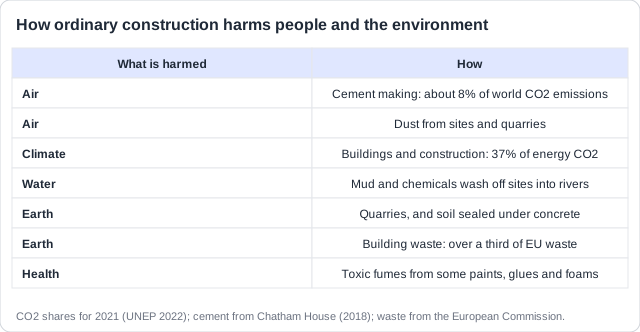
Remember it as: Safe air, safe water, safe earth, safe people.
Memorize terms 3x faster
Smart flashcards show you cards right before you forget them. Perfect for definitions and key concepts.
Green buildings protect air, water and earth through the way they are designed and built, and the way they run, from solar panels to reusing greywater.
Safeguarding air, water and earth
- Air: less energy needed (insulation, sun, shade), renewable power, non-toxic paints.
- Water: collect rainwater, reuse greywater, green roofs to slow runoff.
- Earth: build on old industrial land, use local and recycled materials, waste little.
- Health: daylight, fresh air, no toxic fumes indoors.
- Built to use less energy over its whole life, not only while it is built.
Energy
- Solar panels on the roof and the south wall
- Warm and cold water stored underground for heating and cooling
Water
- Rainwater collected to flush toilets and water the gardens
People
- About 28,000 sensors adjust light and heating to who is there
Real example: The Edge, an office building in Amsterdam finished in 2014, scored 98.36% in the BREEAM rating, the highest score at the time. It uses aquifer thermal energy storage to heat and cool its offices.
Indoor air counts: Some paints, glues and foams release volatile organic compounds. Green buildings use low-fume products and let in fresh air: that is the 'human health' half of the definition.
Materials decide much of a building's harm. Green architecture prefers bio-based materials, local and reused materials, and circular construction. Concrete and steel have high embodied carbon.
Choosing materials
- Bio-based materials (wood, straw, hemp, bamboo) are renewable and store carbon.
- Local materials need less transport fuel.
- Reclaimed and recycled materials need no new mining and keep waste out of landfill.
- Circular construction: design buildings to be taken apart and their parts reused.
- Concrete and steel have high embodied carbon: use less of them.
Straw bales
Settlers in Nebraska's treeless Sandhills built straw-bale houses from the 1890s; some still stand. LILAC in Leeds (2013) built 20 homes from straw-bale panels.
Bottles
At Yelwa, Nigeria (2011), a house was built of plastic bottles filled with sand and bound with mud. A temple in Sisaket, Thailand, uses about 1.5 million glass bottles.
Tall timber
Mjøstårnet in Norway (2019), 85.4 m of wood, was then the world's tallest timber building. Its wood stores carbon instead of releasing it.
Reclaimed steel
At BedZED in London (2002), much of the steel came from demolished buildings, so no new steel had to be made.
Say why it is green: 'It is natural' is not enough. Say what the material saves: it regrows, stores carbon, needs no kiln, travels a short way, or keeps waste out of landfill.
Know your predicted grade
Take timed mock exams and get detailed feedback on every answer. See exactly where you're losing marks.
Long before air conditioning, people built for their climate. Their vernacular architecture holds the indigenous knowledge that green architecture now uses alongside new technology.
New and indigenous knowledge
- Vernacular buildings are suited to the local climate with local materials.
- Barajeel catch breezes and send them down into rooms: cooling with no electricity.
- Thick walls and small windows keep out the sun's heat; courtyards give shade.
- New technology can use the same ideas: Masdar City's modern wind tower.
- 3D printing builds walls fast with little waste, but most printers use concrete.
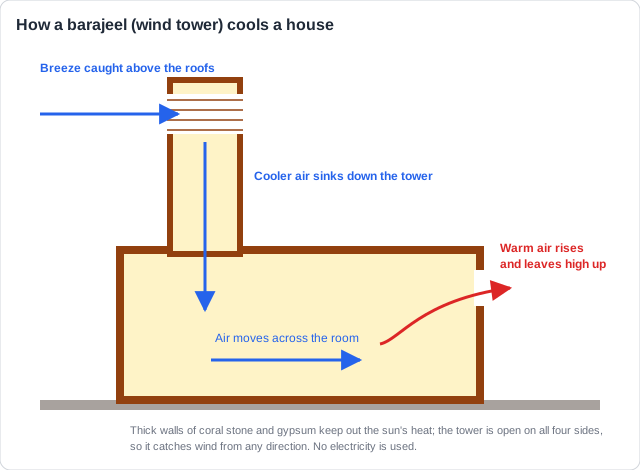
Real example: the houses of Al Fahidi, Dubai's historic district, were built from the late 1800s with barajeel of coral stone, gypsum and palm wood. Masdar City in Abu Dhabi (from 2008) uses narrow, shaded streets and a 45 m modern wind tower on the same idea.
How does a buyer know a building is green? Rating systems check it against a list of points.
LEED and BREEAM
- BREEAM (UK, 1990), the first green building rating: Pass to Outstanding.
- LEED (USA, 1998): Certified, Silver, Gold or Platinum.
- Points for energy, water, materials, waste, health and site.
- They give builders targets and buyers proof.
- Limit: a building rated at design can use more in real life; points can be chased cheaply.
| BREEAM | LEED | |
|---|---|---|
| Started | UK, 1990 | USA, 1998 |
| Top level | Outstanding | Platinum |
| Example | The Edge, Amsterdam: 98.36% | Songdo, South Korea: many rated buildings |
Real example: Songdo, a new city built on land reclaimed from the sea from the 2000s, has many LEED-rated buildings, about 40% green space, and pipes that carry rubbish away underground instead of bin lorries.
Get feedback like a real examiner
Submit your answers and get instant feedback — what you did well, what's missing, and exactly what to write to score full marks.
BedZED, the Beddington Zero Energy Development, was one of the first large green housing schemes in the UK.
BedZED, London: one example in depth
- What: 82 homes and offices in south London, finished in 2002.
- Heat: very thick insulation, triple glazing, south-facing sunspaces.
- Air: coloured wind cowls bring in fresh air and keep the heat of the stale air.
- Materials: much of the steel reclaimed; many materials from within about 56 km.
- Water and travel: rainwater flushes toilets; a car club.
- Limit: its wood-fired power plant did not work reliably and was shut down.
Strengths
- Far less energy needed for heating
- Reused and local materials
- Built on old industrial land
Limits
- Its wood-fired power plant failed
- Cost more to build
- Residents still drive and fly
How this could come up: No paper has asked this statement yet. Likely shapes: Paper 2 Section B (a), outline four features or ways [4]; (b) explain [7]; Paper 1 parts on a building's fact file [1-3].
The Edge, an office building in Amsterdam finished in 2014, scored 98.36% in the BREEAM rating.
Outline four features of The Edge that reduce its environmental impact.
Model answer plan
See the mark-by-mark plan — for / against / judgement, with marking guidance — in study mode.