Ecological urban planning at Higher Level: The same approaches as SL, with resilience planning in Rotterdam, a city below sea level, as the main example. At HL this leads on to compactness and mixed use (8.2.11) and green architecture (8.2.13).
Practise this as you read
- Trace one change through the city's living and non-living parts.
- Explain each advantage of greening by what the plants do.
Free preview
This is the free notes preview
You're reading the free notes. Aimnova Pro unlocks the full study experience — and you can try it with your first topic free to keep:
- FlashcardsLock in vocabulary and key terms with spaced repetition.
- Practice questionsAnswer exam-style questions and get instant AI marking.
- Mock exams & past-paper vaultSit full mocks and see exactly how examiners award marks.
- Personalised study planA daily plan built around your exam date and weak areas.
Plan the city like a living system: Ecological urban planning is holistic: it asks how every building, street and park affects the living and non-living parts of the city.
The points to remember
- Ecological urban planning treats the city as an ecosystem, not just buildings and roads.
- It plans the biotic parts (people, plants, animals, microbes) and the abiotic parts (soil, water, air, climate) together.
- It plans for their relationships: trees cool the air, wetlands store floodwater, parks link habitats.
- It is holistic: one change ripples through the whole system.
- The aim: a city that works with nature, so it is healthier and more resilient.
Remember it as: Not a machine of concrete: a living system of soil, water, air and life.
More plants
- Grass and sedum planted on Rotterdam's flat roofs.
Abiotic change
- Rain held on the roof and released slowly.
Knock-on effect
- Less pressure on drains; fewer flooded streets.
Real example: Rotterdam, much of it below sea level, plans its streets, squares and roofs to work with rain and river water instead of only pumping it away.
Learn what examiners really want
See exactly what to write to score full marks. Our AI shows you model answers and the key phrases examiners look for.
There are five main ways to plan a city as an ecosystem. You need to know one well, and be able to name the others.
Five approaches
- Urban ecology: green spaces, wildlife habitats, allotments, parks, canals, ponds.
- Urban farming: beekeeping, horticulture, aquaculture (fish), city farms.
- Biophilic design: living green walls and roofs, water features, natural light.
- Resilience planning: vertical farms, buildings on stilts where floods come, fail-safe power grids.
- Regenerative architecture: skins that clean the air, rain that refills aquifers, buildings that export energy.
Urban ecology
The London Wetland Centre (2000) turned four old reservoirs into lakes and reed beds for birds, in the middle of the city.
Urban farming
Brooklyn Grange, New York, has grown vegetables and kept bees on city rooftops since 2010.
Biophilic design
CaixaForum Madrid (2008) has a living wall of about 15,000 plants on its outside.
Resilience planning
Rotterdam's water squares are playgrounds that fill with storm water and drain slowly.
Regenerative architecture
A hospital in Mexico City (2013) has a facade coated to break down smog in the air around it.
Know one example well: Learn Rotterdam's water squares (resilience planning) in detail: what they are, where, when, and what they do for the city's ecosystem.
'Greening the city' means adding plants: trees, parks, green roofs and walls. Each benefit comes from something the plants do.
Environmental advantages of greening
- Plants absorb air pollutants, store carbon (a carbon sink) and release oxygen.
- They give habitat, food and corridors for wildlife such as bees and birds.
- They intercept rain and slow runoff, so fewer flash floods; roots hold soil; plants filter dirty runoff.
- They shade buildings and cool the air by evapotranspiration: a weaker urban heat island.
- They absorb noise from traffic.
Remember it as: Clean, home, sponge, shade, hush.
Real example: Rotterdam's green roofs soak up rain, so less runs into the drains in a storm, and give insects a place to feed.
Say how, and keep to the environment: 'Improves air quality', 'increases biodiversity' or 'prevents floods' on their own do not count: say how ('leaves trap dust', 'roots and soil soak up rain'). Beauty, money and community benefits are not environmental advantages.
Never wonder what to study next
Get a personalized daily plan based on your exam date, progress, and weak areas. We'll tell you exactly what to review each day.
Resilience planning helps a city cope with shocks such as floods and heatwaves. Rotterdam, much of it below sea level, is a leading example.
Resilience planning: Rotterdam's water squares
- What: Rotterdam's water squares; the first, Benthemplein, opened in 2013.
- Dry days: a sunken playground and sports court for local people.
- Storms: it fills with about 1.7 million litres of rain, then drains away slowly.
- Abiotic links: less runoff at once, so drains and rivers do not overflow.
- Fits a wider plan: green roofs, floating buildings and parks that flood safely.
Strengths
- Fewer flooded streets
- Useful space when dry
- Works with the water cycle
Limits
- Costly to build
- Holds only so much rain
- Needs space in a crowded city
Real example: the square's three basins fill one by one as the rain gets heavier, so people can still use the dry parts during a light shower.
How this comes up: Paper 1 (May 2023): figures of 'greening the city', then outline two environmental advantages [2]. Each advantage needs how the plants cause it.
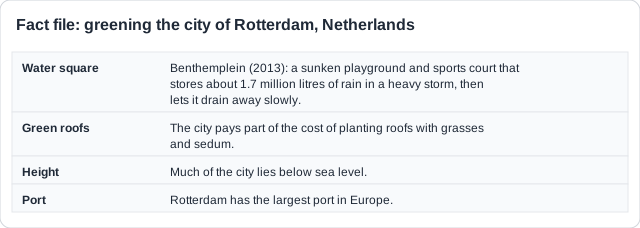
Figure 1 is a fact file on greening the city of Rotterdam.
Outline two environmental advantages of 'greening the city' as shown in Figure 1.
Model answer plan
See the mark-by-mark plan — for / against / judgement, with marking guidance — in study mode.