Sustainable urban planning at Higher Level: The same factors as SL, told through Freiburg's car-free Vauban district and the warning of Malaysia's Forest City. At HL, this leads on to compactness and mixed use (8.2.11), urban sustainability models (8.2.12) and green architecture (8.2.13), and to environmental justice: who gets the trees?
Practise this as you read
- Link every factor to the 3 Es.
- Judge a plan: who gains, who pays, what it costs the environment.
Free preview
This is the free notes preview
You're reading the free notes. Aimnova Pro unlocks the full study experience — and you can try it with your first topic free to keep:
- FlashcardsLock in vocabulary and key terms with spaced repetition.
- Practice questionsAnswer exam-style questions and get instant AI marking.
- Mock exams & past-paper vaultSit full mocks and see exactly how examiners award marks.
- Personalised study planA daily plan built around your exam date and weak areas.
A city that can keep going: Sustainable urban planning asks of every plan: is it good for the environment, can the city afford it, and is it fair?
The points to remember
- Sustainable urban planning meets people's needs now without harming future generations.
- It balances the 3 Es: environment (less pollution and waste), economy (jobs, a city that pays its way), equity (fair to all).
- A green city that pushes poorer people out is not sustainable.
- Factors: affordable homes, public transport, green space, safety, jobs and schools, renewables, recycling, energy efficiency, green buildings, community.
Remember it as: Green, paying its way, fair to all: the 3 Es.
Environment
- Less pollution and waste
- Fewer resources used
- Ecosystems protected
Economy
- Jobs and businesses
- A city that can pay its way
Equity
- Benefits shared fairly
- Homes and services for all
Real example: Vauban, a district of Freiburg, Germany, was built from the late 1990s on an old army barracks for about 5,500 people: few cars, energy-saving homes and a plan made with its future residents.
Memorize terms 3x faster
Smart flashcards show you cards right before you forget them. Perfect for definitions and key concepts.
A sustainable city starts with people: decent homes, safe streets and a way to reach work and school without a car.
Homes, transport and jobs
- Quality, affordable housing close to jobs and services.
- Integrated public transport: buses, trains and bikes linked, often on one ticket, so fewer car trips.
- Security: well-lit, busy streets; safe routes to walk and cycle.
- Education and employment within reach of every neighbourhood.
- Community involvement: residents help shape the plan, so it fits their needs and they support it.
Real example: Vauban's streets have almost no parked cars: residents who own one park it in garages at the edge and pay for the space. A tram has linked it to Freiburg's centre since 2006, and shops, a school and a market are within walking distance. The plan was drawn up with the residents' group Forum Vauban.
One factor, one effect: Say what the measure does: 'buses on their own lanes are quicker than cars, so people leave their cars at home and emissions fall'.
Parks and trees do more than look pleasant, but they are rarely shared out fairly.
Green space: benefits and fairness
- Green spaces cool the city, clean the air, soak up rain and give wildlife habitat.
- Social benefits: wellbeing, places to relax, play and meet, less isolation, pride in the area.
- Economic benefits: higher property values, visitors who spend money, lower cooling and medical bills, upkeep jobs, fewer flood costs.
- Poorer areas often have fewer trees: denser housing, less planting, and leafy areas cost more to live in.
- So poorer residents face higher cooling bills, more heat and noise, and worse health.
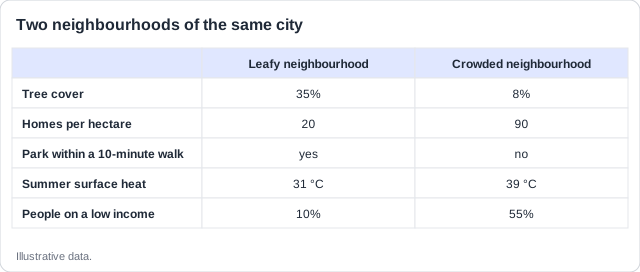
Say how, and say what kind: Describe a relationship with both variables: 'as the share on a low income rises, tree cover falls'. 'Improves health' alone is not enough: say how (more exercise, less stress). 'More tourism' alone is not an economic benefit: say that visitors spend money.
Real example: Vauban kept the old trees of the barracks and a green strip along the stream at its edge, and its car-free streets became safe places for children to play.
Know your predicted grade
Take timed mock exams and get detailed feedback on every answer. See exactly where you're losing marks.
A sustainable city uses less energy, water and materials, and makes less waste.
Energy, water and waste
- Renewable energy: solar panels, wind, district heating from waste or wood.
- Energy efficiency and green buildings: insulation, passive houses, green roofs.
- Reuse and recycle waste: separate collection, composting, recycled building materials.
- Save water: grey water for parks, rainwater harvesting, sustainable drainage.
- Cleaner transport: electric vehicle charging, cycle lanes, electric buses.
Cuts what the city uses
- Insulated, efficient buildings
- Grey water for parks
- Bikes, buses, electric vehicles
Cuts what the city throws away
- Recycling and composting
- Reused building materials
- Waste burned for heat
Real example: in Vauban all homes meet a low-energy standard and many are passive houses. The Solar Settlement's houses make more electricity than they use, and a wood-chip power plant heats the district.
Planners must prepare for two big pressures at once: more people, and a changing climate.
Planning for growth and a changing climate
- Population growth needs more homes, transport, water, schools and jobs; unplanned, it brings sprawl and slums.
- Climate change needs adaptation (flood defences, shade, cooling, drought-proof water) and mitigation (lower emissions).
- Some measures help with both: green space, public transport, efficient buildings.
- Limits on spreading: green belts and urban growth boundaries protect the land around a city.
- Read a growth map: which direction, along which roads, onto what land, and how fast.
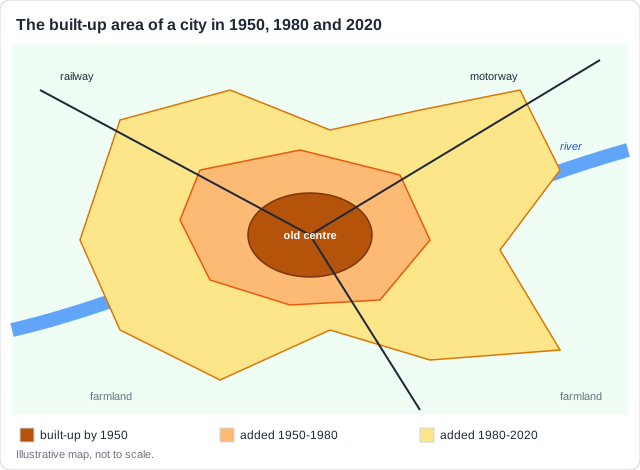
Describing a growth map: Say how much it grew, in which direction, along which routes and onto what land: 'the city grew most after 1980, outwards along the motorway and railway, onto farmland'.
Real example: Forest City, Malaysia, shows planning that ignored sustainability: four islands were built on reclaimed land over seagrass beds and mangroves for 700,000 people, but only a few thousand lived there by 2023.
Get feedback like a real examiner
Submit your answers and get instant feedback — what you did well, what's missing, and exactly what to write to score full marks.
How this comes up: Paper 2, Section B (a) (May 2026 HL): identify four ways to reduce the environmental impact of rural-urban migration [4]. Ways to stop migration do not count.
Millions of people move from the countryside to cities each year.
Identify four ways to reduce the environmental impact caused by rural-urban migration.
Model answer plan
See the mark-by-mark plan — for / against / judgement, with marking guidance — in study mode.