Environmental migration at Higher Level: This statement is Higher Level only. It explains how climate change, drought and land degradation push people to move, from sudden disasters to slow changes such as sea level rise, and how such migration can affect political stability.
Practise this as you read
- Distinguish sudden onset from slow onset causes, with real examples.
- Explain how a change in drought or flooding influences migration and political stability.
- Use one named example of an area people have left because of an environmental issue.
Free preview
This is the free notes preview
You're reading the free notes. Aimnova Pro unlocks the full study experience — and you can try it with your first topic free to keep:
- FlashcardsLock in vocabulary and key terms with spaced repetition.
- Practice questionsAnswer exam-style questions and get instant AI marking.
- Mock exams & past-paper vaultSit full mocks and see exactly how examiners award marks.
- Personalised study planA daily plan built around your exam date and weak areas.
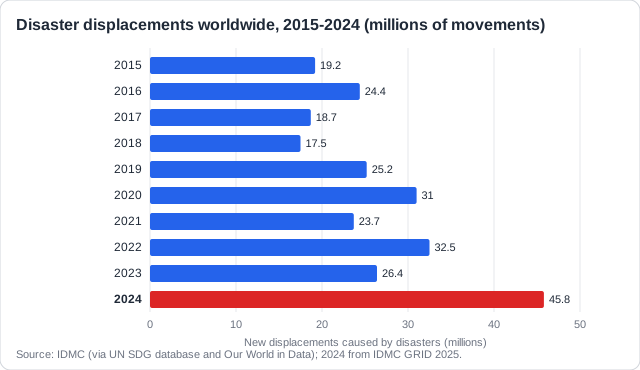
When the environment pushes people out: People who leave because of floods, droughts or rising seas are part of environmental migration, a growing part of population change. Most of them are internally displaced.
The points to remember
- Environmental migration: moving because the environment changes.
- Causes: climate change, drought, land degradation, floods and storms.
- Most people move within their own country (internally displaced); some cross borders.
- Moves can be temporary (back after a flood) or permanent (land lost for good).
- Climate migrants are not refugees under the 1951 Refugee Convention, so they have few legal rights.
Not legally refugees: News reports say 'climate refugees', but a refugee. This gap in the law is a key debate.
See how examiners mark answers
Answer exam-style questions with model answers. Learn exactly what earns marks and what doesn't.
A sudden onset disaster forces people out at once. When the same disaster keeps returning, short moves turn into permanent ones.
Sudden onset events
- Sudden onset events: flooding, droughts, forest fires, intensified storms.
- Homes, crops and roads are destroyed in hours or days.
- Most people move a short distance and return when they can.
- Repeated events wear people down until they leave for good.
Pakistan's floods, 2022
- Monsoon rain left about a third of the country under water
- 33 million people affected, at least 1,739 deaths
- About 8 million displaced, compared with 70,000 in 2021
Mozambique's repeated cyclones
- Cyclone Idai, March 2019: over 600 deaths, the city of Beira badly damaged
- Cyclone Kenneth six weeks later; Cyclone Freddy in 2023
- Each storm destroys crops and seed, so families move to towns for good
A slow onset change gives no single day of disaster. The land simply stops supporting the people who live on it.
Slow onset events
- Slow onset events: desertification, sea level rise, saltwater inundation.
- Migration from slow onset events is increasing.
- Land slowly stops supporting crops, animals or drinking water.
- People often leave one by one: young men first, to send money home.
- Moves are usually permanent: the land does not come back.
Sahel
- Years of drought and desertification: Lake Chad shrank by about 90% between the 1960s and the 1980s
Move south
- Cattle herders move south into farmland, adding to conflict with farmers in Nigeria's Middle Belt
Bangladesh coast
- Rising seas and saltwater inundation make rice fields and wells salty
Move to Dhaka
- Families leave for the capital and live in informal settlements
Drought can be both: A long drought builds up slowly, but a flash drought, which dries the soil in a few weeks, is sudden. Say which kind your example is.
Study smarter, not longer
Most students waste 40% of study time on topics they already know. Our AI tracks your progress and optimizes every minute.
For people on a low atoll, sea level rise threatens the whole country. Some governments now plan migration before it is forced.
Small island states
- Low islands face sea level rise, storm surges and salt in their fresh water.
- Tuvalu: about 9,600 people on atolls a few metres above the sea.
- Tuvaluans move to New Zealand and now Australia on special visas.
- Kiribati bought land in Fiji to grow food and, one day, perhaps to move to.
- Planned moves let people go with dignity, before a disaster forces them.
The threat
Tuvalu: storm surges and salt water reach homes, the pits where pulaka (a kind of taro) is grown, and the fresh water under the islands.
Leaving
In 2024 Tuvalu had more births than deaths, but its population fell by 1.7% because so many emigrated.
New Zealand
Since 2002 New Zealand's Pacific Access Category has given Tuvaluans and I-Kiribati residence places by ballot.
Australia
The Falepili Union treaty (2023): up to 280 Tuvaluans a year may move. The first ballot in 2025 drew 5,157 entries, about half the population.
Kiribati
In 2014 it bought about 6,000 acres on Vanua Levu, Fiji, for food and possible resettlement: 'migration with dignity'.
Environmental change does not only move people. When livelihoods collapse, it can also shake governments.
Migration and political stability
- Migration: no drinking water, poor hygiene, food shortages, lost farm income.
- Stability: a government that fails to help loses trust; protests and riots follow.
- Disease spreads where water and food run short.
- The poorest and marginalised suffer most, which can fuel violence.
- Migrants crowd into city slums, or raise tension with other countries.
- Money spent on the crisis slows the economy.
Drought
- Five rainy seasons in a row failed between 2020 and 2022, the worst drought in 40 years
Losses
- Crops failed and over half the animals died in some regions; about 7.8 million people affected
Migration
- About 1.17 million people left their homes for camps around towns such as Baidoa and Mogadishu (January 2021 to September 2022)
Stability
- Crowded camps, disease and a weak government that cannot help everyone leave people open to armed groups
Both halves of the question: If a question asks about migration and political stability, write about both: points on only one earn at most two of three marks. And write about people: animals moving does not count.
Practice with exam-style questions
Answer exam-style questions and get AI feedback that shows you exactly what examiners want to see in a full-marks response.
How this comes up: Paper 2: explain how a change shown on a map or graph, such as more droughts, can influence environmental migration and political stability [3]. Essays may ask you to use a named example of environmental migration.
Between 2020 and 2022 five rainy seasons in a row failed in Somalia, and about 7.8 million people, half the population, were affected.
Explain how drought can influence environmental migration and political stability in Somalia.
Model answer plan
See the mark-by-mark plan — for / against / judgement, with marking guidance — in study mode.