Managing growth indirectly at Higher Level: The same ideas as SL, with different places: Bangladesh, Iran, South Korea and Ireland's Great Famine. At HL, weigh choices against resources in a [9] essay, with named places on both sides.
Practise this as you read
- Link each policy to births, deaths or migration.
- Judge when choices matter more than resources.
Free preview
This is the free notes preview
You're reading the free notes. Aimnova Pro unlocks the full study experience — and you can try it with your first topic free to keep:
- FlashcardsLock in vocabulary and key terms with spaced repetition.
- Practice questionsAnswer exam-style questions and get instant AI marking.
- Mock exams & past-paper vaultSit full mocks and see exactly how examiners award marks.
- Personalised study planA daily plan built around your exam date and weak areas.
Managing growth without a population law: An indirect policy is not about births at all, yet it changes them. Schools, clinics, jobs and pensions change how many children people choose to have, how long they live and where they move.
The points to remember
- An indirect policy has another main aim (schools, clinics, jobs) but also changes births, deaths or migration.
- The main kinds: gender equality, education, public health, welfare and economic development.
- Most of them lower the birth rate; health care also lowers the death rate.
- Jobs and development change migration: jobs pull people in, a lack of them pushes people out.
- A direct policy aims straight at births: a limit on family size, or a bonus for each baby.
Remember it as: Teach girls, heal children, pay pensions: births fall by choice.
Direct
- Aims straight at births
- Singapore, 1972: 'Stop at Two'
- Fast, but can be forced
Indirect
- Aims at schools, health, jobs
- Bangladesh: stipends, clinics, jobs
- Slower, but chosen
Real example: Bangladesh never limited family size by law. Its fertility rate fell from about 6.9 children per woman in the early 1970s to about 2 by the 2010s. Tap each circle to see how.
Girls' school
- From 1994 rural girls were paid a stipend to stay in secondary school.
Health care
- Women health workers visited homes with contraception and vaccines.
Jobs for women
- Millions of women moved from villages to garment factories near Dhaka.
See how examiners mark answers
Answer exam-style questions with model answers. Learn exactly what earns marks and what doesn't.
Of all indirect policies, educating girls and raising the status of women lower the birth rate the most. It is often called the most effective long-term strategy.
The points to remember
- Girls who stay in school marry later and have their first child later, so they have fewer children.
- Educated women know about and use contraception and family planning.
- Women with jobs and careers delay children or choose fewer: a child costs them time and income.
- A higher status of women (equal rights, emancipation) means women decide how many children to have.
- Say education of women, or sex education. 'More education lowers fertility' alone is too vague.
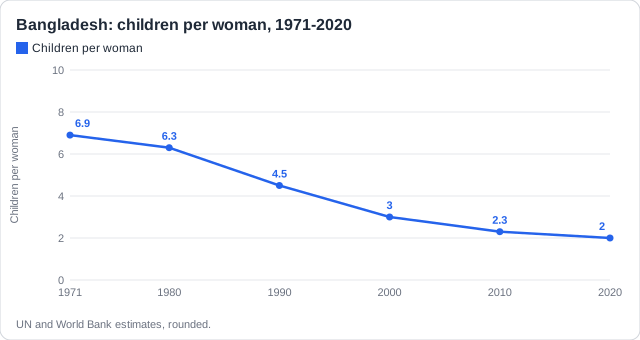
Real example: in Bangladesh, a stipend paid from 1994 kept rural girls in secondary school, on condition they stayed unmarried. Millions of women took jobs in garment factories, mostly from the 1980s on, and the Grameen Bank lent small sums to women to start businesses. Women married later and gained a say over family size.
Two traps: Write 'the education of women' or 'sex education', never just 'more education lowers fertility'.
A list of words (education, jobs, empowerment) earns little. Link each one to fewer births: 'women stay in school longer, so they marry later and have fewer children'.
Better health care lowers the death rate first. Then, as child mortality falls and family planning spreads, the birth rate falls too.
The points to remember
- Health care, vaccination, clean water, sanitation and better food cut the death rate.
- When fewer children die, parents need fewer births to be sure some children survive.
- Family planning clinics give contraception, advice and sex education, so fewer births are unplanned.
- Health workers in villages bring these services to people who cannot reach a hospital.
- Deaths fall first, births later, so the population grows fast for a while.
Iran, 1986
- About 7 children per woman
- Few clinics in villages
- Many children died young
Iran, 2000
- About 2 children per woman
- Thousands of village health houses
- Free contraception and advice
Real example: in the 1980s and 1990s Iran built thousands of village health houses, about 16,500 by 2004. From 1989 they gave free contraception. Child deaths fell, and Iran's fertility rate dropped from about 7 to about 2 in only 14 years, one of the fastest falls ever recorded.
Name the rate: Health care cuts the death rate first; female education cuts the birth rate. Say which rate each policy changes.
Study smarter, not longer
Most students waste 40% of study time on topics they already know. Our AI tracks your progress and optimizes every minute.
Money matters too. As a country grows richer, children cost more and bring in less, and pensions take the place of a large family in old age.
The points to remember
- The cost of raising and educating children rises, so parents choose fewer.
- With urbanisation and machines on farms, children stop being workers and become a cost.
- Pensions and care for the old mean parents no longer need many children to support them in old age.
- Economic stability cuts the need for children as workers; a recession delays births.
- Jobs pull migrants in; a lack of jobs pushes people to emigrate.
- Long working hours, costly housing and late marriage push the birth rate very low.
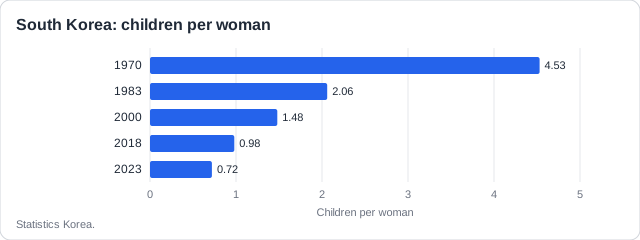
Real example: in South Korea families pay for private after-school classes, city flats cost a great deal, and working hours are long. Most women are educated and in careers, people marry late, and very few children are born outside marriage. In 2023 women had 0.72 children each.
Not credited: 'Low income from farming means they cannot afford many children' is not credited: in farming families children are often extra workers. Give the cost of raising children in a rich, urban society instead.
Are people's numbers set by their choices or by the resources around them? It depends on how developed a society is.
The points to remember
- Social: the role of women, age at marriage. Cultural: religion and family size norms.
- Political: population policies, wars. Economic: tax incentives, the cost of children, jobs.
- Resources: food, water, energy. A shortage raises deaths (famine) and pushes people to move.
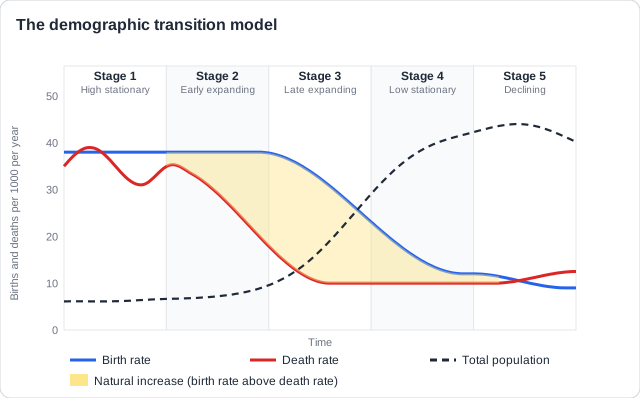
- In the later stages of the demographic transition, births are set mainly by social and economic choices.
- In the early stages, resources can still limit a population: famine, drought, disease.
- Technology and trade (importing food) raise the limits that resources set.
Resources limit
- Ireland, 1845-1852: potato blight
- About 1 million people died
- About 1 million emigrated
Choices limit
- South Korea: rich, well fed
- Births set by cost and careers
- 0.72 children per woman
Real example: in Ireland's Great Famine (1845-1852) a disease destroyed the potato crop most poor families lived on: about a million people died and about a million emigrated. Today a rich, well-fed country like South Korea shrinks by choice, not by hunger.
For a [9] essay: Give both sides with named places: social, cultural, political and economic factors (Japan, Kerala, China) and resources (a famine, a drought). Conclude: in the later stages choices dominate; only early-stage populations are still limited by food and water.
Practice with exam-style questions
Answer exam-style questions and get AI feedback that shows you exactly what examiners want to see in a full-marks response.
How this comes up: Paper 2, Section B (c) [9]: 'Discuss the validity of this statement' on what controls human numbers. Marked in bands: terms, breadth, named examples, both sides, a supported conclusion.
'Human population growth today is shaped more by people's choices than by the limits of the environment.'
Discuss the validity of this statement.
Model answer plan
See the mark-by-mark plan — for / against / judgement, with marking guidance — in study mode.