Population policies at Higher Level: The same ideas as SL, with different countries: Singapore, Iran, Hungary and Germany. At HL, read each policy through three lenses: the law that sets it, the money behind it, and whether it is fair.
Practise this as you read
- Law: Iran's 2021 law on contraception; Germany's Skilled Immigration Act.
- Economics: Hungary's loans; why a Baby Bonus is small against the cost of a child.
- Ethics: coercion, reproductive rights, and who decides.
Free preview
This is the free notes preview
You're reading the free notes. Aimnova Pro unlocks the full study experience — and you can try it with your first topic free to keep:
- FlashcardsLock in vocabulary and key terms with spaced repetition.
- Practice questionsAnswer exam-style questions and get instant AI marking.
- Mock exams & past-paper vaultSit full mocks and see exactly how examiners award marks.
- Personalised study planA daily plan built around your exam date and weak areas.
Steering a population on purpose: Population policies manage growth directly. They can be anti-natalist, pro-natalist, or aimed at migration.
The points to remember
- Anti-natalist policies aim to lower the birth rate: fewer children per family.
- Pro-natalist policies aim to raise the birth rate: more children per family.
- Migration policies control immigration (people arriving) and emigration (people leaving).
- They are direct: they target births or migrants on purpose.
- Governments act when growth is too fast (food, water, jobs run short) or too slow (ageing, too few workers).
- Health policies matter too: screening and public health lower the death rate, so people live longer and growth speeds up.
Remember it as: Fewer, more, or move: three ways to steer a population.
Each policy pulls on one or more levers in people's lives:
The five levers
- Cultural: change what a normal family looks like, with campaigns and posters.
- Religious: religious leaders back or oppose contraception and large families.
- Economic: payments, tax cuts, fines and loans.
- Social: childcare, schools, housing and health care.
- Political: laws, limits, bans and visa rules.
| Lever | How it works | Real example |
|---|---|---|
| Cultural | Campaigns change the normal family size | Singapore's 1972 'Stop at Two' posters |
| Religious | Leaders back or oppose contraception | Iran: religious leaders backed contraception in 1989 |
| Economic | Payments, tax cuts, loans | Hungary writes off a family loan after a third child |
| Social | Childcare, housing, help to marry | Singapore's Social Development Unit (1984) helped graduates meet and marry |
| Political | Laws, limits, visas | Germany's Skilled Immigration Act (2020) |
Get feedback like a real examiner
Submit your answers and get instant feedback — what you did well, what's missing, and exactly what to write to score full marks.
An anti-natalist policy lowers the birth rate. It suits a country whose population is growing faster than its food, water, jobs and schools.
Anti-natalist tools
- Laws and limits: a cap on children per family, with fines or lost jobs and benefits.
- Economic disincentives: taxes or higher fees for each extra child.
- Family planning: free contraception and advice, so couples can avoid unwanted births.
- Campaigns for later marriage and smaller families.
- Educating women and giving them jobs and careers: they marry later and want fewer children.
- Pensions and vaccination: parents no longer need many children for old age, or to replace children who die.
Real examples: Singapore and Iran. Singapore used price and rules (disincentives); Iran used voluntary family planning with religious support. Both cut births within a generation.
Singapore 1972
- 'Stop at Two': higher hospital fees for each extra birth, no paid maternity leave after the second child, school places favoured small families.
Singapore result
- The TFR fell from about 3.1 (1970) to below replacement, about 1.8, by 1977.
Iran 1989
- Free contraception, classes for every couple before marriage, rural health workers, and religious leaders backing it.
Iran result
- The TFR fell from more than 6 in the mid-1980s to about 2 by 2000.
The side effects: Singapore overshot: births kept falling below replacement, so it reversed the policy in 1987. Iran is now ageing faster than almost any country, so it reversed too, from 2012. A cut in births today means fewer workers in 20 to 30 years.
A pro-natalist policy raises the birth rate. It suits a country whose total fertility rate is below the replacement level.
Pro-natalist tools
- Money: baby bonuses, tax cuts and allowances for each child.
- Social help: free or cheap childcare, schooling and subsidised housing.
- Work help: long paid maternity and paternity leave, flexible hours for parents.
- Campaigns and religious messages that praise larger families.
- Banning abortion or limiting contraception: coercive, and widely seen as unethical.
- Why: an ageing population, a high old-age dependency ratio, too few workers, a shrinking country.
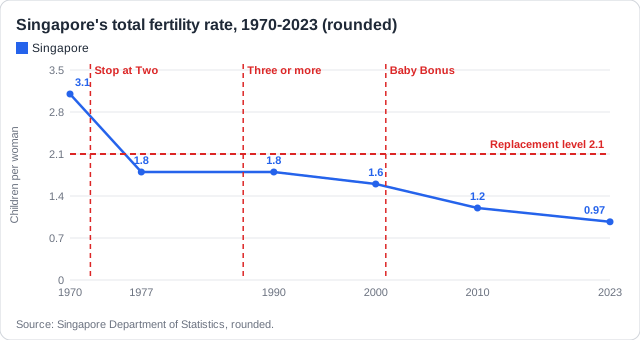
Real examples. Singapore switched in 1987 to 'Have three or more if you can afford it', and has paid a Baby Bonus since 2001, yet its TFR fell to 0.97 in 2023. Housing and schooling cost a lot, most women have careers and long working hours, people marry later, and the bonus is small against the cost of a child: it shifts when couples have children more than how many. Hungary's 2019 plan writes off a large family loan after a third child, and mothers of four or more pay no income tax for life. Its TFR rose from 1.23 (2011) to about 1.6 (2021).
Coercion and a trap: Iran, from 2012: the government reversed its family planning, and a 2021 law restricts free contraception and sterilisation. Pro-natalist laws that limit choice raise the same rights questions as anti-natalist ones.
A graph shows a country's fertility rate projected to rise? Give pro-natalist policies (money, leave, childcare). Do not give migration: it changes how many people live there, not how many children each woman has.
Learn what examiners really want
See exactly what to write to score full marks. Our AI shows you model answers and the key phrases examiners look for.
Migration policies change growth by controlling who arrives and who leaves. They matter most in countries whose births no longer replace their deaths.
Migration policies
- Immigration rules decide who may arrive: quotas, points systems, work visas, refugee places.
- Countries with ageing populations invite young workers to fill jobs and slow population decline.
- Immigrants are mostly of working age, and their families add children, so births can rise too.
- Emigration: some governments send workers abroad; poor jobs and pay push young people out.
- Emigration of young adults lowers a country's growth and its future births.
- Migration changes population size, not the fertility rate (children per woman).
Immigration policies
- Points systems and quotas
- Work visas for jobs in short supply
- Places for refugees
- Families allowed to join
Emigration
- Labour export schemes
- Young people pushed out by few jobs
- Money sent home
- Fewer births at home
Real example: Germany. Deaths have outnumbered births every year since 1972, so its population grows only through immigration. About 890,000 asylum seekers arrived in 2015, many from Syria, and the Skilled Immigration Act (2020) recruits workers from outside the EU. Emigration: after Poland joined the EU in 2004, about 2 million Poles, mostly young adults, moved to other EU countries, and Poland's births fell.
In a 'discuss policies' answer: Migration counts, but only for a small share: one or two points, each linked to growth. Most points should be about births.
| Country | Aim and tool | Did it work? |
|---|---|---|
| Singapore | Fewer, then more: fees, then a Baby Bonus | Fewer: yes, fast. More: no, TFR 0.97 |
| Iran | Fewer: voluntary family planning | Yes: TFR more than 6 to about 2 |
| Hungary | More: loans written off, tax breaks | Partly: 1.23 to about 1.6, then down |
| Germany | Grow: skilled immigration | Yes: population still growing |
Do direct policies work?
- Coercive policies (limits, bans) change births fast, but with human costs.
- Births often fell before the policy: development was already lowering fertility.
- Pro-natalist money often changes when couples have children more than how many.
- Policies fail through lack of funding, cultural resistance or conflicting factors such as high house prices.
- Population momentum: a young population keeps growing for decades after fertility falls.
Ethics, a real case: during India's 1975-77 Emergency, about 6 million men were sterilised in 1976 alone, many under pressure or force. It turned many people against family planning for years.
For intervention
- Sustainability needs a stable population
- Scarce resources affect everyone
- It prevents future suffering, such as famine
- Collective responsibility for the future
Against intervention
- Reproductive rights are human rights
- Cultural and religious values
- Coercion is unethical
- Consumption matters more than numbers
- Population control has a colonial and racist history
Two traps: Asked how policies change growth? Link each one to births, deaths or family size. A policy's general effect on the economy is not credited, and neither is judging the policy.
Coercive limits, rewards and voluntary family planning are different: name which kind.
Never wonder what to study next
Get a personalized daily plan based on your exam date, progress, and weak areas. We'll tell you exactly what to review each day.
Could nature stabilise our numbers instead of policies? A stable population needs births to fall to match deaths.
Natural limits or policies?
- Malthus: population grows faster than food, so famine, disease and war cut it back.
- Boserup: pressure on food drives new technology, so the food supply keeps ahead.
- Natural limits: disease and pandemics, famine, water shortage, disasters, pollution, too little land.
- Technology pushes limits back: high-yield crops, irrigation, desalination, water treatment, vertical farming.
- Natural limits cause crashes and recovery, not a steady size; a stable size comes from falling birth rates.
- A stable population keeps the same size: births = deaths, with no net migration.
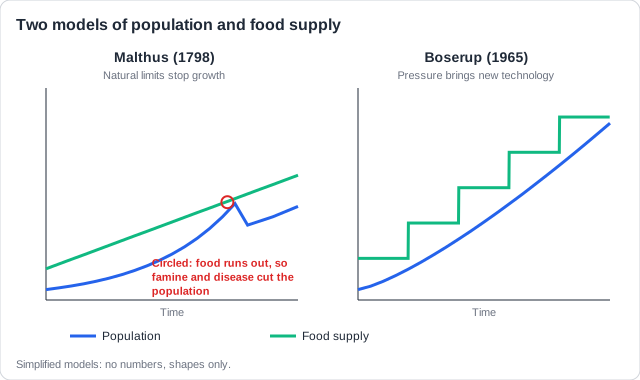
Remember it as: Malthus: the limits win. Boserup: new ideas win.
Real examples. Ethiopia's 1983-1985 famine killed up to about 1 million people, yet its population has grown from about 40 million then to about 130 million: the limit caused a crash, not a stop. Israel, mostly desert, now gets most of its drinking water from desalination: technology moved a water limit that once looked fixed.
A strong conclusion: Technology has pushed many natural limits back, so they rarely stabilise a population. Falling birth rates, from development and policies, do. But a finite planet must have an outer limit.
How this comes up: Paper 2, Section B (b) [7]: discuss policies that raise and lower growth. Up to four points a side, migration two at most, and one conclusion line.
Singapore has used policies first to lower and then to raise its birth rate.
Discuss how government policies can change the growth rate of a country's population.
Model answer plan
See the mark-by-mark plan — for / against / judgement, with marking guidance — in study mode.