Preventing waste at Higher Level: The same ideas as SL, with different places: Rwanda, France, Sweden and Fresh Kills. At HL, judge whole programmes: which level of the model they act at, and whether that makes them sustainable.
Practise this as you read
- Place each strategy at a level of the model.
- Weigh a programme's strengths against its limits.
Free preview
This is the free notes preview
You're reading the free notes. Aimnova Pro unlocks the full study experience — and you can try it with your first topic free to keep:
- FlashcardsLock in vocabulary and key terms with spaced repetition.
- Practice questionsAnswer exam-style questions and get instant AI marking.
- Mock exams & past-paper vaultSit full mocks and see exactly how examiners award marks.
- Personalised study planA daily plan built around your exam date and weak areas.
Stop it, or clean it up: A preventative strategy deals with waste before it causes harm. A restorative strategy repairs harm already done. Prevention is the more sustainable of the two.
The points to remember
- A preventative strategy stops waste being made, or stops it reaching the environment.
- A restorative strategy cleans up waste that is already there and repairs the damage.
- Prevention works before the damage; restoration works after it.
- The most sustainable choice of all: use and buy less, so less waste is made.
Remember it as: A tap left running: turn it off before you mop the floor.
Preventative
- Before the damage
- Make less waste
- Stop waste getting out
Restorative
- After the damage
- Clean up waste
- Repair habitats
Real example: Rwanda banned plastic bags in 2008: preventative, because fewer bags are made and used. On the last Saturday of each month, people join Umuganda and clear litter: restorative.
Know your predicted grade
Take timed mock exams and get detailed feedback on every answer. See exactly where you're losing marks.
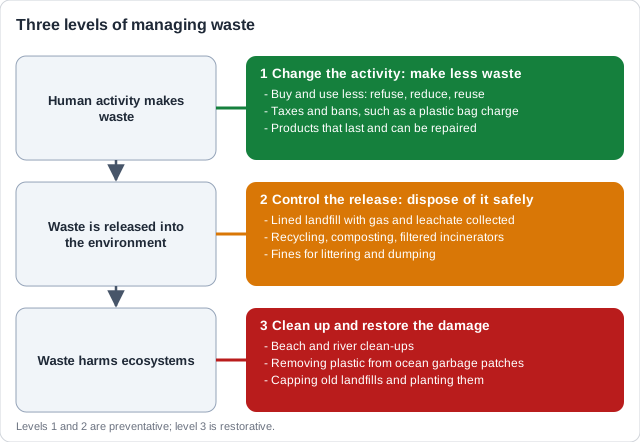
The pollution management model shows where action can happen.
The three levels
- Level 1, change human activity: make less waste (campaigns, taxes, bans, longer-lasting goods).
- Level 2, control the release: dispose of waste safely (lined landfill, recycling, composting).
- Level 3, clean up and restore: litter picks, ocean clean-ups, capping and planting old landfills.
- Levels 1 and 2 are preventative; level 3 is restorative.
- Level 1 is the most sustainable, but changing people's habits is slow, so most action is at levels 2 and 3.
Level 1: change
- France, 2016: big supermarkets may not throw away unsold food; they must give it to charities.
Level 2: control
- Sweden sends less than 1% of household waste to landfill; the rest is recycled or burned for energy.
Level 3: restore
- Baltimore's Mr Trash Wheel, a water-powered machine, has scooped rubbish out of the harbour since 2014.
In a [9] essay: Cover all three levels, each with a named example, then judge which works best. Level 1 is best in theory, but people's habits change slowly.
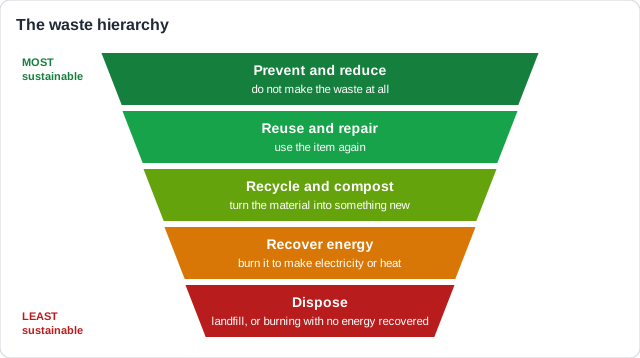
The waste hierarchy puts the same idea in order: the best waste is waste that is never made.
The points to remember
- The waste hierarchy ranks options from best to worst.
- Prevent/reduce > reuse > recycle/compost > recover energy > dispose.
- Even recycling uses energy and makes some pollution, so reducing waste beats it.
- Extra Rs: refuse what you do not need; rot (compost) food and garden waste.
- Products that last and can be repaired keep waste out of the bin for years.
Remember it as: Refuse, reduce, reuse, recycle, rot: in that order.
Real example: ReTuna, a shopping centre in Eskilstuna, Sweden, opened in 2015 and sells only repaired and second-hand goods. People drop off unwanted items, and the shops fix and resell them: reuse and repair, near the top of the hierarchy.
Why reduce beats recycle: Recycling still needs collection lorries, energy and water, and some material is lost each time. Reducing uses no extra resources at all.
Get feedback like a real examiner
Submit your answers and get instant feedback — what you did well, what's missing, and exactly what to write to score full marks.
Governments, companies and people can use many preventative tools. Each one makes it easier, cheaper or more normal to make less waste.
Preventative tools
- Education and campaigns so people buy, use and throw away less.
- Laws and bans: ban single-use plastics; limit packaging; set waste limits for companies.
- Taxes and charges: a bag charge, a tax on waste or packaging, pay-as-you-throw bins.
- Incentives: money back on returned bottles; grants for repair or home composting.
- Better design: goods that last, can be repaired or reused; biodegradable packaging.
- Better facilities: easy places to donate, reuse and recycle.
Change minds
- Awareness campaigns
- School lessons on waste
- Labels on what to recycle
Change prices
- Bag and packaging charges
- Waste taxes
- Deposits on bottles
Change rules
- Bans on single-use plastic
- Limits on packaging
- Repair rules for goods
Real example: France's 2020 anti-waste law bans shops from destroying unsold clothes and other non-food goods (from 2022), and since 2021 phones and laptops carry a repairability score.
Name a strategy, not an action: Asked for strategies? 'Recycle clothes' is an action, not a strategy. Say who does what: 'the government subsidises clothes-donation points' or 'a campaign encourages people to repair'.
Some waste will always be left. Disposing of it safely is still preventative: it stops leachate and gases reaching the environment.
Making a landfill safer
- Line the landfill with clay or a plastic liner, or build it on impermeable rock.
- Collect and treat leachate, the polluted liquid that drains out of waste.
- Collect methane and burn it for energy; this also stops fires and explosions.
- Build landfills away from rivers, groundwater, homes and valuable ecosystems.
- Cover and compact waste daily so litter does not blow away; screen it from view.
- Send less waste there in the first place: recycle, compost or burn it for energy.
Open dump
- No liner: leachate soaks into soil
- Gas builds up: fires
- Litter blows away
Sanitary landfill
- Liner and leachate pipes
- Methane collected for energy
- Daily soil cover
Real example: Mexico City's Bordo Poniente landfill took about 12,000 tonnes of waste a day until it closed in 2011. Built without a proper liner, it let leachate seep towards the groundwater; a plan followed to capture its methane for energy.
Learn what examiners really want
See exactly what to write to score full marks. Our AI shows you model answers and the key phrases examiners look for.
Restorative strategies are needed where damage is already done, but they come too late for much of it.
Why prevention is more sustainable
- Restoration: clean-ups of beaches, rivers and oceans, landfill mining, capping and replanting.
- It works after the harm: species may already be lost and habitats hard to restore.
- It has to be repeated while waste keeps arriving, using more energy and resources.
- Prevention protects biodiversity and keeps ecosystems away from tipping points.
- Prevention cuts how much and what kind of waste is released, so less harm to species.
Remember it as: Prevention stops the harm; restoration chases it.
Real example: Fresh Kills, on Staten Island, New York, was once the world's largest landfill. It closed in 2001 and is being turned into Freshkills Park, almost three times the size of Central Park. The waste had to be capped, and its gas and leachate will need treatment for decades.
Two traps: Do not say prevention is better because it is cheaper: that point is not credited. Give the ecological reason: less waste released, biodiversity protected, tipping points avoided.
Asked for one preventative and one restorative strategy? Safest: preventative stops waste being made (a ban, a tax, a campaign); restorative removes waste already in nature (a clean-up). Recycling and incineration deal with waste already made, so never give them as preventative.
How this comes up: Paper 1: a fact file on a city's or country's waste programme, then 'Evaluate' [6]: up to four points for, four against, and a conclusion.
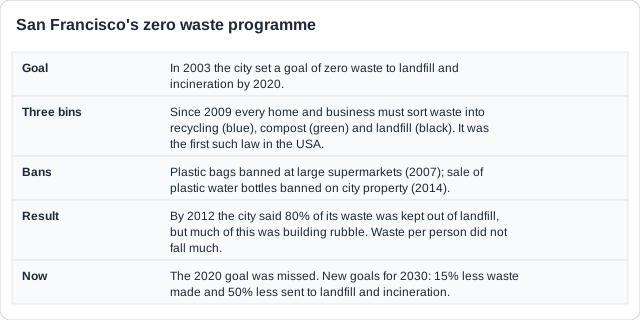
Figure 1 is a fact file on San Francisco's zero waste programme.
Evaluate the sustainability of San Francisco's zero waste programme.
Model answer plan
See the mark-by-mark plan — for / against / judgement, with marking guidance — in study mode.