When waste becomes pollution at Higher Level: The same statement as SL, with different real cases: Lake Washington, landfill newspapers, iodine-131 and plutonium-239, the Stockholm Convention and sea turtles. At HL, link persistence to the nutrient and carbon cycles, and to who should pay to clean it up.
Practise this as you read
- Explain why a pollutant persists: biodegradability or half-life.
- Describe its impacts on organisms.
Free preview
This is the free notes preview
You're reading the free notes. Aimnova Pro unlocks the full study experience — and you can try it with your first topic free to keep:
- FlashcardsLock in vocabulary and key terms with spaced repetition.
- Practice questionsAnswer exam-style questions and get instant AI marking.
- Mock exams & past-paper vaultSit full mocks and see exactly how examiners award marks.
- Personalised study planA daily plan built around your exam date and weak areas.
Too much, too fast: Pollution is not about any waste at all: it is about waste added faster than nature can deal with it.
Absorbed or polluted?
- Ecosystems can absorb some waste: decomposers break it down and water dilutes it.
- Pollution happens when harmful substances are added faster than they can be broken down or made harmless.
- Pollution can be matter (chemicals, sewage, plastic) or energy (noise, light, heat).
- Pollution is a direct harm: it damages or kills organisms, which weakens food webs.
- The same waste can be absorbed in small amounts but overwhelm an ecosystem in large ones.
Remember it as: Pollution is too much, too fast for nature to clean up.
Matter and energy
- Plastic: an estimated 8 million tonnes a year enters the oceans; turtles mistake bags for jellyfish.
- Air: factory smoke causes smog and acid rain.
- Water: fertilisers cause algal blooms that kill fish.
- Energy: noise disturbs whales; light confuses migrating birds.
Real example: from 1941 to 1963 treated sewage was piped into Lake Washington, Seattle. Its nutrients came in faster than the lake could process them, and algae turned the water murky. Once the sewage was diverted, between 1963 and 1968, the lake cleared within a few years.
Stop wasting time on topics you know
Our AI identifies your weak areas and focuses your study time where it matters. No more overstudying easy topics.
How quickly an ecosystem can deal with waste depends first on how easily living things can break it down.
Biodegradability
- Biodegradability = how quickly a substance is broken down by living things (bacteria, fungi).
- Food, paper and cotton are biodegradable: they rot in weeks or months.
- Plastics, glass and metals have low biodegradability: they last for centuries.
- Plastic does not rot: it breaks into smaller pieces, down to microplastics under 5 mm.
- Breakdown is faster with warmth, water and oxygen; slow in cold, dry, airless places.
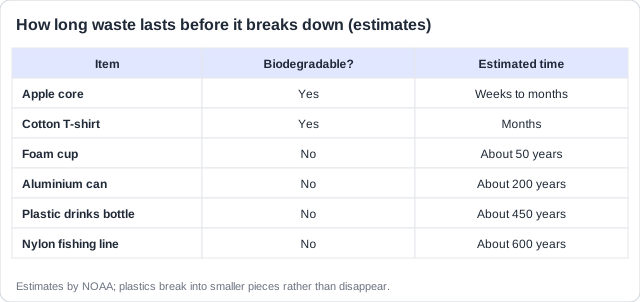
Real example: when the archaeologist William Rathje dug into US landfills, he found newspapers decades old that could still be read: without oxygen and water, even biodegradable waste breaks down very slowly.
Breaking up is not breaking down: Plastic that breaks into tiny pieces has not biodegraded. The microplastics are still plastic, spread further and are easier for animals to swallow.
Half, then half again: Some pollutants decay or lose their activity over time. Their half-life tells you how long they stay harmful.
Half-life
- Half-life = the time for half of a substance to decay or lose its activity.
- After one half-life 50% is left, after two 25%, after three 12.5%.
- A long half-life means the substance stays harmful for a long time.
- Radioactive waste: caesium-137 about 30 years; iodine-131 about 8 days.
- Pesticides too: DDT in soil has a half-life of about 2 to 15 years.
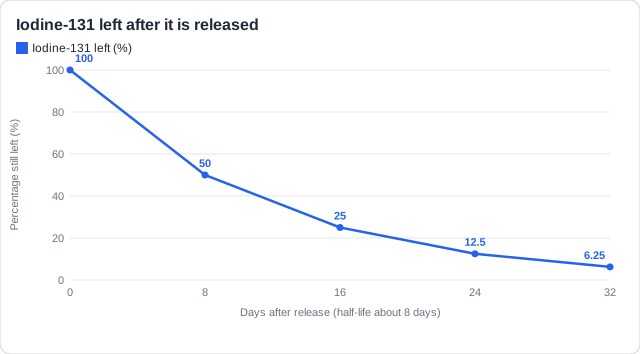
Real example: iodine-131, with a half-life of about 8 days, is mostly gone within months of a nuclear accident. Plutonium-239, with a half-life of about 24,000 years, stays dangerous for hundreds of thousands of years, so its waste must be stored deep underground.
See how examiners mark answers
Answer exam-style questions with model answers. Learn exactly what earns marks and what doesn't.
When a pollutant lasts a long time, every new amount adds to what is already there. That is why persistent pollutants cause long-term harm.
Persistent pollutants
- Persistent pollutants have long half-lives or low biodegradability.
- They accumulate: in soil, water and sediments, and in the bodies of living things.
- They build up in an organism (bioaccumulation) and up the food chain (biomagnification).
- Top predators carry the most and suffer most: poor health, fewer young.
- Examples: DDT, PCBs, mercury, plastics and the toxins they carry.
- People are exposed through food, water and air; some chemicals disturb hormones.
Non-persistent
- Breaks down fast
- Short half-life
- Harm is local and short
- Food waste, sewage
Persistent
- Breaks down slowly or not at all
- Long half-life
- Builds up for years
- DDT, PCBs, mercury, plastics
Real example: in 2001 countries signed the Stockholm Convention to ban or limit the worst persistent pollutants, the 'dirty dozen'. DDT was allowed only to control malaria, because it lasts for years in soil and builds up in birds of prey.
What non-biodegradable waste does: Questions ask for the impacts of non-biodegradable waste on ecosystems. Each impact needs the harm and what it does to organisms.
Impacts on ecosystems
- Animals swallow plastic, feel full and starve.
- Animals get tangled in nets, bags and rings and drown or are injured.
- Microplastics and chemicals bioaccumulate and biomagnify: fewer young, death.
- Heavy metals and chemicals leak into soil, water and groundwater.
- Waste covers soil and habitats: less light, less photosynthesis, less growth; broken glass injures.
- Fewer of one species means less food for the next trophic level.
Real example: sea turtles eat jellyfish, and a floating plastic bag looks like one. A swallowed bag can block the gut, so the turtle feels full, stops eating and starves.
What does not score: Greenhouse gases are not an impact of non-biodegradable waste here. 'Biodiversity falls' or 'it is toxic' alone score nothing: say how organisms are harmed.
Study smarter, not longer
Most students waste 40% of study time on topics they already know. Our AI tracks your progress and optimizes every minute.
How this comes up: Paper 2, Section A: one mark for why plastic is a worse pollutant than other waste, then impacts on ecosystems.
A beach clean in Cornwall collects food scraps, paper and plastic bottles.
Identify one reason why most plastics may be considered more serious pollutants than the food and paper.
Model answer plan
See the mark-by-mark plan — for / against / judgement, with marking guidance — in study mode.
The next part asks what that plastic does once it is in the sea.
Describe two negative impacts of plastic waste on marine ecosystems.
Model answer plan
See the mark-by-mark plan — for / against / judgement, with marking guidance — in study mode.