Household waste at Higher Level: The same statement as SL, with different real data: the USA's waste in 2018, a lined paper cup and EU plastic packaging. At HL, read a composition chart and say what it means for how the waste can be treated.
Practise this as you read
- List the guide's nine kinds of household waste.
- Sort them into biodegradable and not.
Free preview
This is the free notes preview
You're reading the free notes. Aimnova Pro unlocks the full study experience — and you can try it with your first topic free to keep:
- FlashcardsLock in vocabulary and key terms with spaced repetition.
- Practice questionsAnswer exam-style questions and get instant AI marking.
- Mock exams & past-paper vaultSit full mocks and see exactly how examiners award marks.
- Personalised study planA daily plan built around your exam date and weak areas.
A bit of everything: Solid domestic waste is never one thing. Open any bin and you find many materials.
What is in household waste
- Solid domestic waste (SDW) is the solid waste thrown away by homes.
- With waste from shops, offices and schools it is called municipal solid waste.
- It is very mixed: paper, cardboard, glass, metal, plastics and organic waste.
- Organic waste comes from the kitchen (peel, leftovers) and the garden (grass, leaves).
- It also holds packaging, clothing and construction debris from home repairs.
- Food and green waste is the biggest part worldwide: about 44%.
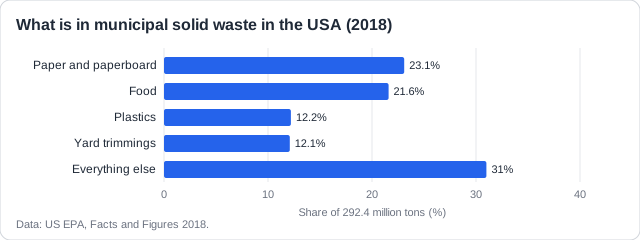
Real example: in the USA in 2018, paper and paperboard (23.1%) was a bigger share of waste than food (21.6%). Food and yard trimmings together made up a third.
Remember it as: Paper, plastic, glass, metal, food and garden, plus packs, clothes and rubble.
Get feedback like a real examiner
Submit your answers and get instant feedback — what you did well, what's missing, and exactly what to write to score full marks.
The contents split into two groups: what living things can break down and what they cannot. This decides what happens to each item in a landfill or the sea.
Biodegradable or not
- Biodegradable: broken down by living things such as bacteria and fungi.
- Biodegradable SDW: food, garden waste, paper, cardboard, wood, cotton.
- Non-biodegradable: plastics (PET bottles, polystyrene), glass, metals (aluminium, steel).
- Also non-biodegradable: e-waste, batteries, synthetic textiles (polyester, nylon), rubble.
- Paper and food are not non-biodegradable: they rot.
Biodegradable
- Food: peel, leftovers
- Garden: grass, leaves
- Paper and cardboard
- Cotton, wool, wood
Non-biodegradable
- Plastics: PET, polystyrene
- Glass
- Metals: aluminium, steel
- E-waste, batteries, polyester, rubble
Real example: a paper coffee cup looks biodegradable, but a thin plastic lining keeps it from leaking. The paper rots; the lining does not, so the cup is hard to compost or recycle.
Two materials, one mark: Asked to state two non-biodegradable materials? Both must be right for the mark. Food, garden waste and paper score nothing: they rot.
The parts people forget: Packaging, clothes and rubble from home repairs are also in the guide's list. They are made of several materials at once.
Packaging, clothing and debris
- Packaging is not one material: paper, plastic, glass, wood and metal.
- The EU made 186.5 kg of packaging waste per person in 2022.
- Clothing is cotton or wool (biodegradable) or polyester and nylon (plastic fibres).
- Construction debris from home repairs: bricks, tiles, plaster, old sinks.
- Mixed items, such as a paper cup lined with plastic, are hard to sort.
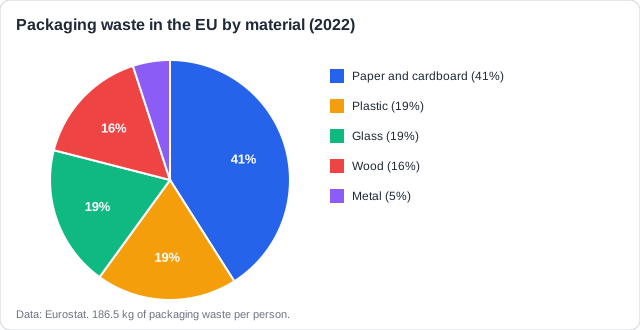
Real example: in 2022 each person in the EU threw away 36.1 kg of plastic packaging, and only 14.7 kg of it was recycled.
Learn what examiners really want
See exactly what to write to score full marks. Our AI shows you model answers and the key phrases examiners look for.
How this comes up: Paper 2, Section A: one mark for two materials in household waste that do not biodegrade.
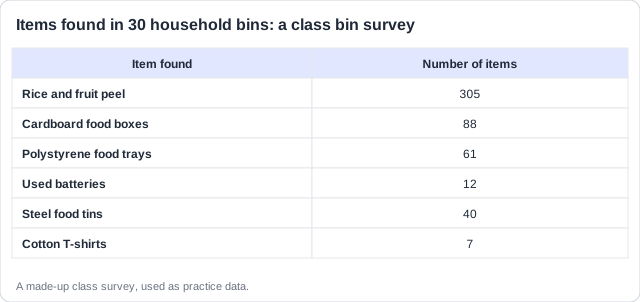
A class sorted the contents of household bins (Figure 1).
State two non-biodegradable materials present in the solid domestic waste.
Model answer plan
See the mark-by-mark plan — for / against / judgement, with marking guidance — in study mode.