Nuclear power at Higher Level: This statement is Higher Level only. It asks how nuclear power works and why it is both non-renewable and low-carbon, then weighs its low running cost and steady output against its high building cost, uranium mining, thermal pollution, accidents and radioactive waste.
Practise this as you read
- Suggest an advantage and a disadvantage of nuclear power in a named country.
- Evaluate nuclear power as a way to cut carbon emissions.
Free preview
This is the free notes preview
You're reading the free notes. Aimnova Pro unlocks the full study experience — and you can try it with your first topic free to keep:
- FlashcardsLock in vocabulary and key terms with spaced repetition.
- Practice questionsAnswer exam-style questions and get instant AI marking.
- Mock exams & past-paper vaultSit full mocks and see exactly how examiners award marks.
- Personalised study planA daily plan built around your exam date and weak areas.
Splitting atoms to make electricity: A nuclear power station makes heat by nuclear fission. The heat makes steam, and the steam drives turbines, just as in a coal power station, but nothing is burned.
The points to remember
- Fuel: uranium-235 (or plutonium-239), mined, then enriched and made into fuel rods.
- Fission: a neutron splits a nucleus, releasing heat and more neutrons: a chain reaction.
- Control rods absorb neutrons to control the reaction; a moderator slows neutrons.
- The heat turns water to steam, which spins turbines and generators.
- Cooling water from a river or the sea turns the steam back into water.
- Tiny fuel, huge energy: uranium gives about 20,000 times the energy of the same mass of coal.
Fuel
Flamanville 3, France (connected to the grid on 21 December 2024): rods of enriched uranium pellets.
Fission
Neutrons split uranium-235; a chain reaction releases heat.
Control
control rods and a water moderator keep the reaction steady.
Steam
The heat turns water into steam that spins a turbine and a 1,650 MW generator.
Cooling
Seawater from the English Channel cools the steam back into water.
| Kind of reactor | What it means |
|---|---|
| Conventional fission reactors | today's reactors, using enriched uranium |
| Breeder reactors | make more fuel than they use; some designs can use thorium |
| small modular reactors | smaller and possibly cheaper and safer; only a few running so far |
| Fusion (future) | joins light nuclei such as hydrogen; no commercial power station yet |
Study smarter, not longer
Most students waste 40% of study time on topics they already know. Our AI tracks your progress and optimizes every minute.
Nuclear power sits between fossil fuels and renewables: like coal it uses a mined fuel, but like wind it is low-carbon.
Non-renewable but low-carbon
- Non-renewable: uranium is a finite metal that must be mined.
- Low-carbon: no carbon dioxide while running; life-cycle emissions about as low as wind.
- Low-carbon is not the same as renewable.
- About 9% of the world's electricity in 2024; France made 67% of its electricity this way.
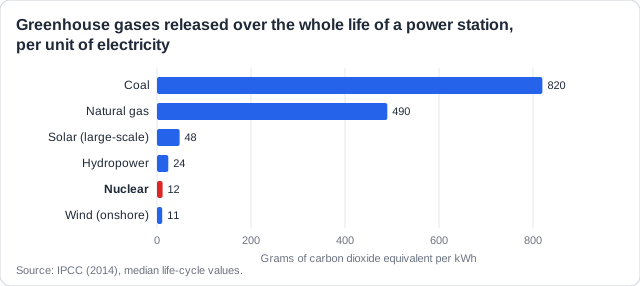
Real example: France made 361.7 of its 539.0 TWh of electricity from nuclear power in 2024, about 67%, so its electricity is among the lowest-carbon in Europe. The small life-cycle emissions come from mining, building and taking stations apart, not from running them.
Low-carbon, not renewable: Do not call nuclear power renewable. It is low-carbon, but its fuel, uranium, is a finite metal that is mined and will run out.
Most of the cost of nuclear power is paid before a single unit of electricity is made.
Expensive to build, cheap to run
- High construction costs, often far over budget and years late.
- Once built: low-cost electricity, because fuel is a small part of the cost.
- Constant output in any weather: about 90% capacity factor, good for baseload.
- Small land area and a long life: 40 to 60 years or more.
- Decommissioning at the end of its life is slow and expensive.
Building: Flamanville 3
- Started in 2007
- Connected in December 2024, 12 years late
- Cost rose from 3.3 to over 13.2 billion euro
Running: Barakah, UAE
- Four reactors, all running by September 2024
- 5,600 MW, about a quarter of the UAE's electricity
- Steady output day and night in any weather
A station runs at about 90% of its full output over a year (its capacity factor), far more than wind or solar, so it suits baseload supply. At the end of its life comes decommissioning, which can take decades.
Practice with exam-style questions
Answer exam-style questions and get AI feedback that shows you exactly what examiners want to see in a full-marks response.
Nuclear power harms the environment at both ends of the process: where the uranium is mined, and where the station's cooling water goes.
Mining and thermal pollution
- Uranium mining leaves radioactive tailings, dust and radon gas.
- It can pollute water and harm miners' and neighbours' health.
- Thermal pollution: warm cooling water is released into rivers or the sea.
- Warmer water holds less dissolved oxygen and changes water chemistry, stressing fish.
Mining
- Navajo Nation, USA, 1944-1986: about 30 million tons of uranium ore mined; over 500 mines were abandoned, leaving tailings and radon
Harm
- Homes and water sources near the old mines still have high radiation; the US government is paying to clean them up
Warm water
- France, summer 2022: rivers such as the Rhone were so warm that plants had to cut output, because French law limits thermal pollution
Why
- Warmer water holds less dissolved oxygen and changes the water's chemistry, so fish and other river life suffer
France's bad year: In 2022 French nuclear output fell to 279 TWh, its lowest in over thirty years: about half the reactors were shut for repairs, and hot rivers cut output further.
Every reactor makes radioactive waste. The worst of it, high-level waste, must be kept away from people and water for longer than human history.
Radioactive waste
- Radioactive waste is produced; high-level waste stays dangerous for thousands of years.
- Spent fuel cools for years in pools, then goes into thick steel and concrete casks.
- It is stored indefinitely in containers that shield the environment from radiation.
- Plan for the long term: deep geological disposal, sealed in bedrock.
- Spent fuel can be misused for weapons (proliferation) or attacked, so it must be guarded.
Pellet
Onkalo, Finland: the spent fuel itself is a hard ceramic that holds most of its radioactivity.
Canister
It is sealed in a thick copper canister with a cast-iron insert.
Clay
Each canister sits in a hole packed with bentonite.
Bedrock
The holes are 400-430 m down in ancient crystalline bedrock, built to last 100,000 years.
Real example: Onkalo is the world's first deep disposal site for spent fuel. After a trial run in 2024-25, the first disposal hole was drilled in August 2026. It has room for about 3,250 canisters. Elsewhere waste waits in casks at power stations, and proliferation and theft must be guarded against.
Feeling unprepared for exams?
Get a clear study plan, practice with real questions, and know exactly where you stand before exam day. No more guessing.
Two accidents shaped how the world sees nuclear power.
The risk of accidents
- Accidents are rare, but one accident can be catastrophic.
- Radiation spreads across borders; land may be left empty for decades.
- Accidents change policy: some countries closed reactors, others kept building.
- Low probability, high consequence, weighed against the certain harm of climate change.
- Technocentrists often support nuclear; many ecocentrists oppose it.
Chernobyl, Ukraine, 1986
- 26 April: a test went wrong; a reactor exploded and burned
- The radioactive cloud spread over Europe; Sweden detected it
- A 30 km exclusion zone; the town of Pripyat is still empty
Fukushima Daiichi, Japan, 2011
- 11 March: an earthquake and tsunami cut the cooling
- Three reactors melted down; over 150,000 people evacuated
- Japan shut every reactor; Germany decided to close all of its own
What changed: Germany closed its last three reactors on 15 April 2023. Japan restarted some of its reactors and France kept building, because they see nuclear as low-carbon and secure. technocentrists tend to see a manageable risk; ecocentrists worry about waste and accidents.
Remember it as: Rare but severe: weigh a small chance of disaster against certain climate change.
How this comes up: Paper 1: suggest an advantage and a disadvantage of nuclear power in a named country [2]. Paper 2: evaluate nuclear power as a low-carbon option [7], or discuss it in an essay on energy choices [9].
France makes about two-thirds of its electricity in nuclear power stations, and is building more reactors.
Evaluate the use of nuclear power to reduce a country's carbon emissions from electricity.
Model answer plan
See the mark-by-mark plan — for / against / judgement, with marking guidance — in study mode.