Fossil fuel dependence at Higher Level: This statement is Higher Level only. It asks why the world economy still depends on coal, oil and gas, how long their reserves might last, and what could bring the end sooner or later. Learn the R/P ratio, the factors that move it, and the peak oil debate.
Practise this as you read
- Calculate an R/P ratio from reserves and production.
- Explain the factors that change the timeline for depletion.
Free preview
This is the free notes preview
You're reading the free notes. Aimnova Pro unlocks the full study experience — and you can try it with your first topic free to keep:
- FlashcardsLock in vocabulary and key terms with spaced repetition.
- Practice questionsAnswer exam-style questions and get instant AI marking.
- Mock exams & past-paper vaultSit full mocks and see exactly how examiners award marks.
- Personalised study planA daily plan built around your exam date and weak areas.
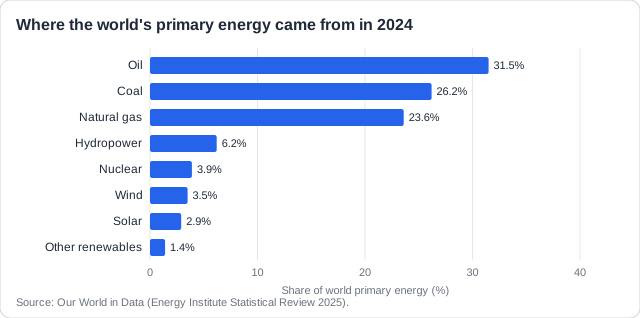
A world economy built on finite fuels: Coal, oil and natural gas are finite. Yet they still supply about four-fifths of the world's primary energy, and the whole economy depends on them.
The points to remember
- About 80% of the world's primary energy still comes from coal, oil and gas.
- Oil runs almost all transport: cars, lorries, ships and planes.
- Coal and gas make most electricity; gas heats many homes.
- Industry needs them too: steel (coal), concrete (cement kilns), fertilizer (gas).
- All three are finite: they formed over millions of years and cannot be replaced.
| Industry | Why it needs a fossil fuel |
|---|---|
| Steel | iron ore is turned into iron in furnaces using coke made from coal |
| Concrete | cement is made by heating limestone in a kiln, usually fired by coal or gas |
| Fertilizer | ammonia is made by the Haber process, which uses natural gas |
Real example: the world burned a record of about 8.8 billion tonnes of coal in 2024, mostly in China and India, even as solar and wind grew faster than ever.
Get feedback like a real examiner
Submit your answers and get instant feedback — what you did well, what's missing, and exactly what to write to score full marks.
How long will the fuels last? The usual measure is the R/P ratio, worked out from the proved reserves.
Reserves and the R/P ratio
- Proved reserves: fuel known to be there that can be extracted at a profit today.
- R/P ratio = reserves ÷ production in one year = years left at today's rate.
- End of 2020: oil about 53 years, gas about 49, coal about 139.
- It is a snapshot, not a countdown: both the reserves and the rate keep changing.
Formula
R/P ratio = proved reserves ÷ production in one year.
Numbers
Oil, end of 2020: 1,732 billion barrels ÷ 32.3 billion barrels a year.
Answer
= 53.6, so about 54 years at the 2020 rate of production.
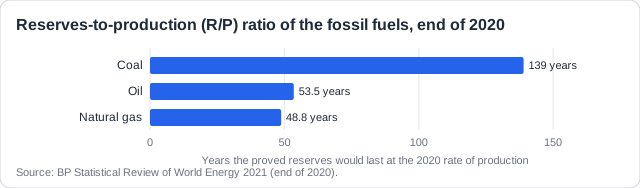
The R/P ratio for oil was about 48 years in 2000 and about 53 years in 2020. Twenty years of use, and the reserves went up, not down.
What moves the date of final depletion
- Rate of consumption: faster use brings depletion closer; slower use delays it.
- New discoveries add to reserves, e.g. oil off Guyana from 2015.
- Extraction technology (fracking, deep-sea drilling) turns hard-to-reach fuel into reserves.
- Price: a higher price makes costly deposits, such as oil sands, worth extracting.
- More renewables or nuclear cut demand, so the fuels last longer.
Remember it as: Use it faster, run out sooner; find more, drill smarter, need less: run out later.
| Factor | Effect on the timeline | Real example |
|---|---|---|
| Rate of consumption | faster use shortens it | world coal use hit a record in 2024 |
| Discovery of new deposits | lengthens it | Guyana: about 11 billion barrels found offshore from 2015; first oil in December 2019 |
| Technology for extraction | lengthens it | fracking of shale made the USA the largest oil producer |
| Price | a high price lengthens it | Canada's oil sands pay only when oil is dear |
| More renewables or nuclear | lengthens it | electric cars and solar power cut demand |
Reserves that grew: World oil reserves rose from about 1,301 billion barrels in 2000 to about 1,732 billion in 2020, even though more than 600 billion barrels were used in those years.
Learn what examiners really want
See exactly what to write to score full marks. Our AI shows you model answers and the key phrases examiners look for.
peak oil is the idea that production cannot grow forever. The USA shows both the idea and its limits.
The peak oil debate
- Peak oil: production rises, peaks, then declines as easy oil runs out.
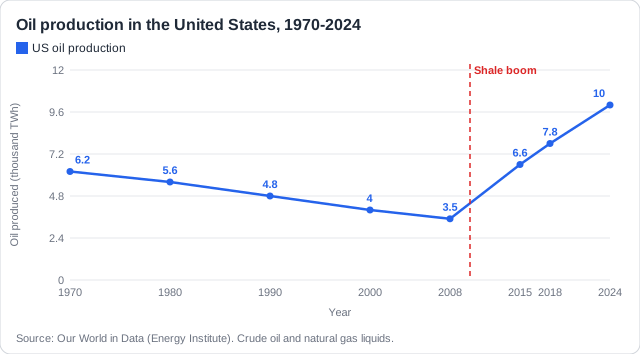
- Hubbert (1956) predicted the US peak; US output did peak in 1970.
- Fracking of shale reversed the decline: a record 13.2 million barrels a day in 2024.
- Today the debate is also about peak demand: will we stop wanting oil before it runs out?
Prediction
- 1956: the geologist M. King Hubbert predicted US oil output would peak between 1965 and 1970
Peak
- 1970: US crude output peaked, then fell for almost 40 years
Technology
- From about 2010, fracking of shale rock released oil that could not be reached before
New record
- 2018: output passed the 1970 peak; 2024: a record 13.2 million barrels a day
Real example of peak demand: in its 2025 outlook the International Energy Agency gave two scenarios: with the policies governments have announced, oil demand peaks around 2030; with only the policies already in law, it keeps rising to 2050.
Depending on finite fuels is risky, and the end of fossil fuels may come from choices, not from empty wells.
Why it matters, and what decides the end
- Dependence brings risks: price shocks, energy insecurity, climate change.
- Fuels may be left in the ground before they run out, if demand falls.
- But dependence is hard to end: steel, cement, fertilizer, planes and ships.
- Coal could last over a century, yet burning it all would wreck the climate.
- So the timeline depends more on choices than on what is left in the ground.
Running out drives the change
- Easy oil gets used first, so new oil is costlier
- Oil and gas R/P ratios are only about 50 years
- Rising prices make renewables more attractive
Choices drive the change
- Reserves keep growing with new finds
- Coal would last over 130 years
- Climate targets and cheap renewables cut demand first
Not a countdown: Do not write 'oil will run out in 53 years'. The R/P ratio assumes nothing changes; say what could make the real date earlier or later.
Never wonder what to study next
Get a personalized daily plan based on your exam date, progress, and weak areas. We'll tell you exactly what to review each day.
How this comes up: Paper 2: calculate an R/P ratio from a table, outline factors that affect how long fossil fuels will last, or discuss whether running out or climate policy will end our dependence. Paper 1: a country's energy data with fossil fuels as the main source.
In 2000 the world's proved oil reserves would have lasted about 48 years at that year's rate of production. Twenty years later the figure was about 53 years.
Explain why it is difficult to predict when the world's oil will finally run out.
Model answer plan
See the mark-by-mark plan — for / against / judgement, with marking guidance — in study mode.