Battery storage at Higher Level: This statement is Higher Level only. It asks why huge batteries are needed to cut carbon emissions, and what they cost: the mining, transport and processing of lithium, cobalt and rare earth elements, with their pollution and the tensions they cause between countries and communities.
Practise this as you read
- Evaluate the role of lithium, cobalt or rare earth elements in renewable energy.
- Discuss whether large-scale battery storage is sustainable.
Free preview
This is the free notes preview
You're reading the free notes. Aimnova Pro unlocks the full study experience — and you can try it with your first topic free to keep:
- FlashcardsLock in vocabulary and key terms with spaced repetition.
- Practice questionsAnswer exam-style questions and get instant AI marking.
- Mock exams & past-paper vaultSit full mocks and see exactly how examiners award marks.
- Personalised study planA daily plan built around your exam date and weak areas.
Storing sunshine for the evening: Solar and wind power are intermittent. To cut carbon emissions, a grid running on them needs huge batteries that store electricity when it is plentiful and release it later.
The points to remember
- Wind and solar are intermittent, so their electricity must be stored for later.
- Batteries charge when there is a surplus and release it at peak demand.
- They react in a fraction of a second, keeping the grid stable.
- They let wind and solar replace coal and gas, so carbon emissions fall.
- So they are needed on a huge scale: about 14 times more by 2030 (IEA).
Problem
- September 2016: a storm cut power lines and the whole of South Australia, a state running largely on wind power, lost electricity
Battery
- December 2017: the Hornsdale Power Reserve, 100 MW, built by Tesla next to a wind farm in under 100 days
Job
- It stores spare wind power, releases it at peak demand, and steadies the grid within a fraction of a second
Result
- It saved users over 150 million Australian dollars in two years and grew to 150 MW in 2020
The scale needed: the world added 42 GW of battery storage in 2023. To triple renewable power by 2030, the International Energy Agency says battery storage must grow about 14 times, to about 1,200 GW.
Study smarter, not longer
Most students waste 40% of study time on topics they already know. Our AI tracks your progress and optimizes every minute.
Effective batteries need a few special elements and their oxides: lithium, cobalt and rare earth elements. This page follows one element, lithium.
The elements batteries need
- Lithium carries the charge in lithium-ion batteries; about 87% of lithium goes into batteries.
- Cobalt (with nickel and manganese) is used in many car and grid batteries.
- Rare earth elements make strong magnets for wind turbines and electric motors.
- Some rare earths are used in batteries and fuel cells, and to make solar cells more efficient.
- All are non-renewable, and their mining is concentrated in a few countries.
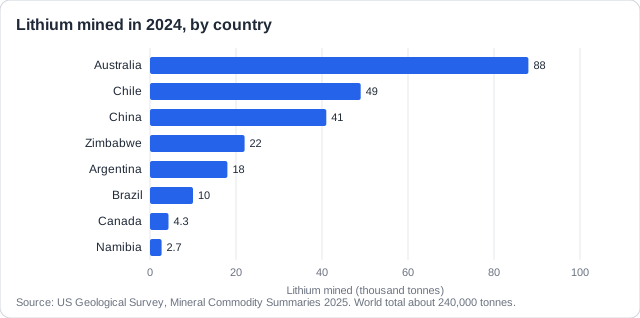
Lithium from brine: Chile
- brine is pumped from under the Salar de Atacama, a salt flat
- It evaporates in huge ponds in the sun for months
- Lithium is left behind
Lithium from rock: Australia
- spodumene is blasted from open-pit mines
- It is crushed and shipped, mostly to China
- There it is roasted with acid to refine it
A battery that cuts emissions on the grid still has emissions and pollution behind it: mining, transporting, processing and construction.
From mine to battery: the costs
- Mining clears land and damages habitats.
- Mining and processing use and deplete water, often in dry places.
- Processing releases toxins: acids, heavy metals, sometimes radioactive waste.
- Tailings dams can fail, flooding land and rivers with waste.
- Transporting ores and building batteries burn fuel and emit carbon dioxide.
- Pollution reaches the oceans too; deep-sea mining is planned for battery metals.
| Stage | Real example |
|---|---|
| Mining uses water | Salar de Atacama, Chile: pumping of groundwater for lithium rose from zero (1986) to 1.8 cubic metres a second (2018); Andean flamingos fell about 12% in 11 years |
| Processing releases toxins | Baotou, China: rare earth processing filled a lake with toxic, slightly radioactive tailings |
| Tailings dams fail | Brumadinho, Brazil, 25 January 2019: an iron ore tailings dam collapsed, killing 270 people; battery-metal mines store waste the same way |
| Transport and building | Australian spodumene is shipped to China to be refined, then made into batteries, burning fuel at every step |
| The oceans | companies plan to dredge nodules from the deep Pacific floor |
Not 'zero-emission': Batteries do not create energy and are not emission-free. Say what their materials cost: habitat, water, toxins and carbon dioxide from mining, transport and processing.
Practice with exam-style questions
Answer exam-style questions and get AI feedback that shows you exactly what examiners want to see in a full-marks response.
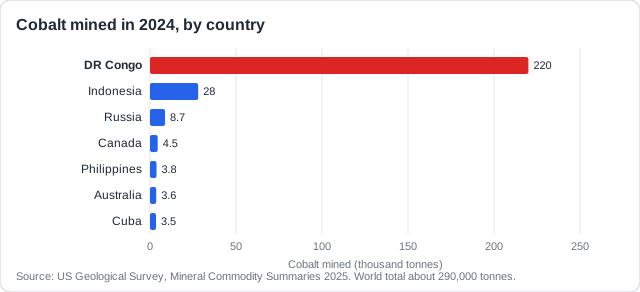
The elements are found in a few places, but every country wants them. That brings unintended consequences.
Sociopolitical tensions
- The elements are found and processed in few countries, but demand is global.
- One country can hold a monopoly, as China does in processing, and use it as a lever.
- Mining can bring unethical practices, such as child labour in the DR Congo.
- Local people may protest against new mines that threaten water and farms.
- Governments compete for supply, causing geopolitical tension.
| Tension | Real example |
|---|---|
| Child labour | Amnesty International (2016): children as young as seven doing artisanal mining for cobalt around Kolwezi, DR Congo, for one or two dollars a day |
| Local protest | Serbia: protests against Rio Tinto's Jadar lithium mine stopped it in 2022; when it was revived in 2024, tens of thousands marched in Belgrade |
| State control | Chile, 2023: the government announced the state would take majority control of new lithium projects |
| A monopoly | China refines most of the world's battery metals and has limited exports of some in disputes (see 7.1.19) |
Large batteries bring risks of their own, but better designs and recycling can cut both the risks and the mining.
Risks and better batteries
- Batteries can catch fire; a fire releases toxic smoke and heavy metals.
- LFP batteries need no cobalt or nickel; sodium-ion needs no lithium.
- Batteries and their metals can be recycled; new EU law will require recycled content.
- Responsible sourcing: checks on mines for child labour and pollution.
- Other storage helps too: pumped hydro, heat stores, and simply using less energy.
Moss Landing, California, 16 January 2025: A fire spread through a 300 MW building holding about 100,000 lithium-ion batteries. Battery fires usually start with thermal runaway. About 1,200 residents were evacuated, and scientists later found nickel, manganese and cobalt in the soil nearby.
Less mining
- LFP cells: no cobalt
- sodium-ion cells: no lithium
- Recycled metals from old batteries
Still a problem
- Lithium and graphite are still mined
- Recycling plants are few and costly
- Demand is growing faster than recycling
Remember it as: Batteries clean the grid, but dirty the mine: shrink the mine.
Feeling unprepared for exams?
Get a clear study plan, practice with real questions, and know exactly where you stand before exam day. No more guessing.
How this comes up: Paper 2: evaluate the role of lithium, cobalt or rare earth elements in renewable energy [7], or discuss battery storage in an essay. Paper 1: a fact file or chart on a battery or a mine, with 'discuss' or 'evaluate'.
Two grid batteries: a fact file.
Hornsdale, South Australia (2017): after a state-wide blackout, a 100 MW lithium-ion battery was built next to a wind farm. It stores spare wind and solar power and releases it at peaks, and saved users over 150 million Australian dollars in two years. Moss Landing, California (2025): a fire in a 300 MW battery building led to 1,200 people being evacuated and heavy metals in nearby soil. The batteries need lithium, mostly from Australia, Chile and China, and some types need cobalt, mostly from the DR Congo.
Discuss whether large-scale battery storage is a sustainable way to support renewable energy.
Model answer plan
See the mark-by-mark plan — for / against / judgement, with marking guidance — in study mode.