Energy security at Higher Level: This statement is Higher Level only. It asks what makes a country's energy supply secure, why importing it from a few suppliers is risky, and how a country can make its supply safer. Learn the definition, Europe's 2022 gas crisis, the three ways to improve security, and how to weigh a real energy plan.
Practise this as you read
- Define energy security with both key words.
- Discuss a country's plan: points for, points against, a judgement.
Free preview
This is the free notes preview
You're reading the free notes. Aimnova Pro unlocks the full study experience — and you can try it with your first topic free to keep:
- FlashcardsLock in vocabulary and key terms with spaced repetition.
- Practice questionsAnswer exam-style questions and get instant AI marking.
- Mock exams & past-paper vaultSit full mocks and see exactly how examiners award marks.
- Personalised study planA daily plan built around your exam date and weak areas.
Energy you can afford and count on: A country has energy security when its people can get the energy they need at a price they can pay (affordable), and it does not suddenly run short (reliable).
The points to remember
- Energy security = access to energy that is affordable and reliable.
- Affordable: homes and firms can pay for it, and prices do not jump suddenly.
- Reliable: it is there when needed: no cuts, shortages or blackouts.
- A country that imports most of its energy, from few suppliers, is less secure.
- Threats: war or politics, price shocks, storms and disasters, intermittent renewables.
- Security also means access for all: poor or remote communities may still go without.
Secure
- Many sources in the mix
- Much of it made at home
- Stable prices
- Stocks and storage for emergencies
Insecure
- One main fuel, mostly imports
- One or two suppliers
- Prices set by world markets
- A weak grid that storms can cut
Real example: Jamaica imports oil and gas for about 91% of its energy, so every rise in world prices raises its electricity bills. In October 2025 Hurricane Melissa cut power to over 70% of its electricity customers: supply was neither affordable nor reliable.
Two words, both needed: Say both: affordable and reliable. A country can have cheap energy that keeps failing, or reliable energy that many cannot pay for (energy poverty).
Memorize terms 3x faster
Smart flashcards show you cards right before you forget them. Perfect for definitions and key concepts.
Before 2022 much of Europe's natural gas came from one supplier, Russia, through long pipelines. That left the European Union exposed.
Europe and Russian gas
- Dependence: in 2021 Russia supplied about 45% of the gas the EU imported.
- Shock: in 2022 supply was cut and gas prices hit a record in August.
- Response: new suppliers, new LNG terminals, full storage, less gas used.
- Result: Russia's share fell to about 19% by 2024, but energy cost much more.
- Lesson: one supplier for a key fuel is a risk to energy security.
Dependence
- 2021: about 45% of the gas the EU imported came from Russia; Germany bought more than half of its gas there
Shock
- 2022: after Russia invaded Ukraine, pipeline gas was cut; on 26 August 2022 the main European gas price closed at a record of about 338 euro per MWh
Response
- New suppliers such as Norway and the USA; Germany opened its first LNG terminal at Wilhelmshaven in December 2022; homes and factories cut gas use
Result
- By 2024 Russia supplied about 19% of EU gas imports, but bills had soared and some factories closed
Use it in an essay: Europe 2022 shows both sides: dependence on one supplier made energy insecure, and the fix (LNG from far away) was more reliable but less affordable.
The guide names three ways to improve energy security: energy efficiency, relying less on imports, and diversification. Storage helps all three.
How a country improves its energy security
- Energy efficiency: use less energy for the same service, so less must be bought.
- Cut imports: make more energy at home, such as solar, wind, hydropower or nuclear.
- Diversify sources: a mix of several sources, so one failure is not a crisis.
- Diversify suppliers: buy from many countries, by pipeline and by ship.
- Storage: stocks of fuel and batteries cover a shortage for a while.
| Way | Real example | Its limit |
|---|---|---|
| Diversify suppliers | Lithuania's floating LNG terminal, Independence, opened in 2014; on 2 April 2022 Lithuania stopped buying Russian gas | LNG by ship usually costs more than piped gas |
| Cut imports with home-grown power | Japan plans 40-50% of its electricity from renewables and about 20% from nuclear by 2040 | flat land is scarce; nuclear restarts face public worry |
| Energy efficiency | EU homes and factories cut their gas use in the winter of 2022-23 | people must change habits; better insulation and machines cost money first |
| Diversify sources | Jamaica's 2024 plan adds wind, solar, hydropower and batteries to an oil and gas energy mix | wind and solar are intermittent |
Remember it as: Use less, make more at home, spread the risk.
Know your predicted grade
Take timed mock exams and get detailed feedback on every answer. See exactly where you're losing marks.
Graphs show how a country's energy mix changes over time. Japan is the classic case: an island with little coal, oil or gas of its own, and low self-sufficiency.
Reading energy graphs
- Describe the trend: what rose, what fell, with years and numbers.
- Link each change to its cause, e.g. Fukushima in 2011 shut Japan's reactors.
- Then give the impact: more imports, higher costs, more carbon dioxide.
- To compare societies, use energy per person, not the country total.
- Use real data from Our World in Data, Gapminder or the World Bank.
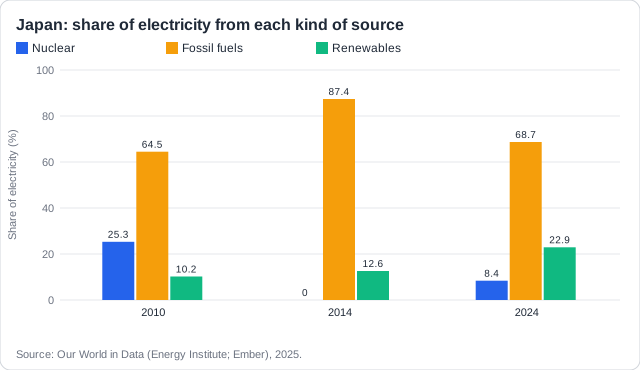
Real example, read off the graph: nuclear fell from 25.3% (2010) to 0% (2014), and fossil fuels rose from 64.5% to 87.4%. Japan's self-sufficiency fell from 20.2% to 6.3%, so it bought far more imported gas and coal. By 2024 renewables had doubled to 22.9%. Over 95% of its crude oil still comes from the Middle East.
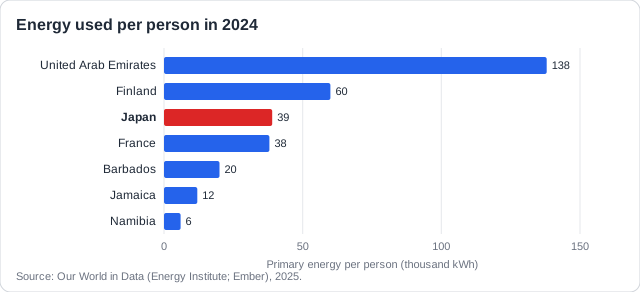
Papers give you a country's energy plan and ask whether it will make the country more secure. Weigh it: up to four points for, up to four against, then a judgement.
Weighing an energy plan
- For: fewer imports, so less exposed to world crises and prices.
- For: more sources (diversified), and local renewables that do not run out.
- For: renewables are cheap to run once built; efficiency cuts demand.
- Against: high set-up cost; new grid and storage take money and time.
- Against: solar and wind are weather-dependent; experts and permits are needed.
- Against: a plan may leave fossil fuels in the mix, and poor rural people unserved.
Jamaica's 50% target: for
- Less imported oil and gas, so less exposed to world prices
- Sun and wind are local and will not run out
- Cheap to run once built
Jamaica's 50% target: against
- High cost to build, for a small economy
- Batteries and stronger power lines are also needed
- Hurricanes can wreck panels, turbines and lines
Link every point to security or cost: Not just 'renewable energy is expensive' or 'solar is cheap'. Say what it does to the reliability or affordability of supply: 'expensive to build at first, but cheap to run, so bills fall over time'.
Get feedback like a real examiner
Submit your answers and get instant feedback — what you did well, what's missing, and exactly what to write to score full marks.
How this comes up: Paper 1: a country's energy plan in a fact file, with 'discuss its aims to achieve energy security' [6], or 'evaluate one renewable option for energy security and economic benefit' [4] from a climate table. Paper 2: an essay on energy security and energy choices.
Lithuania's gas terminal: a fact file.
Before 2014 Lithuania bought all its natural gas from Russia through one pipeline. In 2014 a floating terminal named Independence opened in the port of Klaipeda, so ships could bring liquefied natural gas (LNG) from any country. It can supply more gas than Lithuania uses, so it also supplies Latvia and Estonia. Lithuania leased the ship for ten years and then bought it, and gas users pay towards the cost. In April 2022 Lithuania stopped buying Russian gas. LNG shipped from far away usually costs more than gas piped from a neighbour.
Discuss whether the gas terminal has improved Lithuania's energy security.
Model answer plan
See the mark-by-mark plan — for / against / judgement, with marking guidance — in study mode.