Conservation and efficiency at Higher Level: The same ideas as SL, with different examples: Brazil's 2001 power cuts, Copenhagen's cyclists, the Pyxis Ocean's sails and Japan's Top Runner standards. At HL, saving energy is one of the three ways to improve energy security (7.2.7), with diversification and fewer imports.
Practise this as you read
- Distinguish conservation from efficiency.
- Evaluate how effective two examples are.
Free preview
This is the free notes preview
You're reading the free notes. Aimnova Pro unlocks the full study experience — and you can try it with your first topic free to keep:
- FlashcardsLock in vocabulary and key terms with spaced repetition.
- Practice questionsAnswer exam-style questions and get instant AI marking.
- Mock exams & past-paper vaultSit full mocks and see exactly how examiners award marks.
- Personalised study planA daily plan built around your exam date and weak areas.
Use less, waste less: The cheapest energy is the energy you never use. Energy conservation and energy efficiency both cut demand.
The points to remember
- Energy conservation = changing behaviour to use less energy.
- Energy efficiency = technology that gives the same result with less energy.
- Both cut demand, so a country needs to import less fuel.
- Conservation is often free; efficiency usually costs money up front but saves it later.
Remember it as: Conservation: do less. Efficiency: waste less.
Conservation (behaviour)
- Switch off lights and standby
- Heating down, jumper on
- Bus or bike, not car
Efficiency (technology)
- LED lighting with sensors
- Insulated, well-designed homes
- Efficient appliances, heat pumps
Real example: in 2001 a drought left Brazil's hydropower reservoirs low, and the government ordered homes and businesses to cut electricity use by 20%; they did it within months, mainly by changing behaviour.
Memorize terms 3x faster
Smart flashcards show you cards right before you forget them. Perfect for definitions and key concepts.
Energy conservation means using less: at home, at work and when travelling. Transport matters most for countries that import oil.
The points to remember
- Turn off lights and devices; use daylight; do not leave things on standby.
- Turn down heating and air conditioning; take shorter hot showers.
- Travel less by fuel-driven vehicles: public transport, walking, cycling, car sharing.
- Governments help: congestion charges, carbon taxes on fuel, cycle-to-work schemes, campaigns.
- Industry: run machines for less time; work from home; buy local goods.
Home
- Lights and standby off
- Heating and cooling turned down
Travel
- Bus, train, bike, walking
- Car sharing; fewer flights
Government
- Congestion charge, fuel tax
- Campaigns, cycle lanes
Two answers that are not conservation: 'Use renewable energy' changes the source, not the amount used. 'Build new roads' encourages more driving.
Real example: in Copenhagen nearly half of all trips to work or study are made by bike, helped by hundreds of kilometres of protected cycle lanes.
Energy efficiency means getting the same light, heat or transport from less energy, through better design and technology.
The points to remember
- Housing designed to keep heat in (insulation, triple glazing) or keep heat out (shading, reflective roofs).
- Low-energy intelligent lighting: LEDs use at least 75% less energy; sensors switch them off.
- Efficient appliances with energy labels; heat pumps; smart meters to show use.
- Ships with sails (wind-assisted shipping) burn less fuel.
- Goods designed to be repaired and recycled (the circular economy) save the energy of making new ones.
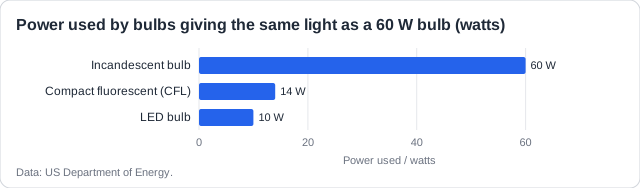
Passivhaus homes
Thick insulation and airtight walls: heating needs at most 15 kWh per square metre a year, a fraction of a normal home.
Heat pumps
Move heat from outside air or ground into the home: 3-4 units of heat for every unit of electricity.
Sails on ships
Rigid sails on cargo ships use the wind to cut the fuel the engines burn.
Design for recycling
Phones and goods that can be repaired and taken apart save the energy of making new ones.
Real example: in 2023 the cargo ship Pyxis Ocean sailed with two 37.5 m tall rigid 'WindWings' sails, designed to cut its fuel use by about 1.5 tonnes a day for each sail.
Know your predicted grade
Take timed mock exams and get detailed feedback on every answer. See exactly where you're losing marks.
For a country that imports its fuel, saving energy is also a way to protect itself from other countries' decisions.
The points to remember
- Every unit of energy saved is a unit not imported.
- Using less makes a country less exposed to price rises and supply cuts: energy security.
- Saving energy is the fastest and often the cheapest way to cut imports.
- It also cuts emissions and air pollution.
Use less
- Conservation and efficiency cut demand.
Import less
- Less coal, oil and gas bought abroad.
More secure
- Less exposed to price shocks and supply cuts; lower emissions.
Real example: Japan, which imports about 90% of its energy, runs the 'Top Runner' scheme (since 1998): each new appliance must match the most efficient model on sale, so fridges and air conditioners use far less electricity than in the 1990s.
The guide asks you to judge how effective two examples are. Ask: how much energy did it save, for how long, and at what cost?
The points to remember
- Effective when many people take part, it is enforced, and it lasts.
- Behaviour change can be fast but may fade once a crisis passes.
- Efficiency lasts for the life of the equipment, but costs up front.
- Rebound effect: when energy becomes cheaper to use, people may use more of it.
- Reduction on a graph = demand without measures − demand with measures, in the same year.
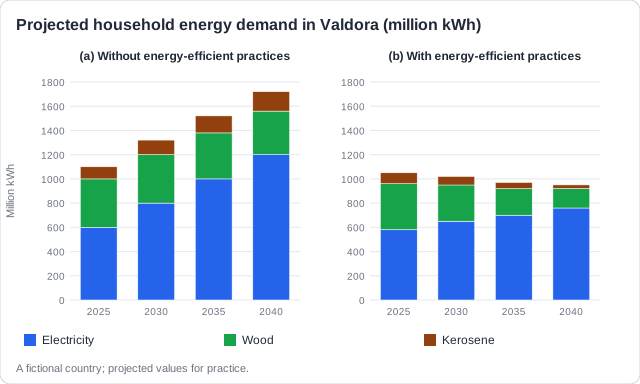
Worked example: In Valdora, demand in 2040 is about 1,720 million kWh without efficiency practices and about 950 with them. Reduction = 1,720 − 950 = 770 million kWh.
Strengths
- Fast and cheap (conservation)
- Long-lasting (efficiency)
- Cuts imports and emissions
Limits
- Behaviour fades after a crisis
- Up-front cost of new technology
- Rebound: cheaper energy, more use
Get feedback like a real examiner
Submit your answers and get instant feedback — what you did well, what's missing, and exactly what to write to score full marks.
How this comes up: Paper 1 (May 2026): a country's energy mix, then 'suggest how it could lower its carbon footprint through changes in its energy mix, energy conservation and energy efficiency' [3]: one mark for each heading.
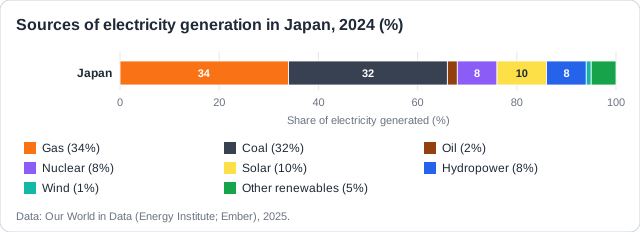
The figure shows the sources of electricity in Japan in 2024.
With reference to the figure, suggest how Japan could lower its carbon footprint through changes in its energy mix, energy conservation and energy efficiency.
Model answer plan
See the mark-by-mark plan — for / against / judgement, with marking guidance — in study mode.