Intermittency and storage at Higher Level: The same ideas as SL, with different examples: California's duck curve, Snowy 2.0, the Moss Landing battery fire and Orkney's hydrogen. At HL, large-scale batteries return in 7.2.10, with the mining of lithium and cobalt they depend on.
Practise this as you read
- Explain why intermittent sources need storage.
- Describe one storage solution with a named example.
Free preview
This is the free notes preview
You're reading the free notes. Aimnova Pro unlocks the full study experience — and you can try it with your first topic free to keep:
- FlashcardsLock in vocabulary and key terms with spaced repetition.
- Practice questionsAnswer exam-style questions and get instant AI marking.
- Mock exams & past-paper vaultSit full mocks and see exactly how examiners award marks.
- Personalised study planA daily plan built around your exam date and weak areas.
When the wind drops: Wind power needs the wind to blow, and solar power needs the Sun. Their output is intermittent, but people need electricity all the time.
The points to remember
- Supply must match demand every second, or the grid fails.
- Solar stops at night and falls under cloud and in winter.
- Wind stops when the air is calm; tides come and go twice a day.
- So their output is variable: it depends on weather, season, time of day or tides.
- Energy must be stored when production is high, for when it is low.
- Sources that can be turned up at will: hydro with a reservoir, geothermal, biomass, fossil fuels.
Intermittent
- Solar: night, cloud, winter
- Wind: calm days
- Tidal: slack water twice a day
Can be turned up at will
- Hydropower with a reservoir
- Geothermal and biomass
- Fossil fuels and nuclear
Not 'overproduction': Storage is needed because supply is variable, not because renewables 'make too much'. Say: store at times of high production for times of low production.
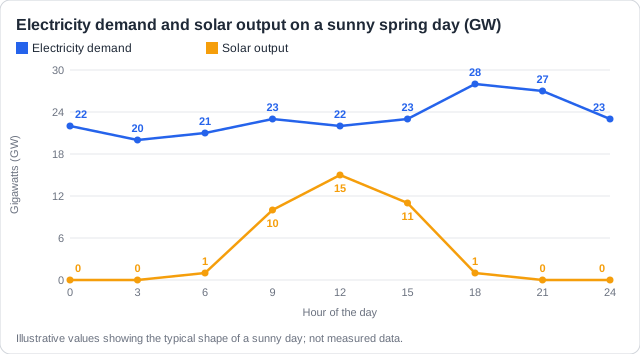
Real example: in California, solar power floods the grid at midday, then falls just as people get home and demand peaks; the grid operator called the shape of the remaining demand the 'duck curve'.
Study smarter, not longer
Most students waste 40% of study time on topics they already know. Our AI tracks your progress and optimizes every minute.
Storage is how a grid moves energy from when it is plentiful to when it is needed.
The points to remember
- Demand has peaks: in many places the biggest is in the early evening.
- Solar output peaks at midday, when demand is not at its highest.
- Peak-shaving = levelling out the peaks: store surplus energy, release it at the peak.
- Without storage, the peak is met by fossil fuel stations kept on standby.
- Storage lets a grid use more wind and solar and waste less of it.
Midday
Solar output is high: charge the stores.
Evening
Solar falls, demand peaks: release the stored energy.
Result
The peak is 'shaved': fewer standby fossil fuel stations.
Remember it as: Store it when it is plentiful, use it when it is needed.
Pumped hydroelectricity storage (PHS) is the world's largest kind of electricity storage.
The points to remember
- Two reservoirs at different heights.
- When there is surplus electricity, pump water uphill.
- At the peak, let it flow down through turbines to make electricity.
- It returns about three quarters of the energy used to pump it.
- For: huge, long-lasting, quick to start. Against: needs mountains and water; floods valleys; costly.
Surplus power
- Night or a windy, sunny spell: cheap electricity pumps water up.
Upper reservoir
- The water stores the energy, ready for hours.
Peak demand
- Water rushes down through turbines and makes electricity within seconds.
Real example: Snowy 2.0 in Australia will link two existing reservoirs through 27 km of tunnels to store about 350 GWh, but its cost estimate has risen to about A$12 billion and it is years late.
Practice with exam-style questions
Answer exam-style questions and get AI feedback that shows you exactly what examiners want to see in a full-marks response.
Large batteries are the fastest-growing kind of storage. They are built in months, not years.
The points to remember
- Lithium-ion batteries store electricity as chemical energy.
- For: respond in a fraction of a second; built anywhere, quickly; costs falling fast.
- Against: store only a few hours; need mined lithium, cobalt; fire risk; wear out.
- Big batteries also keep the grid's frequency steady when a power station trips.
Why batteries are booming
- Fast: milliseconds
- Built in months
- Prices fell about 90% since 2010
Their limits
- A few hours of storage
- Lithium and cobalt mining (7.2.10)
- Fires can be hard to put out
Real example: in January 2025 a fire broke out at Moss Landing, California, one of the world's largest battery sites; nearby residents were told to leave, and the fire raised questions about battery safety.
Two more solutions store energy as a fuel or as heat, so it can be kept longer or used at solar power stations.
The points to remember
- Hydrogen and fuel cells: surplus power splits water (electrolysis); a fuel cell turns the hydrogen back into electricity, giving out only water.
- Hydrogen can be stored for weeks, but much of the energy is lost on the way.
- Thermal storage: surplus heat warms molten salt; later the heat makes steam for a turbine.
- Used at concentrated solar plants to keep generating after sunset.
Electrolysis
- Surplus electricity splits water
- Hydrogen is stored in tanks
Fuel cell
- Hydrogen and oxygen combine
- Electricity out; only water released
Molten salt
- Sunlight heats salt to hundreds of °C
- Heat makes steam after sunset
Real example: on the Orkney Islands, Scotland, wind and tidal turbines often make more electricity than the islands can use, so since 2017 the surplus has been used to make hydrogen, which is stored and turned back into power with fuel cells.
Feeling unprepared for exams?
Get a clear study plan, practice with real questions, and know exactly where you stand before exam day. No more guessing.
Each kind of storage suits a different job. A grid with lots of wind and solar uses several.
| Storage | How long it stores | Strength | Limit |
|---|---|---|---|
| Batteries | Seconds to a few hours | Very fast, built quickly | Mining, fire risk |
| Pumped hydro | Hours to a day or more | Huge, lasts decades | Needs mountains, floods valleys |
| Hydrogen and fuel cells | Days to weeks | Long-term storage | Loses much of the energy |
| Thermal (molten salt) | Hours | Cheap with solar heat | Only at solar thermal plants |
The points to remember
- Seconds to hours: batteries. Hours to days: pumped hydro. Days to weeks: hydrogen.
- No single store fits every need: grids combine them.
- Other solutions: interconnectors to neighbours, demand response (using power when it is plentiful), a mix of sources.
- Every store loses some energy and has its own environmental cost.
Why fossil fuel back-up is still common: Long calm, dark spells can last days, longer than batteries can cover. Until storage and interconnectors grow, many grids keep gas power stations on standby.
How this comes up: Paper 2 Section A (May 2026): 'state why some renewable sources create the need for energy storage' [1]. Expect a follow-up on how one storage solution works.
California makes about a quarter of its electricity from solar power.
(a) State why energy production from some renewable sources creates the need for energy storage systems.
(b) Explain how large batteries can help California meet its evening peak in demand.
Model answer plan
See the mark-by-mark plan — for / against / judgement, with marking guidance — in study mode.