Energy choices at Higher Level: The same factors as SL, with different countries: Iceland v China, Denmark, South Africa, Saudi Arabia, Morocco and Brazil, Japan after Fukushima and Chile's coal exit. At HL, energy security has its own micro (7.2.7): here you learn how it combines with cost, availability and values to shape a country's mix.
Practise this as you read
- Compare two contrasting countries factor by factor.
- Evaluate a country's energy approach.
Free preview
This is the free notes preview
You're reading the free notes. Aimnova Pro unlocks the full study experience — and you can try it with your first topic free to keep:
- FlashcardsLock in vocabulary and key terms with spaced repetition.
- Practice questionsAnswer exam-style questions and get instant AI marking.
- Mock exams & past-paper vaultSit full mocks and see exactly how examiners award marks.
- Personalised study planA daily plan built around your exam date and weak areas.
Every country has its own mix: No energy source is perfect, so every country chooses a mix that balances cost, supply, pollution and its own values. The same factors push different countries in different directions.
The points to remember
- Availability: the resources a country has, set by its geography and geology (rivers, sunshine, coal).
- Economic cost: building and running costs, and whether the country can afford them.
- Energy security: reliable, affordable supply that does not depend on risky imports.
- Pollution and sustainability: climate targets, air quality, damage to land and water.
- Energy efficiency: how much of the energy is turned into useful power.
- Also values (EVSs), politics, public opinion, technology and population.
Remember it as: What we have, what we can afford, what we fear, what we value.
What we have
- Norway's mountains and rain: hydropower.
What we can afford
- Poland's cheap local coal.
What we fear
- Japan's dependence on imported fuel.
What we value
- Denmark's push for wind after the 1970s oil crises.
Real example: Saudi Arabia makes almost all of its electricity from oil and gas, which it has in huge amounts, even though it has some of the strongest sunshine on Earth.
Learn what examiners really want
See exactly what to write to score full marks. Our AI shows you model answers and the key phrases examiners look for.
Two very different countries show how geography, population and the need for growth shape a mix.
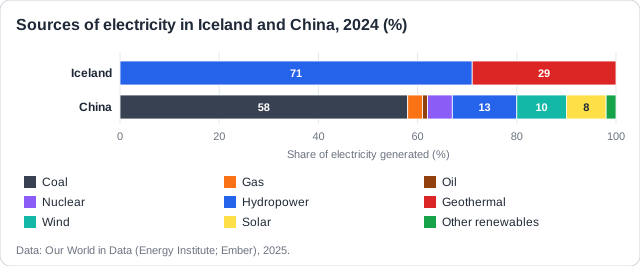
Iceland: hydro and geothermal
- On a plate boundary: hot rock near the surface
- Glacier rivers for hydropower
- 100% renewable electricity; about 90% of homes heated by geothermal water
- But: small population; dams flood highland habitats
China: coal, plus record renewables
- Huge coal reserves; fast-growing demand
- Coal 58% of electricity (2024)
- Also more solar built in 2024 than the rest of the world combined
- Smog and climate targets push change
Use both countries in every answer: For each factor, say how it pushes each country: 'Germany's anti-nuclear values closed its reactors, while France's need for security after 1973 built them'.
Real example: China's choice of coal follows its geology and its drive for growth, but smog in cities such as Beijing and its target of peak emissions before 2030 are pushing it to build wind and solar faster than any other country.
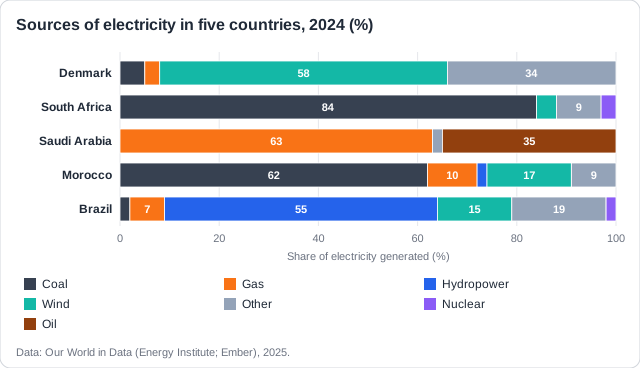
Long answers reward a range of named countries. Learn one line for each of these, with the factor it shows.
Denmark
No hydro or coal; after the 1970s oil crises it built wind: 58%.
South Africa
Huge coal reserves: 84% coal; power cuts pushed rooftop solar.
Saudi Arabia
Vast oil and gas, cheap at home: 98% of electricity.
Morocco
Imports about 90% of its energy; building solar and wind.
Brazil
Great rivers: 55% hydropower; sugarcane ethanol for cars.
Geography or the environment?: Geography decides what a country can use; concern for the environment decides what it chooses from that list. Countries rich in fossil fuels often keep using them even when they care about climate change.
Never wonder what to study next
Get a personalized daily plan based on your exam date, progress, and weak areas. We'll tell you exactly what to review each day.
Energy security is one of the strongest factors. A country that cannot rely on its supply will pay almost any price to secure it.
The points to remember
- Energy security = access to affordable and reliable energy.
- Countries that import most of their energy are exposed to price rises and supply cuts.
- Security can push choices either way: local renewables (more sustainable) or local coal and shale gas (less sustainable).
- Diversifying sources and saving energy both improve security.
Security making choices greener
- Denmark built wind after the 1970s oil crises
- Morocco builds solar to cut fuel imports
- Europe sped up renewables after 2022
Security making choices less green
- The USA expanded shale gas and oil by fracking
- Germany burned more coal in 2022
- Poland keeps its own coal
Real example: after the Fukushima disaster in 2011, Japan, which imports about 90% of its energy, shut its reactors and made up the gap with imported gas and coal, raising its fuel bills and emissions.
People's environmental value systems, and the governments they elect, decide which of the possible sources a country actually uses.
The points to remember
- Technocentric governments favour nuclear, carbon capture and big renewable projects.
- Ecocentric groups favour using less, small-scale renewables and oppose nuclear.
- Anthropocentric policies use laws and markets: carbon taxes, targets, subsidies.
- Public opinion and protest can close power stations or stop new ones.
- Lock-in: existing power stations, jobs and companies with a stake in fossil fuels slow change.
Technocentric choices
- Nuclear power as a climate solution
- Carbon capture and storage
- Large wind and solar farms
Ecocentric choices
- Use less energy
- Small, local renewables
- No nuclear: waste and risk
Real example: in Chile, after decades of local and national protests, the owners of coal power stations agreed to close them all by 2040, and a carbon tax was introduced in 2017.
Stop wasting time on topics you know
Our AI identifies your weak areas and focuses your study time where it matters. No more overstudying easy topics.
Governments steer energy choices with laws and money. Papers ask for a strategy at government level, not something one person does.
The points to remember
- Subsidies and grants for solar panels, wind turbines, batteries and electric vehicles.
- Taxes on carbon, fossil fuels or imported fuel (a carbon tax).
- Better rates for electricity sold from renewable sources.
- Easier planning permission and grid investment to connect new wind and solar farms.
- Bans or phase-outs of fossil fuel plants; research; education campaigns.
- Strategies are government-level: not 'people should turn off lights'.
Pay
Subsidies, grants and better rates for renewable power.
Charge
Carbon taxes and taxes on imported fossil fuels.
Build
Grid lines, storage, charging points.
Rule
Phase-outs, easier permits, efficiency standards.
Name the tool: 'Pass a law' or 'invest in renewables' alone is too vague. Say what the law does or what is paid for: 'subsidise rooftop solar panels'.
Real example: after years of power cuts, South Africa in 2023 gave households a tax rebate for rooftop solar panels, and rooftop solar capacity grew rapidly.
How this comes up: Paper 1 (specimen HL): a fact file on one country's energy policy, then 'evaluate the approach, reaching a reasoned judgement' [6]: up to four a side and one mark for the conclusion.
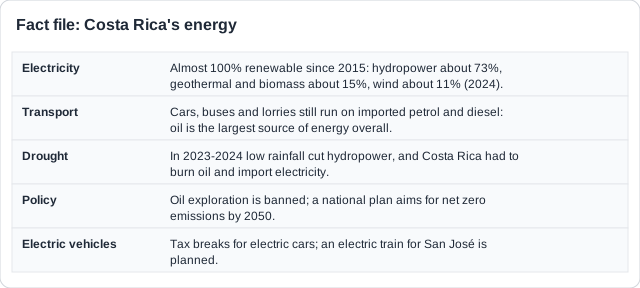
The fact file describes Costa Rica's energy.
Evaluate Costa Rica's approach to energy, reaching a reasoned judgement.
Model answer plan
See the mark-by-mark plan — for / against / judgement, with marking guidance — in study mode.