Sustainability of energy sources at Higher Level: The same comparison as SL, with different examples: Alberta's oil sands, Onkalo's nuclear waste store, Noor Ouarzazate, Hornsea's blades, Brazil's ethanol, Lynas and Germany's mix. Nuclear power gets its own HL micro (7.2.9) and battery materials theirs (7.2.10); here you learn to compare all sources side by side.
Practise this as you read
- Compare sources by lifecycle emissions and other costs.
- Evaluate a change in a country's mix.
Free preview
This is the free notes preview
You're reading the free notes. Aimnova Pro unlocks the full study experience — and you can try it with your first topic free to keep:
- FlashcardsLock in vocabulary and key terms with spaced repetition.
- Practice questionsAnswer exam-style questions and get instant AI marking.
- Mock exams & past-paper vaultSit full mocks and see exactly how examiners award marks.
- Personalised study planA daily plan built around your exam date and weak areas.
No energy source is free of harm: Some sources are far more sustainable than others. To compare them, look at the whole lifecycle.
The points to remember
- Renewable or finite? A sustainable source does not run out.
- Lifecycle emissions: CO₂ from building, running and dismantling, per kWh.
- Other pollution: acid rain, smog, spills, radioactive or toxic waste.
- Land, water and wildlife: what is flooded, mined, cleared or killed.
- Every source has an environmental cost, including restoring the land afterwards.
- Reliability and cost: does it run all the time, and can people afford it?
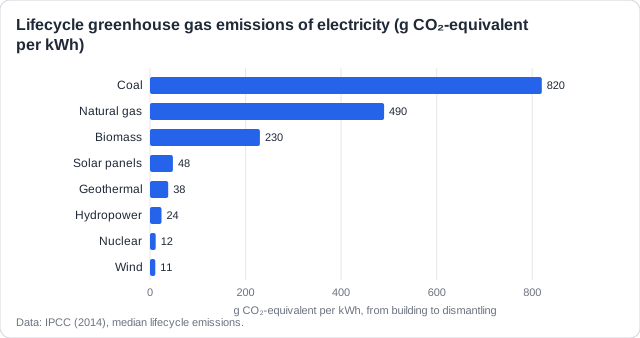
One more term: Energy return on investment (EROI) is falling for fossil fuels as the easy reserves run out.
Real example: the IPCC's figures show biomass at about 230 g per kWh, far above wind (11 g) or nuclear (12 g), because growing, drying and transporting the fuel all use energy.
Feeling unprepared for exams?
Get a clear study plan, practice with real questions, and know exactly where you stand before exam day. No more guessing.
Fossil fuels harm the environment at every stage: getting them out of the ground, processing them, moving them and burning them.
The points to remember
- Extraction: coal mines scar land and leak acid mine drainage; oil wells spill; fracking can pollute groundwater.
- Refining crude oil uses energy and releases air pollutants.
- Liquefying natural gas (LNG) means cooling it to about −162°C: a lot of energy before it is used.
- Burning: CO₂ (climate change), SO₂ (acid rain), NOₓ (smog), particulates (lung disease), mercury.
- Coal is the dirtiest; gas gives about half the CO₂ of coal, but methane leaks cut that benefit.
- Finite, and restoring old mines and spill sites costs billions.
Coal (most polluting)
- Most CO₂ per unit of energy
- Most SO₂, particulates and mercury
- Mining scars land; acid mine drainage
Natural gas (least polluting fossil fuel)
- About half the CO₂ of coal
- Little SO₂ or particulates
- Methane leaks from wells and pipes
Real example: Canada's Alberta oil sands are mined by clearing boreal forest; the sticky bitumen is separated with hot water, leaving huge tailings ponds that must one day be cleaned up.
Nuclear power makes very little CO₂, but it is non-renewable and carries rare but serious risks.
Fission
Neutrons split uranium-235 nuclei, releasing heat and more neutrons.
Chain reaction
Control rods absorb neutrons to keep the reaction steady.
Steam
The heat boils water; steam spins a turbine and generator.
New designs
Small modular reactors (SMRs); fusion is not yet in use.
The points to remember
- For: about 12 g CO₂ per kWh, as low as wind; runs day and night; needs little land and fuel.
- Against: uranium mining damages land and water; non-renewable.
- Radioactive waste stays dangerous for thousands of years and must be stored safely.
- Accidents are rare but severe: Chernobyl (1986), Fukushima (2011).
- Very expensive and slow to build and to decommission; thermal pollution of rivers and seas.
Strengths
- Low-carbon: about 12 g CO₂ per kWh
- Reliable: runs about 90% of the time
- Little land and little fuel
Weaknesses
- Waste dangerous for thousands of years
- Rare but severe accidents
- Costly and slow to build; uranium mining
Real example: Onkalo, in Finland, is the world's first deep store for spent nuclear fuel: tunnels about 430 m down in ancient bedrock, built to keep the waste sealed for 100,000 years.
Memorize terms 3x faster
Smart flashcards show you cards right before you forget them. Perfect for definitions and key concepts.
Solar power is renewable and clean to run, but making, installing and disposing of the equipment has costs too.
The points to remember
- For: renewable, no emissions in use, cost has fallen fast, works on rooftops.
- Against: weather dependent (intermittent): nothing at night.
- Making panels uses energy and mined materials (silicon, silver, aluminium).
- Large solar farms cover land and can change desert ecosystems.
- Recycling is hard: up to 78 million tonnes of panel waste by 2050 (IRENA).
- High set-up cost; batteries to store power are expensive.
Make
Purifying silicon uses a lot of electricity, often from coal.
Install
Solar farms cover land; dust must be cleaned off with water.
Run
No emissions, but no power at night or under thick cloud.
Dispose
After about 25-30 years panels must be recycled or landfilled.
Real example: Noor Ouarzazate in Morocco (about 580 MW) uses mirrors to heat molten salt, which stores heat and keeps making electricity after sunset.
Wind and hydropower are the two biggest renewable sources of electricity after solar. Both are low-carbon, but both have local costs.
The points to remember
- Wind for: renewable, no emissions in use, cheap once built, quick to build.
- Wind against: intermittent; birds and bats killed; noise; spoils views; blades are huge to transport and hard to recycle.
- Hydro for: reliable and controllable; reservoirs give flood control, water supply, fishing.
- Hydro against: floods habitats; moves people; blocks fish migration; traps sediment; flooded plants rot and release methane.
- Hydro output falls in droughts; dams are very costly and can fail.
Construction
- Concrete and steel for towers and dams
- Roads into remote valleys and hills
Transport
- Turbine blades can be longer than a football pitch
- Heavy parts need special ships and roads
End of life
- Fibreglass blades are hard to recycle
- Old dams fill with silt and are costly to remove
Real example: the Hornsea wind farms off England are the world's largest offshore wind project; each blade is over 80 m long, and old blades from early farms have been buried in landfill, as at Casper, Wyoming, USA.
Know your predicted grade
Take timed mock exams and get detailed feedback on every answer. See exactly where you're losing marks.
Two more renewable sources show the same pattern: renewable, but with costs that depend on where and how they are used.
The points to remember
- Tidal barrage for: tides are predictable, twice a day, every day.
- Tidal against: few suitable estuaries; very costly to build; changes silt and mudflat habitats for birds and fish.
- Biofuels for: renewable and carbon-neutral if regrown: crops absorb the CO₂ they later release; replace petrol.
- Biofuels against: compete with food crops for land; use water, fertiliser and pesticides; can drive deforestation; monocultures.
Carbon-neutral only if regrown: Burning a biofuel releases CO₂, but new crops absorb it again. So 'biofuels release CO₂' is not a drawback on its own: the real drawbacks are land, food, water and forests.
Real example: most new cars in Brazil can run on ethanol from sugarcane, replacing much of its petrol, but critics say new cane fields push cattle ranching into savanna and rainforest.
Renewable energy depends on some non-renewable materials. The most talked-about are the rare earth elements.
The points to remember
- Rare earth elements (REEs), e.g. neodymium, make strong magnets for wind turbines and electric car motors.
- They are non-renewable: mined from the ground.
- Mining and refining release toxic and radioactive waste and use a lot of water.
- Supply is concentrated: China mines about 70% and refines about 90%: a geopolitical risk.
- They can be recycled from old magnets, but little is recycled today.
Why we need them
- Strong magnets for wind turbines
- Electric car motors
- Some batteries and solar cells
Their costs
- Toxic, radioactive mining waste
- Water use and habitat loss
- One country controls supply
Real example: Australian company Lynas refines rare earths at Kuantan, Malaysia; local people protested for years about how its low-level radioactive waste would be stored.
Get feedback like a real examiner
Submit your answers and get instant feedback — what you did well, what's missing, and exactly what to write to score full marks.
Putting it together: some sources are far more sustainable than others, yet the less sustainable ones still dominate in many countries.
| Source | Renewable? | Lifecycle CO₂ | Main costs |
|---|---|---|---|
| Coal | No | Very high | Mining, acid rain, particulates |
| Natural gas | No | High | Fracking, methane leaks, LNG |
| Nuclear | No | Very low | Uranium mining, waste, accidents |
| Solar | Yes | Low | Making and recycling panels, land |
| Wind | Yes | Very low | Birds, blades, intermittent |
| Hydropower | Yes | Low | Flooding, people moved, fish |
The points to remember
- Most sustainable (long run): wind, solar, hydro, geothermal: renewable and low-carbon.
- Least sustainable: coal, then oil, then gas: finite and high-carbon.
- Nuclear: low-carbon but finite, with waste and risk.
- Renewables are not yet the main source in many places: cost, new infrastructure, unsuitable geography, technology.
- Some countries have their own fossil reserves or other priorities (food, health, water).
- Switching cuts CO₂, acid rain and smog, imports and price shocks, and creates jobs.
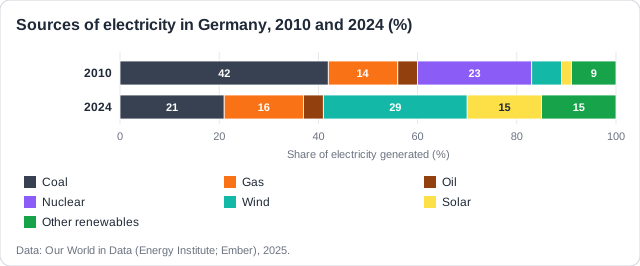
Real example: Germany halved coal's share between 2010 and 2024 and grew wind and solar, but it also closed all its low-carbon nuclear plants, so its emissions fell less than they could have.
How this comes up: Paper 1 (May 2024, both time zones): a chart of planned changes in energy supply, then 'evaluate how the changes are likely to influence carbon emissions' [3]. Every point must say what happens to carbon dioxide.
The figure shows the sources of electricity in Germany in 2010 and 2024.
Evaluate how the changes in electricity sources shown in the figure are likely to have influenced carbon dioxide emissions in Germany.
Model answer plan
See the mark-by-mark plan — for / against / judgement, with marking guidance — in study mode.