Renewable and non-renewable at Higher Level: The same statement as SL, with different real cases: the world's sand, the recovering ozone layer, the Aral Sea and the Ogallala Aquifer. At HL, always ask how fast a resource is replaced compared with how fast it is used.
Practise this as you read
- Classify a resource and name how it renews.
- Explain how overuse turns renewable into non-renewable.
Free preview
This is the free notes preview
You're reading the free notes. Aimnova Pro unlocks the full study experience — and you can try it with your first topic free to keep:
- FlashcardsLock in vocabulary and key terms with spaced repetition.
- Practice questionsAnswer exam-style questions and get instant AI marking.
- Mock exams & past-paper vaultSit full mocks and see exactly how examiners award marks.
- Personalised study planA daily plan built around your exam date and weak areas.
Nothing is endless: All resources are finite, even those that renew.
The points to remember
- All resources are finite: Earth has a fixed amount of every material.
- Even renewable resources have a limit: how fast they are replaced.
- Humanity uses about 1.7 Earths of resources a year: we take more than nature replaces.
- So any resource can run short if it is used faster than it is replaced.
Remember it as: Renewable means 'replaced', not 'endless'.
Real example: sand looks endless, yet the world uses about 40 to 50 billion tonnes of sand and gravel a year, mostly for concrete. Desert sand is too smooth to bind, so builders take it from rivers and beaches faster than rivers replace it.
Practice with exam-style questions
Answer exam-style questions and get AI feedback that shows you exactly what examiners want to see in a full-marks response.
Classify a resource by whether, and how, it is replaced as fast as it is used.
Renewable or non-renewable
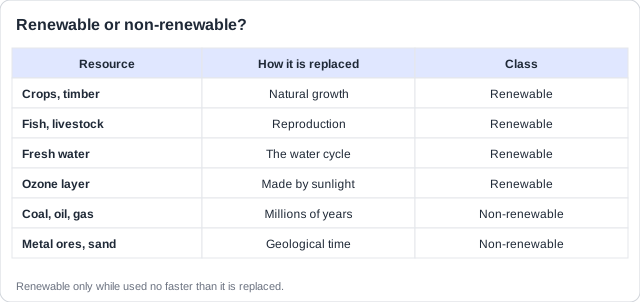
- Renewable resources are replaced as fast as they are used.
- Some renew by natural growth or reproduction: food crops, timber, fish, livestock.
- Others renew by recurring processes: fresh water (the water cycle), ozone (made by sunlight).
- Non-renewable resources form over millions of years: coal, oil, gas, metal ores, sand.
- Once used, non-renewables are gone on a human timescale.
Real example: ozone is made all the time in the stratosphere when sunlight splits oxygen. Since the 1987 Montreal Protocol cut CFCs, the ozone layer is recovering: about 2040 for most of the world, about 2066 over Antarctica.
Old words: Some older books call water and soil 'replenishable'. Today's term is renewable through recurring processes.
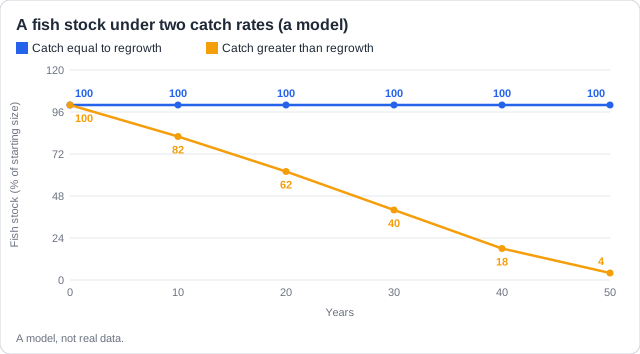
Renewable, but not for ever: If a renewable resource is used beyond its regeneration rate, its use becomes unsustainable and it becomes non-renewable.
When renewable becomes non-renewable
- Use a renewable resource faster than its regeneration rate and the stock shrinks.
- Its use becomes unsustainable, and it becomes a non-renewable resource.
- Fish: catch more than the stock's regrowth and it collapses.
- Water: pump more than rain refills and the aquifer or lake dries.
- Fossil groundwater, stored for thousands of years, barely refills: it is effectively non-renewable.
Real example: from the 1960s the rivers feeding the Aral Sea were diverted to irrigate cotton. Far more water was taken than the rivers could replace, and the sea lost about 90% of its area: renewable water used as if it were non-renewable.
Feeling unprepared for exams?
Get a clear study plan, practice with real questions, and know exactly where you stand before exam day. No more guessing.
How this comes up: Paper 2, Section B (a): four marks, four linked points, with a named example.
Groundwater under the Great Plains of the USA is pumped to irrigate maize and wheat.
Outline how a renewable resource can become a non-renewable resource, using a named example.
Model answer plan
See the mark-by-mark plan — for / against / judgement, with marking guidance — in study mode.