Ecosystem services at Higher Level: The same statement as SL, with different real cases: hand-pollinated pears in Sichuan, Chesapeake Bay's forest buffers, Indonesia's peat fires and the 2023 Amazon drought. At HL, explain each service as a chain: the ecosystem, what it does, and who loses when it stops.
Practise this as you read
- Link each human activity to the service it changes.
- Weigh the impacts of climate change: losses and gains.
Free preview
This is the free notes preview
You're reading the free notes. Aimnova Pro unlocks the full study experience — and you can try it with your first topic free to keep:
- FlashcardsLock in vocabulary and key terms with spaced repetition.
- Practice questionsAnswer exam-style questions and get instant AI marking.
- Mock exams & past-paper vaultSit full mocks and see exactly how examiners award marks.
- Personalised study planA daily plan built around your exam date and weak areas.
Nature's life support: Ecosystems provide life-supporting ecosystem services.
Four kinds of ecosystem service
- Ecosystem services are the benefits ecosystems give that keep life going, for people and all living things.
- Provisioning: goods such as food, fresh water, timber and medicines.
- Regulating: climate, floods, erosion, water purification, pollination, pests.
- Supporting: soil formation, nutrient cycling, photosynthesis, habitat.
- Cultural: recreation, tourism, beauty, spiritual value, education.
Remember it as: Things we take, things nature controls, things it builds, things we enjoy.
Real example: in Hanyuan county in Sichuan, China, wild bees became so scarce, after heavy pesticide use and habitat loss, that farmers climb their pear trees to pollinate each flower by hand with brushes. People now do, slowly and at a cost, what bees once did for free.
When the question says 'service': Many questions do not accept goods (timber, food sold) as a service, and some do not accept tourism. Give a regulating or supporting service, such as a carbon sink or holding soil.
Stop wasting time on topics you know
Our AI identifies your weak areas and focuses your study time where it matters. No more overstudying easy topics.
The guide names four services that support life. Learn each with what the ecosystem does.
The four services in the guide
- Water replenishment: soil and roots let rain soak in and refill groundwater and rivers.
- Flood and erosion protection: wetlands store flood water; roots hold soil; mangroves slow waves.
- Pollution mitigation: reed beds and streamside plants take up nitrates and phosphates.
- Carbon sequestration: plants absorb CO2 and store carbon in wood, soil, peat and mud.
- All four support all living things, including humans.
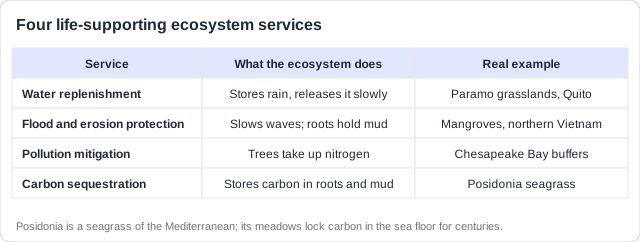
Real example: farmers around Chesapeake Bay in the USA are paid to plant forest buffers. The trees take up nitrogen from fertiliser that would otherwise feed algal blooms in the bay.
Damage the ecosystem, lose the service: Human activity changes ecosystems, and with them the services everyone depends on.
How human activity affects services
- Deforestation: less carbon stored, more soil erosion, more floods, less rain soaking in, habitat lost.
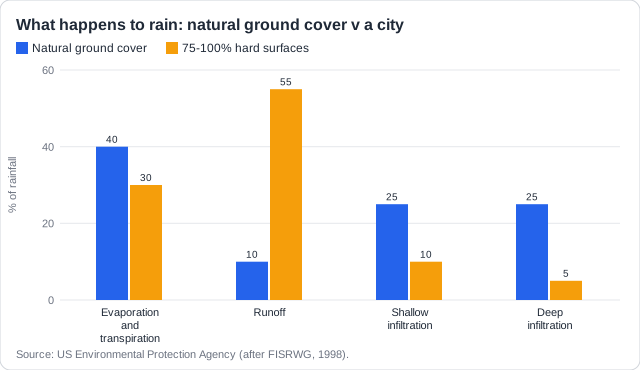
- Paving and building: rain cannot soak in, so less groundwater and more flash floods.
- Draining wetlands: lost water filtering and flood storage.
- Intensive farming: monocultures, fertiliser runoff, pesticides that kill pollinators, eroded soil.
- Humans can also restore services: replant forests, rewild, plant cover crops and windbreaks.
Real example: in Indonesia, peat swamp forest was drained for plantations. In 2015 the dry peat caught fire and burned for months, releasing huge amounts of stored carbon and choking cities with smoke: a carbon sink turned into a carbon source.
Link the land use to the service: Each mark needs both halves: the human activity (monoculture, paving, clearing) and the service it changes (pollination, flood control, carbon storage).
See how examiners mark answers
Answer exam-style questions with model answers. Learn exactly what earns marks and what doesn't.
Climate change shifts the conditions ecosystems are adapted to, so the services they give change too.
Climate change and ecosystem services
- Warmer seas bleach corals: less coastal protection and fewer fish.
- Droughts and fires: forests store less carbon and may even release it.
- Melting glaciers: less meltwater for farms and cities in dry seasons.
- Rising seas and storms: salt water reaches farmland and wetlands; mangroves can drown.
- Some gains in cold places: longer growing seasons, but the overall effect is hard to predict and mostly negative.
Real example: in 2023 drought hit the Amazon. The Rio Negro at Manaus fell to its lowest level in over 120 years of records, and more than 150 river dolphins died in hot, shallow water in Lake Tefe. A drier forest stores less carbon and recycles less rain.
For a 9-mark discussion: Name ecosystems in different parts of the world, give negative and positive impacts, and judge how likely the losses are.
How this comes up: Paper 2, Section B (b): seven marks, one per service, each with a human activity and how it changes the service.
In 2024, the world's forests, wetlands, soils and oceans were still giving people clean water, fertile soil and a stable climate, but many were under pressure.
Explain how life-supporting services provided by ecosystems may be impacted by human activity.
Model answer plan
See the mark-by-mark plan — for / against / judgement, with marking guidance — in study mode.