Air conditioning at Higher Level: This statement is Higher Level only. It looks at a machine billions of people want: what it does to the climate and the ozone layer, why some societies use far more of it, and the cleaner ways to keep cool.
Practise this as you read
- Explain the differences in air conditioning use between countries.
- Evaluate the alternatives to air conditioning, with real examples.
Free preview
This is the free notes preview
You're reading the free notes. Aimnova Pro unlocks the full study experience — and you can try it with your first topic free to keep:
- FlashcardsLock in vocabulary and key terms with spaced repetition.
- Practice questionsAnswer exam-style questions and get instant AI marking.
- Mock exams & past-paper vaultSit full mocks and see exactly how examiners award marks.
- Personalised study planA daily plan built around your exam date and weak areas.
Keeping cool warms the planet: Air conditioners are energy-intensive, burn fossil-fuel electricity and leak a refrigerant that used to destroy ozone and still warms the climate. As the world heats up, we use more of them.
The points to remember
- Air conditioners are energy-intensive: cooling uses about 10% of the world's electricity.
- Most electricity still comes from fossil fuels, so cooling adds greenhouse gas emissions.
- They traditionally contained ODSs: CFC-12 in car units, HCFC-22 in home units.
- Today most use HFCs: they leak, and they are potent greenhouse gases.
- It is a positive feedback loop: a hotter world needs more cooling, which warms it further.
- They also pump waste heat outdoors, adding to the urban heat island.
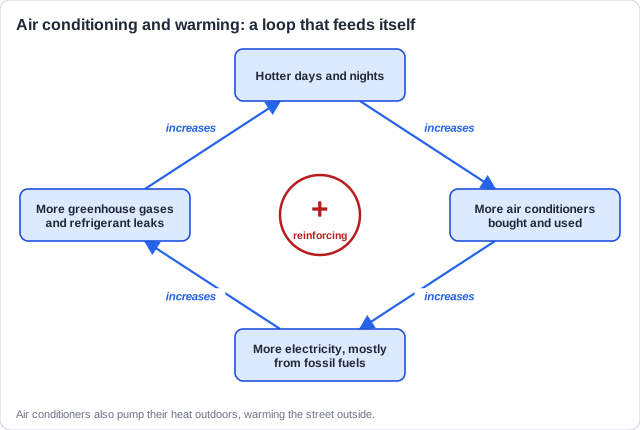
Real example: in about 2016 there were 1.6 billion air conditioners in the world; the International Energy Agency expects about 5.6 billion by 2050. During India's heatwave in May 2024 the country's peak demand hit a record of about 250 gigawatts, driven by cooling, and most of that power came from coal. This is the positive feedback at work.
Study smarter, not longer
Most students waste 40% of study time on topics they already know. Our AI tracks your progress and optimizes every minute.
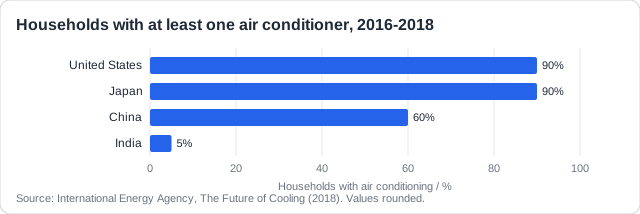
Air conditioning use differs hugely between societies. Data like this is compared per capita or per household, so countries of different sizes can be compared fairly.
Why use differs between societies
- Climate: hot, humid places need more cooling.
- Income: units and electricity cost money, so richer households and countries have more.
- Electricity: homes need a reliable power supply to run them.
- Buildings and habits: thick walls, shutters, shade and dress codes change how much is needed.
- Growth: as incomes rise in hot countries such as India and Indonesia, ownership will rise fast.
United States, about 90%
- Rich: units and power are affordable
- Hot, humid summers in the south
- Big, detached houses
India, about 5%
- Very hot, but many cannot afford a unit
- Power cuts in some areas
- Fans and coolers are cheaper
Real example: since 2005 Japan's government has run 'Cool Biz' every summer: offices set air conditioners to 28°C and staff leave their jackets and ties at home. Habits, not just climate and money, change how much cooling a society uses.
The first set of solutions keeps the air conditioner but makes it cleaner: better gases, and less electricity for the same cooling.
Cleaner air conditioners
- Substitute refrigerants: HCFCs and HFCs are being replaced by gases with far less warming.
- Efficiency standards make every new machine give more cooling per unit of electricity.
- Sensible settings: each degree warmer saves electricity.
- Efficient units cost more to buy but less to run: an economic trade-off.
Remember it as: Better gas, better machine, warmer setting.
Japan's Top Runner, since 1999
- The most efficient model on sale becomes the target
- All makers must reach it within a few years
- Air conditioners got far more efficient
India's default setting, since 2020
- New units are set to 24°C when switched on
- Each degree warmer saves about 6% of the power
- People can still change it
The economics: efficiency standards raise the price of a new unit, which can keep the poorest from buying one. But lower electricity bills pay the extra back over the machine's life, and the country needs fewer power stations.
Practice with exam-style questions
Answer exam-style questions and get AI feedback that shows you exactly what examiners want to see in a full-marks response.
The second set of solutions needs less air conditioning in the first place: passive cooling, cooler roofs, and more nature in the city.
Alternatives to air conditioning
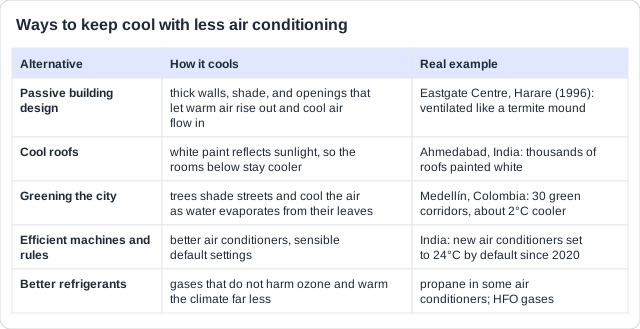
- Improved building design: thick walls, shade, light colours and air flow keep rooms cool without power.
- Cool roofs: white roofs reflect sunlight, so the rooms below stay cooler.
- Greening: trees and parks shade streets and cool the air as water evaporates from leaves.
- Rewilding cities: rivers, wetlands and wild green spaces cool the city and help wildlife.
- But in extreme humid heat these may not be enough: air conditioning can save lives.
Harare
- The Eastgate Centre (1996) copies a termite mound: warm air rises out through chimneys and cool night air is drawn in. It uses about a tenth of the energy of a similar air-conditioned building.
Medellín
- From 2016 to 2019 the city planted over 30 green corridors along roads and streams. Trees give shade, and water evaporates from their leaves: the corridors are about 2°C cooler.
Singapore
- In Bishan-Ang Mo Kio Park (2012) a concrete canal was turned back into a winding river with plants and wildlife: rewilding that cools the area and floods less.
Keep it balanced: Air conditioning is not only a luxury. The 2003 European heatwave killed about 70,000 people. In extreme heat, cooling saves lives, so the aim is cleaner and smarter cooling, not none at all.
How this comes up: Paper 2: a chart of air-conditioning use in different countries to read and explain, or an outline of alternatives. Paper 1 or Section B: evaluate the alternatives, with real examples and a judgement.
Medellín, Colombia, planted over 30 green corridors between 2016 and 2019, and the corridors are now about 2°C cooler. In Harare, Zimbabwe, the Eastgate Centre stays cool with almost no air conditioning.
To what extent can alternatives replace air conditioning in hot cities?
Model answer plan
See the mark-by-mark plan — for / against / judgement, with marking guidance — in study mode.