HFCs at Higher Level: This statement is Higher Level only. It follows what happened after CFCs were banned: their replacements saved the ozone layer but warmed the planet, and the world used the same treaty to fix that too.
Practise this as you read
- Outline why governments agreed to phase down HFCs.
- Identify an advantage and a disadvantage of staggered dates.
Free preview
This is the free notes preview
You're reading the free notes. Aimnova Pro unlocks the full study experience — and you can try it with your first topic free to keep:
- FlashcardsLock in vocabulary and key terms with spaced repetition.
- Practice questionsAnswer exam-style questions and get instant AI marking.
- Mock exams & past-paper vaultSit full mocks and see exactly how examiners award marks.
- Personalised study planA daily plan built around your exam date and weak areas.
A fix for the ozone layer: When CFCs were banned, fridges and air conditioners still needed a coolant. HCFCs came first, then HFCs. With no chlorine, HFCs do almost no harm to the ozone layer.
The points to remember
- CFCs were used as coolants in fridges and air conditioners, in aerosol sprays and in foam.
- The Montreal Protocol (1987) phased CFCs out, so industry needed replacements.
- HCFCs came first: much less ozone-depleting, but still a little, so they are being phased out too.
- HFCs contain no chlorine, so they cause almost no ozone depletion.
- They can be used in the same ways: safe, not flammable, good coolants in the same machines.
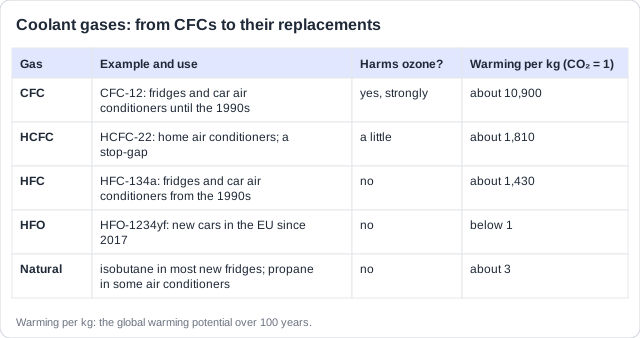
Real example: until the early 1990s, car air conditioners used CFC-12. Carmakers then switched to the HFC HFC-134a, which worked in almost the same way. The ozone layer was protected, but each kilogram that leaked still trapped about 1,430 times as much heat as carbon dioxide.
See how examiners mark answers
Answer exam-style questions with model answers. Learn exactly what earns marks and what doesn't.
HFCs solved the ozone problem but not the climate problem. A gas's global warming potential shows how strongly it warms the Earth compared with carbon dioxide.
Ozone-safe, but potent greenhouse gases
- HFCs are potent greenhouse gases: they absorb outgoing infrared radiation strongly.
- 1 kg of HFC-134a traps about as much heat as 1,430 kg of carbon dioxide over 100 years.
- Their use grew fast as fridges and air conditioners spread, especially in hot, growing economies.
- They leak from appliances during use and when old appliances are scrapped without collecting the gas.
- So fixing one problem, the ozone layer, added to another, climate change.
Remember it as: Safe for ozone, bad for climate.
Real example: in 2017 Project Drawdown, a group of scientists ranking ways to cut warming, put 'refrigerant management' at the top of its list: collecting and destroying the gas in redundant appliances. Most of the gas in a fridge escapes not in the kitchen but at the end of its life, when it is crushed without the gas being collected.
Two traps: Do not write that HFCs damage the ozone layer: they do not. And HCFCs are not the same as HFCs: HCFCs still contain chlorine, so they do a little ozone damage as well as warming.
In 2016, 197 countries met in Kigali, Rwanda, and used the Montreal Protocol, the treaty that saved the ozone layer, to tackle HFCs. The result was the Kigali Amendment, a phasedown.
The Kigali Amendment
- The Kigali Amendment (Rwanda, 2016, in force 2019) added HFCs to the Montreal Protocol.
- It is a phasedown: HFC use is cut by 80-85% by the late 2040s, not banned.
- Staggered dates: rich countries cut from 2019; most developing countries freeze in 2024; a few hot countries in 2028.
- Rich countries pay through the Multilateral Fund to help poorer countries switch.
- If fully followed, it could avoid up to 0.4°C of warming by 2100.
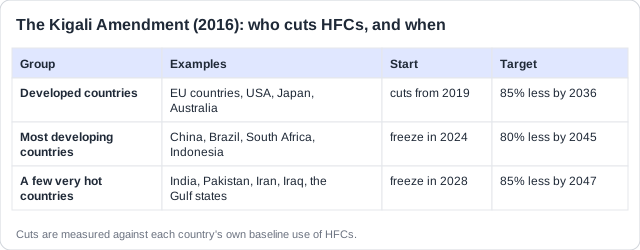
Staggered dates: for
- Poorer countries get time to raise money
- Time to get new technology and train people
- Fairer, so more countries sign up
- Rich countries start cutting sooner
Staggered dates: against
- Full phasedown takes longer
- Firms may move HFC work to late countries
- Late countries may profit from HFC trade
- Unequal rules can cause disputes
Real example: the USA passed a law to cut HFCs by 85% in 2020 and the Senate ratified the Kigali Amendment in September 2022, with support from both parties and from US makers of the new coolants. India, one of the hot countries with later dates, ratified it in 2021.
Why governments agreed
- HFCs were found to be potent greenhouse gases adding to global warming.
- Science showed how fast HFC use, and its warming effect, was growing.
- Governments accepted that it needed international action, as with CFCs.
- Alternatives to HFCs were already being developed.
- Rich countries agreed to pay to help poorer ones switch.
Study smarter, not longer
Most students waste 40% of study time on topics they already know. Our AI tracks your progress and optimizes every minute.
Replacing HFCs means finding coolants that are safe for both the ozone layer and the climate: HFOs and natural refrigerants.
What replaces HFCs
- HFOs: new man-made coolants that break down in days, so they cause almost no warming.
- Natural refrigerants: isobutane and propane, carbon dioxide and ammonia.
- Trade-offs: some are flammable (propane) or toxic (ammonia), and new machines and training cost more.
- Old gas must be collected from fridges and air conditioners before they are scrapped, or it leaks.
Greenfreeze, 1992
- An East German firm, Foron, with Greenpeace
- Used isobutane, a natural gas
- No ozone harm, almost no warming
- Now standard in fridges across Europe
The catch
- Isobutane and propane are flammable
- Only small amounts can be used safely
- Technicians need new training
- Bigger systems may need other gases
Real example: since 2017 every new car sold in the European Union must use an air-conditioning gas with a global warming potential below 150. Carmakers switched from HFC-134a to HFO-1234yf, which breaks down in the air within days.
How this comes up: Paper 2, Section A: a figure comparing CFCs, HCFCs and HFCs, then short parts: why governments agreed to cut HFCs [2], and one advantage and one disadvantage of the staggered dates [1] each.
In September 2022 the United States Senate voted to ratify the Kigali Amendment to the Montreal Protocol, joining well over 100 countries that had already agreed to cut their use of HFCs.
Outline why governments agreed to phase down the use of HFCs in the Kigali Amendment.
Model answer plan
See the mark-by-mark plan — for / against / judgement, with marking guidance — in study mode.