The polar ozone hole at Higher Level: This statement is Higher Level only. It explains why the ozone hole opens over Antarctica every spring: a cold, trapped winter, special clouds, and chlorine waiting for the Sun. You need each condition and what it does.
Practise this as you read
- Explain why polar ozone depletion is greatest in spring.
- Outline why the Antarctic loses more ozone than the Arctic.
Free preview
This is the free notes preview
You're reading the free notes. Aimnova Pro unlocks the full study experience — and you can try it with your first topic free to keep:
- FlashcardsLock in vocabulary and key terms with spaced repetition.
- Practice questionsAnswer exam-style questions and get instant AI marking.
- Mock exams & past-paper vaultSit full mocks and see exactly how examiners award marks.
- Personalised study planA daily plan built around your exam date and weak areas.
Chlorine plus polar weather: Chlorine from CFCs thins the ozone layer everywhere. But over Antarctica, every spring, an ozone hole opens, measured in Dobson units. The cause is the special weather and chemistry of the polar stratosphere.
The points to remember
- The ozone hole opens over Antarctica every spring, from September to November.
- It is deepest in late September and early October, and closes by December.
- An ozone hole is where the ozone layer is below 220 Dobson units.
- It needs ODSs (the chlorine) plus the special polar weather and chemistry.
- It was found in 1985 by scientists of the British Antarctic Survey.
Real example: in 1985 Joe Farman, Brian Gardiner and Jonathan Shanklin of the British Antarctic Survey reported that spring ozone over their Halley base had fallen sharply since the 1970s. Satellites then showed the hole covered the whole continent. In spring 2000 its edge passed over Punta Arenas in southern Chile, and people there were told to cover up against the extra UV.
Practice with exam-style questions
Answer exam-style questions and get AI feedback that shows you exactly what examiners want to see in a full-marks response.
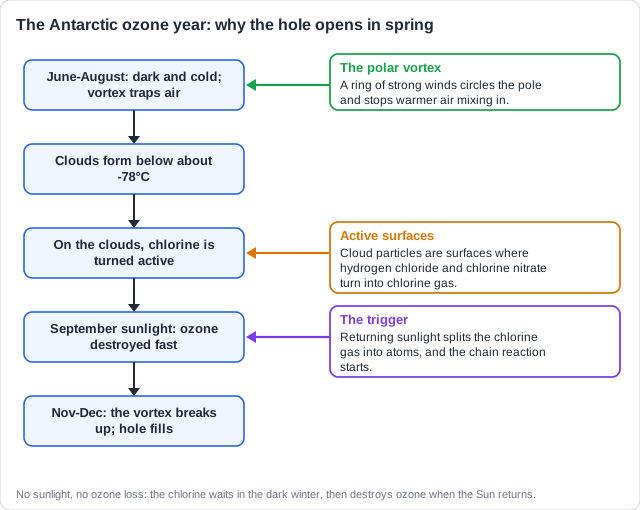
The first set of conditions is the weather. The polar winter does two things: it makes the stratosphere colder than anywhere else on Earth, and it shuts the cold air in.
Cold, dark and trapped
- In the dark polar winter the stratosphere gets extremely cold.
- A polar vortex, a ring of strong winds, isolates the cold air: warmer, ozone-rich air cannot mix in.
- Below about -78°C, polar stratospheric clouds form.
- Over Antarctica these conditions come every winter and last for months.
The polar vortex
- A polar vortex
- Acts like a fence round the pole
- Keeps ozone-rich air out
Polar stratospheric clouds
- polar stratospheric clouds
- Also called mother-of-pearl clouds
- Form only inside the cold vortex
Real example: the winter of 2006 was one of the coldest ever measured in the Antarctic stratosphere. Clouds lasted longer, and the ozone hole that spring was the largest on record, averaging about 26.6 million km²: bigger than North America.
The second set of conditions is the chemistry. Most chlorine in the stratosphere is normally locked up in harmless reservoir gases. The polar clouds set it free.
Active surfaces and spring sunlight
- The cloud particles are active surfaces: reactions happen on them much faster.
- On them, safe reservoir gases turn into chlorine gas: HCl + ClONO₂ → Cl₂ + HNO₃.
- The chlorine gas builds up in the dark, doing no harm yet.
- When sunlight returns in spring, it splits Cl₂ into chlorine atoms, which destroy ozone fast.
- Volcanic aerosols add more surfaces, so a big eruption deepens the ozone loss for a few years.
Remember it as: Cold, clouds, chlorine, then sunlight.
Eruption
- June 1991: Mount Pinatubo in the Philippines put about 15 million tonnes of sulfur dioxide into the stratosphere
Particles
- It formed a haze of sulfate droplets, volcanic aerosols that spread round the world
Surfaces
- The droplets were active surfaces: like the polar clouds, they turned safe chlorine into active chlorine
Ozone loss
- Ozone over much of the world fell to record lows in 1992 and 1993, then recovered as the particles fell out
A balance tipped: Normally ozone is made and destroyed at the same rate, an equilibrium. In the polar spring active chlorine destroys it far faster than sunlight can make it, so the balance tips and a hole forms.
Feeling unprepared for exams?
Get a clear study plan, practice with real questions, and know exactly where you stand before exam day. No more guessing.
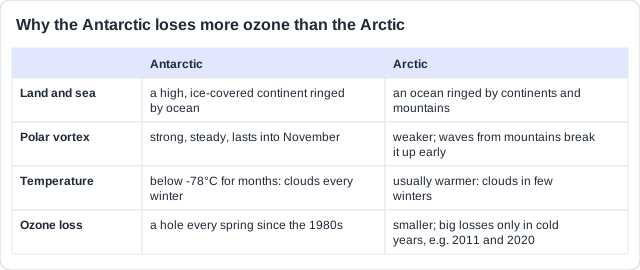
The same chlorine is over both poles. The Antarctic gets a hole every spring and the Arctic usually does not, because of their geography.
Antarctic and Arctic
- The Antarctic is a high, icy continent ringed by ocean: its vortex is strong and steady.
- The Arctic is ocean ringed by land and mountains, which make waves that break up its vortex.
- So the Arctic is warmer: fewer polar stratospheric clouds, and its vortex often ends before spring.
- Arctic ozone loss is smaller and varies; it is large only in very cold years, such as 2011 and 2020.
- More people live near the Arctic, so a big Arctic loss can raise UV over Europe, Canada and Russia.
Real example: in the winter of 2019-2020 the Arctic vortex was unusually strong and cold, and it lasted into April. Polar stratospheric clouds formed for weeks, and in March 2020 ozone over the Arctic fell to the lowest levels ever measured there: a rare Arctic 'hole'.
How this comes up: Paper 2: explain why the hole forms in spring, or why over Antarctica and not the Arctic, often from a graph of ozone through the year. Name the conditions: vortex, cold, clouds, active chlorine, sunlight.
Every year the ozone hole over Antarctica is deepest in late September and early October, then closes by December.
Explain why ozone depletion over Antarctica is greatest in spring.
Model answer plan
See the mark-by-mark plan — for / against / judgement, with marking guidance — in study mode.