Global action at Higher Level: The same statement as SL, with different real cases: Tuvalu, Canada leaving Kyoto, the Montreal Protocol's trade ban and the Kigali Amendment. At HL, judge agreements through law and economics: what binds a sovereign state, and what makes cutting emissions worth its while.
Practise this as you read
- Explain why sovereignty makes pledges voluntary.
- Weigh an agreement: both sides, then a judgement.
Free preview
This is the free notes preview
You're reading the free notes. Aimnova Pro unlocks the full study experience — and you can try it with your first topic free to keep:
- FlashcardsLock in vocabulary and key terms with spaced repetition.
- Practice questionsAnswer exam-style questions and get instant AI marking.
- Mock exams & past-paper vaultSit full mocks and see exactly how examiners award marks.
- Personalised study planA daily plan built around your exam date and weak areas.
One sky, about 200 governments: Greenhouse gases do not stop at borders. The air is a global commons, so cuts by a few countries cannot avoid catastrophic climate change.
The points to remember
- The atmosphere is a global commons: gases from every country mix and warm the whole planet.
- State sovereignty: each country makes its own laws, and no world government can force it to cut.
- If only some states act, others can free-ride: they keep the benefits and avoid the costs.
- Polluting industries can move to countries with weaker rules, so emissions just shift.
- Catastrophic change is avoided only if total global emissions fall.
- So countries must cooperate: negotiate, then sign conventions, protocols and treaties.
Remember it as: One sky, many governments: only a deal between all of them works.
Real example: Tuvalu produces a tiny share of the world's emissions, and most of its land is less than 3 metres above the sea. Nothing Tuvalu does at home can stop the sea rising: it depends on what the big emitters decide.
Use the guide's words: Write state sovereignty, global commons and international cooperation: they show why measures by only some states are not enough.
Never wonder what to study next
Get a personalized daily plan based on your exam date, progress, and weak areas. We'll tell you exactly what to review each day.
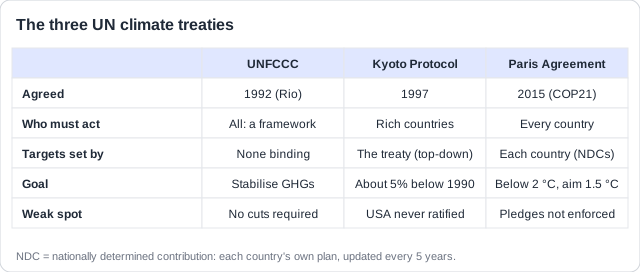
Since 1992 the United Nations has led three main climate agreements. Each one tried to fix the weak spot of the one before.
The UN climate treaties
- UNFCCC (1992, Rio): the framework; aim to stabilise greenhouse gases; almost every country; meets yearly (COP).
- Kyoto Protocol (1997): binding cuts for rich countries only, about 5% below 1990 by 2008-2012.
- Kyoto set targets top-down and allowed carbon trading; the USA never ratified it.
- Paris Agreement (2015): every country; keep warming well below 2 °C, aim for 1.5 °C.
- Paris is bottom-up: each country sets its own plan (NDC) and must strengthen it every 5 years.
- Paris also asks rich countries to give climate finance and all countries to report progress.
Kyoto: top-down
- Targets handed to countries
- Binding, rich countries only
- Big emitters stayed out
Paris: bottom-up
- Each country writes its own plan
- Every country takes part
- Pledges may be too weak
Real example: Canada ratified Kyoto, but its emissions rose instead of falling. In December 2011 it announced it would withdraw, and so avoided any penalty for missing its target: a binding treaty binds only those who stay in.
From talks to rules: Countries agree in steps: they negotiate, sign a framework, add detailed rules, and then look for ways to make others take part.
The tools of global action
- Negotiation: countries meet (the yearly COP) and bargain until all can agree.
- Convention: a broad framework agreement, such as the UNFCCC.
- Protocol: adds detailed, often binding rules to a convention, such as Kyoto.
- Treaty: any written agreement between states that binds those who ratify it.
- Sanctions push countries that do not act, e.g. a cross-border carbon tax on their exports.
- A country can still leave: sovereignty means joining is voluntary.
Real example: the Montreal Protocol (1987) protects the ozone layer. It banned its members from trading the ozone-destroying chemicals with countries that had not joined. By 2009 every UN member had ratified it, the first treaty ever to manage that, and the ozone layer is now slowly recovering.
Do not mix them up: A convention sets the framework; a protocol adds the detailed rules to it. The Kyoto Protocol is a protocol to the UNFCCC convention.
Stop wasting time on topics you know
Our AI identifies your weak areas and focuses your study time where it matters. No more overstudying easy topics.
Questions ask how well international agreements work. Learn both sides, then the values behind each kind of action.
Agreements help
- A global problem needs a global answer: only agreements bring every emitter in.
- UN agreements carry international recognition, and some rules are binding.
- Talks raise the profile of climate change and set shared targets.
- Climate finance and trade deals can make action fair between rich and poor countries.
Agreements fall short
- Agreements take years to negotiate and ratify.
- Most pledges are voluntary: there is no world police to enforce them.
- Countries can leave or free-ride, and short-term politics changes plans.
- Rules can be unfair to some countries, and global emissions are still rising.
Whose values shape global action?
- Anthropocentric values lead most global action: laws, carbon taxes, emissions trading, negotiation.
- Technocentric values: new technology, e.g. renewables, carbon capture, desalination, flood defences.
- Ecocentric values: protect forests (UN-REDD), use less energy, consume less, farm locally.
- Cornucopians say technology will fix it; environmental managers back treaties and markets.
- Soft ecologists want renewables and greener lifestyles; deep ecologists want far lower consumption.
Real example: the Kigali Amendment (2016) added HFCs to the Montreal Protocol. Cutting them could avoid up to about 0.4 °C of warming by 2100: an old, trusted agreement reused for climate.
For a 9-mark essay: Name at least two agreements, give arguments on both sides, link each to a value system, and end with a clear judgement.
How this comes up: Paper 1, from the resource booklet: a 4-mark discuss question with at least one point on each side.
Panama is one of the few countries that removes more carbon dioxide than it emits, thanks to forests covering over half its land. At COP26 in 2021 it asked, with Bhutan and Suriname, for better trade deals in return for staying carbon negative.
Discuss whether international agreements can help countries such as Panama remain carbon negative.
Model answer plan
See the mark-by-mark plan — for / against / judgement, with marking guidance — in study mode.