Decarbonization at Higher Level: The same statement as SL, with different real cases: Costa Rica's renewable electricity, Norway's electric cars, Bhutan's carbon-negative forests and the EU Emissions Trading System. At HL, weigh the economic tools that drive the switch: who pays, and whether the price is high enough to change behaviour.
Practise this as you read
- Explain decarbonization step by step, from power to transport.
- Judge a carbon price: why it can work, and why it can fail.
Free preview
This is the free notes preview
You're reading the free notes. Aimnova Pro unlocks the full study experience — and you can try it with your first topic free to keep:
- FlashcardsLock in vocabulary and key terms with spaced repetition.
- Practice questionsAnswer exam-style questions and get instant AI marking.
- Mock exams & past-paper vaultSit full mocks and see exactly how examiners award marks.
- Personalised study planA daily plan built around your exam date and weak areas.
Take the carbon out of energy: Most carbon dioxide comes from burning fossil fuels for electricity, transport, heat and industry. Decarbonization tackles that source directly.
The points to remember
- Decarbonization: reducing or ending the use of energy sources that release carbon dioxide.
- Those sources are the fossil fuels: coal (the most CO2 per unit of energy), oil and gas.
- They are replaced with renewable energy: solar, wind, hydro, geothermal, tidal.
- Electricity is usually cleaned up first, because power stations are few and large.
- Using less energy (efficiency, insulation) makes the switch faster and cheaper.
Remember it as: Out with coal, oil and gas; in with sun, wind and water.
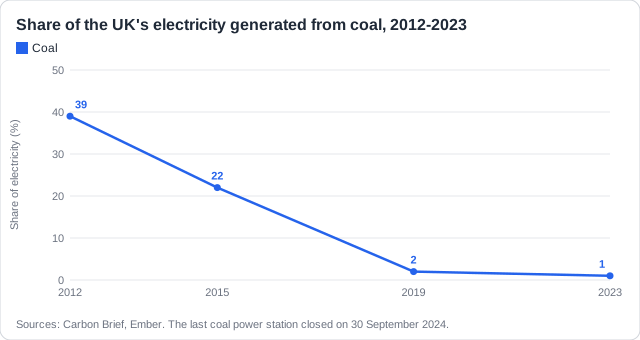
Real example: in 2025 Costa Rica made about 98.6% of its electricity from renewable sources: about 76% from hydro, 12% from wind and 11% from geothermal power. Its electricity is almost carbon free, but its cars still burn petrol and diesel.
Practice with exam-style questions
Answer exam-style questions and get AI feedback that shows you exactly what examiners want to see in a full-marks response.
Clean electricity is only half the job. The other half is making cars, heating and factories run on that electricity instead of on fuel.
Electrification
- Electrification: switching machines from burning fuel to running on electricity.
- Cars and buses become electric vehicles; gas boilers become heat pumps.
- Steelworks can use electric arc furnaces instead of coal-fired blast furnaces.
- It cuts emissions only if the electricity is clean: an electric car charged from coal still pollutes.
- Electric motors waste less energy than engines, so less energy is needed overall.
Electric, clean grid
- Charged from wind, sun, water
- Almost no CO2 in use
- Efficient motor
Electric, coal grid
- Charged from coal power
- CO2 released at the power station
- Smaller saving
Real example: in 2024 almost 89% of new cars sold in Norway were fully electric. Norway's electricity comes almost entirely from hydropower, so each electric car really does cut emissions.
Electric is not always clean: Say where the electricity comes from. An electric bus in a country that burns coal for power still causes carbon dioxide emissions, just at the power station.
Balance the books: Some emissions are very hard to stop, such as those from planes and cement. So the goal is carbon neutrality, not zero.
Carbon neutral, and by when?
- Carbon neutral (net zero): the CO2 released is balanced by the CO2 removed.
- Removal comes from sinks (forests, soils) or carbon capture; offsets pay for removal elsewhere.
- Carbon negative: more removed than released, e.g. Bhutan, Suriname, Panama.
- States set different dates: Finland 2035, Germany 2045, the UK and EU 2050, China 2060, India 2070.
- Dates differ with wealth, energy mix, fossil-fuel jobs and development needs.
- A target is stronger when written into law, weaker as a pledge with no plan.
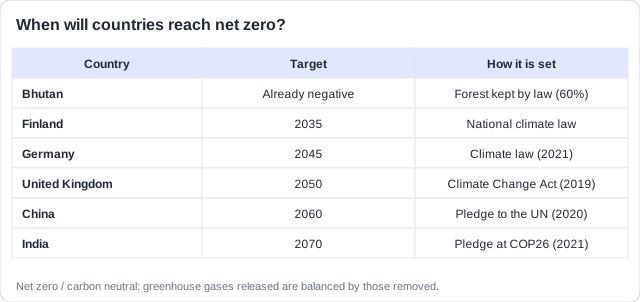
Real example: Bhutan is carbon negative. Its constitution requires at least 60% of the land to stay forest, the forest absorbs about three times the carbon dioxide the country emits, and it exports hydroelectricity to India.
Feeling unprepared for exams?
Get a clear study plan, practice with real questions, and know exactly where you stand before exam day. No more guessing.
Governments rarely ban fossil fuels outright. They make carbon expensive, make clean energy cheap, and set dates.
How countries drive decarbonization
- A carbon tax: a charge per tonne of CO2, so fossil fuels cost more.
- An emissions trading scheme (cap and trade): a cap on total emissions, split into permits.
- Firms that cut sell spare permits; those that pollute must buy more; forests can earn credits.
- Subsidies make renewables and electric vehicles cheaper; phase-out dates end coal and petrol cars.
- Barriers: cost, jobs in coal regions, and wind and sun that vary (storage needed).
Real example: the EU Emissions Trading System began in 2005 and covers about 10,000 power stations and factories. The cap falls every year, and emissions from the sectors it covers fell by almost half between 2005 and 2023, much of it as coal power became too expensive.
Why trading can work
- A price on every tonne
- Cap falls over time
- Forests rewarded
Why it can fail
- Buying permits is cheaper than changing
- Firms plant trees but keep polluting
- Cap set too high, fines too low
- Firms move abroad: jobs lost
Disadvantages that score nothing: Vague answers such as 'it is expensive', 'it limits economic growth', 'rich companies keep polluting' or 'it does not reduce CO2' do not count. Say why: buying permits is cheaper than switching to cleaner technology.
How this comes up: Paper 2, Section B (b): explain a process in seven separate points.
Costa Rica makes about 98.6% of its electricity from renewable sources and aims for net zero emissions by 2050, but transport, mostly petrol and diesel cars, is its largest source of emissions.
Explain how a country can decarbonize its economy to achieve carbon neutrality.
Model answer plan
See the mark-by-mark plan — for / against / judgement, with marking guidance — in study mode.