Responsibility and vulnerability at Higher Level: This statement is Higher Level only. It compares who caused climate change, counted three ways, with who suffers most from it, and asks what is fair: the politics, the money and the ethics of climate justice.
Practise this as you read
- Compare countries by current, cumulative and per-person emissions.
- Explain why the least responsible are often the most vulnerable.
Free preview
This is the free notes preview
You're reading the free notes. Aimnova Pro unlocks the full study experience — and you can try it with your first topic free to keep:
- FlashcardsLock in vocabulary and key terms with spaced repetition.
- Practice questionsAnswer exam-style questions and get instant AI marking.
- Mock exams & past-paper vaultSit full mocks and see exactly how examiners award marks.
- Personalised study planA daily plan built around your exam date and weak areas.
Who caused it? It depends how you count: A country's share of the blame can be counted from what it emits now, from its cumulative emissions since the Industrial Revolution, or per person. Each count tells a different story.
Current and cumulative totals: the points to remember
- Responsibility can be measured in three ways, and each gives a different answer.
- Current totals: what each country emits now; China is largest (about 11.4 billion t in 2022).
- Cumulative totals: all emissions since the Industrial Revolution; the US is largest (about 20 %).
- CO2 stays in the air for centuries, so past emissions still warm the planet today.
- So countries that industrialised first (the US, UK, Germany) carry a large historical share.
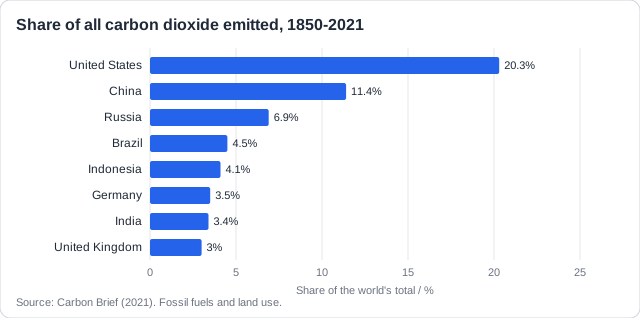
Real example: the United Kingdom, where coal-powered industry began, emits about 1 % of the world's carbon dioxide today. But it has emitted about 3 % of all the carbon dioxide since 1850, almost as much as India, a country with about twenty times as many people.
Never wonder what to study next
Get a personalized daily plan based on your exam date, progress, and weak areas. We'll tell you exactly what to review each day.
Totals favour small countries and punish big ones. Dividing by the population shows how much each person emits, which many see as the fairest measure.
Emissions per person: the points to remember
- Per person = the country's total divided by its population.
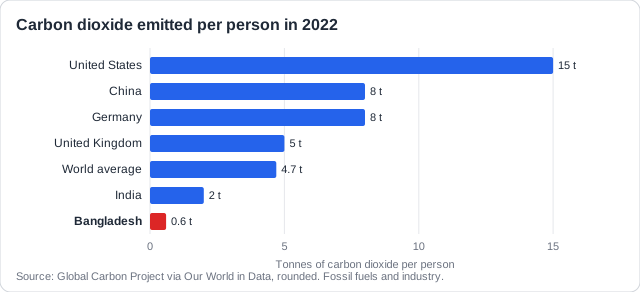
- The US emits about 15 t per person; China about 8 t; India about 2 t; Bangladesh about 0.6 t.
- China's total is twice the US's, but each American emits about twice as much as each Chinese person.
- Rich people everywhere emit most: the richest 10 % caused about half of emissions (1990-2015).
- Which measure is chosen changes who looks responsible: a political choice.
Remember it as: Now, ever, each: three counts, three answers.
Real example: in 2022 India emitted about 2.8 billion tonnes, the third largest total in the world. But with about 1.4 billion people, that is about 2 tonnes each, under half the world average. India argues it should be allowed to grow before cutting as fast as rich countries.
Vulnerability is not the same everywhere. The countries that emitted least are often the most exposed, and have the least adaptive capacity.
Vulnerability: the points to remember
- Vulnerability = exposure + sensitivity - ability to adapt.
- Low-lying places (small islands, river deltas) are exposed to sea level rise and storms.
- Poor countries depend on farming and fishing, so they are sensitive to drought and heat.
- They have less money and technology to adapt: sea walls, irrigation, insurance.
- So the least responsible are often the most vulnerable: Africa emits under 4 % of world CO2.
Tuvalu
- Nine coral islands in the Pacific; about 11,000 people.
- Most land is under 3 m above the sea; salt water spoils crops and wells.
Bangladesh
- About 170 million people, many on a low river delta.
- About 0.3 % of world CO2; a 1 m rise could flood about a sixth of its land.
The Sahel
- Farmers depend on one short rainy season.
- Africa emits under 4 % of world CO2 but faces worsening droughts.
Real example: in 2021 Tuvalu's foreign minister, Simon Kofe, gave his speech to the COP26 climate talks standing knee-deep in the sea on his atoll. In 2023 Tuvalu signed the Falepili Union treaty: Australia will let up to 280 Tuvaluans a year move there.
Stop wasting time on topics you know
Our AI identifies your weak areas and focuses your study time where it matters. No more overstudying easy topics.
If the least responsible suffer most, who should pay? This is the question of climate justice, and of equity. It shapes every climate treaty.
Climate justice, politics and money: the points to remember
- Climate justice: those who caused the most harm, and can pay, should do the most.
- Political: the UN treaty of 1992 says common but differentiated responsibilities.
- Economic: rich countries promised 100 billion US dollars a year in climate finance (2009), reached only in 2022.
- A Loss and Damage Fund was agreed in 2022 to help countries already harmed.
- Arguments against: today's biggest emitter is China; early emitters did not know the harm; paying is unpopular.
- Equity means fair, not equal: different duties for different countries.
Rich, high emitters should pay more
- They caused most of the warming so far
- They grew rich by burning fossil fuels
- They can afford it
- The polluter pays
But...
- China now emits most each year
- Early emitters did not know the harm
- Voters resist paying abroad
- Money pledged is often late or not paid
Real example: at the COP27 talks in Egypt in 2022, countries agreed a fund for loss and damage, and about 700 million US dollars was pledged to it in 2023. In July 2025, after a campaign led by Vanuatu, the International Court of Justice advised that countries have legal duties to cut their emissions.
Use the three lenses: Law: treaties and the court. Economics: who pays, and how much. Ethics: fairness to the poor and to future generations. A strong answer uses at least two.
How this comes up: Paper 2, Section A: charts of emissions (totals, cumulative, per person) to compare and explain. Section B: explain why the least responsible are most vulnerable; discuss or evaluate who should pay, using law, economics and ethics.
Bangladesh emits about 0.6 tonnes of carbon dioxide per person each year, against about 15 tonnes in the United States, yet it is one of the countries most threatened by climate change.
Explain why the countries least responsible for climate change are often the most vulnerable to it.
Model answer plan
See the mark-by-mark plan — for / against / judgement, with marking guidance — in study mode.