Tipping cascades at Higher Level: This statement is Higher Level only. It is about how separate tipping points can interact, so that one element tipping pushes another, and why that makes the future of the climate so uncertain.
Practise this as you read
- Outline a real chain of links between tipping elements.
- Sort tipping elements into biotic, abiotic or a combination.
Free preview
This is the free notes preview
You're reading the free notes. Aimnova Pro unlocks the full study experience — and you can try it with your first topic free to keep:
- FlashcardsLock in vocabulary and key terms with spaced repetition.
- Practice questionsAnswer exam-style questions and get instant AI marking.
- Mock exams & past-paper vaultSit full mocks and see exactly how examiners award marks.
- Personalised study planA daily plan built around your exam date and weak areas.
Falling dominoes: Each tipping element has its own threshold. But they do not sit alone: they share one ocean and one atmosphere. When one tips, it can push the next, starting a tipping cascade.
Tipping cascades: the points to remember
- A tipping element is a big part of the climate system that could tip: an ice sheet, a current, a forest.
- Tipping elements are linked: a change in one pushes on others.
- One tipping can push another closer to or past its own threshold.
- A chain of tippings is a tipping cascade, like a row of dominoes.
- So the thresholds of linked elements can be lower than for each one alone.
Remember it as: One domino falls, the next one wobbles.
Real example: in 2021 Nico Wunderling and colleagues modelled four elements together: the Greenland and West Antarctic ice sheets, the Atlantic currents and the Amazon. The links lowered the warming needed for tipping. The ice sheets often started a cascade, and the Atlantic currents passed it on.
Learn what examiners really want
See exactly what to write to score full marks. Our AI shows you model answers and the key phrases examiners look for.
The guide sorts tipping elements by what they are made of. Some are abiotic, some are biotic, and some are a combination, where living things and physical processes drive each other.
Biotic, abiotic or both: the points to remember
- Tipping elements can be abiotic, biotic or a combination of both.
- Abiotic: non-living, driven by physics: ice sheets, sea ice, ocean currents (AMOC).
- Biotic: living systems: coral reefs, the boreal forest.
- Combination: life and physics together: the Amazon (trees make rain), permafrost (microbes release carbon).
- All kinds can interact: an abiotic change can tip a biotic one, and back.
Abiotic
- Greenland and West Antarctic ice sheets
- Arctic sea ice
- The Atlantic currents (AMOC)
Biotic
- Tropical coral reefs
- The boreal forest of Canada and Siberia
Combination
- The Amazon: trees make much of their own rain
- Permafrost: thawing ice, then microbes releasing carbon
Real example: permafrost in Siberia is a combination. Thawing is physical: ice in the soil melts. What follows is biological: microbes wake up and rot the old plant remains, giving off carbon dioxide and methane, which warm the climate further.
Follow the arrows. Each one is a real way that a change in one element pushes another, often through the AMOC, which links the north and south of the planet.
One possible cascade: the points to remember
- Greenland melts: fresh meltwater flows into the North Atlantic.
- Fresher, lighter water sinks less, so the AMOC weakens.
- A weak AMOC leaves heat in the Southern Ocean, warming West Antarctica.
- It also shifts the tropical rain belt, changing rain over the Amazon and the Sahel.
- Amazon dieback and permafrost thaw release carbon, adding to global warming, which pushes every element.
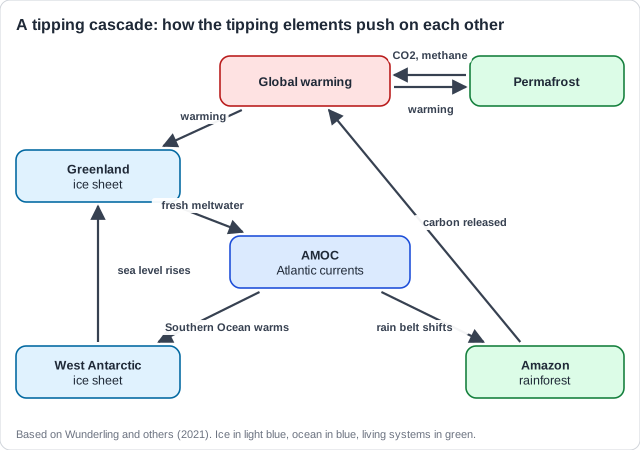
Name both ends of a link: Say which element changes, how the change travels (fresh water, heat, rain, carbon) and which element it pushes: 'Greenland meltwater freshens the North Atlantic, weakening the AMOC'.
Never wonder what to study next
Get a personalized daily plan based on your exam date, progress, and weak areas. We'll tell you exactly what to review each day.
One tipping point is hard enough to predict. Two or more interacting make the scale and the pace of climate change very uncertain.
Why cascades are hard to predict: the points to remember
- Each link adds uncertainty: how strong is it, and how fast?
- Elements tip at different speeds: the AMOC in decades, Greenland over thousands of years.
- Some links are poorly known or left out of climate models.
- So the scale (how much change) and the pace (how fast) of climate change are very uncertain.
- Uncertainty is a reason for caution: the precautionary principle says cut emissions now.
| Element | May tip at | Time to tip once passed |
|---|---|---|
| Labrador Sea convection | about 1.8 °C | about 10 years |
| AMOC | about 4 °C | about 50 years |
| Amazon rainforest | about 3.5 °C | about 100 years |
| Greenland ice sheet | about 1.5 °C | about 10,000 years |
Real example: Armstrong McKay and others (2022) found that at today's warming, about 1.2 °C, five tipping points are already possible, including the Greenland and West Antarctic ice sheets. Because links could set off others, scientists argue for the precautionary principle: keep warming as close to 1.5 °C as possible.
How this comes up: Paper 2, Section A: a map or diagram of tipping elements to read, with a link to outline or explain. Section B: explain how tipping points interact, or discuss what cascades mean for predictions and for action.
Scientists warn that the melting of the Greenland ice sheet could weaken the Atlantic Meridional Overturning Circulation (AMOC), which in turn could affect the Amazon rainforest.
Explain how a tipping cascade like this could make the future of the climate harder to predict.
Model answer plan
See the mark-by-mark plan — for / against / judgement, with marking guidance — in study mode.