Critical thresholds at Higher Level: This statement is Higher Level only. It is about tipping points in the climate system: how positive feedback pushes a system past a critical threshold to a new equilibrium, and what happens when ice sheets, ocean currents or rainforests tip.
Practise this as you read
- Identify the element closest to its tipping point on a chart or map.
- Predict the impacts of an element tipping, each with its consequence.
Free preview
This is the free notes preview
You're reading the free notes. Aimnova Pro unlocks the full study experience — and you can try it with your first topic free to keep:
- FlashcardsLock in vocabulary and key terms with spaced repetition.
- Practice questionsAnswer exam-style questions and get instant AI marking.
- Mock exams & past-paper vaultSit full mocks and see exactly how examiners award marks.
- Personalised study planA daily plan built around your exam date and weak areas.
A small push, a big shift: Climate models show that the Earth may approach a critical threshold. Past it, a system does not just change a little more: it shifts to a new equilibrium, often fast and for good.
Critical thresholds: the points to remember
- A critical threshold (tipping point) is a level beyond which a small extra push causes a big change.
- Positive feedback then drives the system on by itself to a new equilibrium.
- The change can be rapid, unanticipated and catastrophic.
- It is hard or impossible to reverse: going back needs far more than undoing the push.
- Thresholds exist in global systems (ice sheets, ocean currents) and local ones (a reef, a lake).
Before the threshold
- Change is gradual
- The system recovers
- Negative feedback keeps it steady
After the threshold
- Change is rapid
- No way back, even if the push stops
- Positive feedback drives a new state
Real example (local): on the Great Barrier Reef, Australia, ocean heatwaves caused mass bleaching in 2016, 2017, 2020, 2022 and 2024. Reefs need about ten years to recover between events. Where the gaps are too short, dead coral is taken over by seaweed: a new, poorer state that holds.
Study smarter, not longer
Most students waste 40% of study time on topics they already know. Our AI tracks your progress and optimizes every minute.
A threshold is crossed when a positive feedback loop takes over. The Amazon rainforest makes much of its own rain through transpiration, so losing trees means losing rain.
Positive feedback to a tipping point: the points to remember
- Positive feedback amplifies a change: each step makes the next one bigger.
- In the Amazon, fewer trees mean less transpiration, so less rain falls.
- Less rain and longer dry seasons mean more drought and fire, which kill more trees.
- Past a threshold, the forest cannot recover: it shifts to savanna, like the Cerrado next to it.
- Scientists warn the threshold may be 20-25 % deforestation or about 3.5 °C of warming.
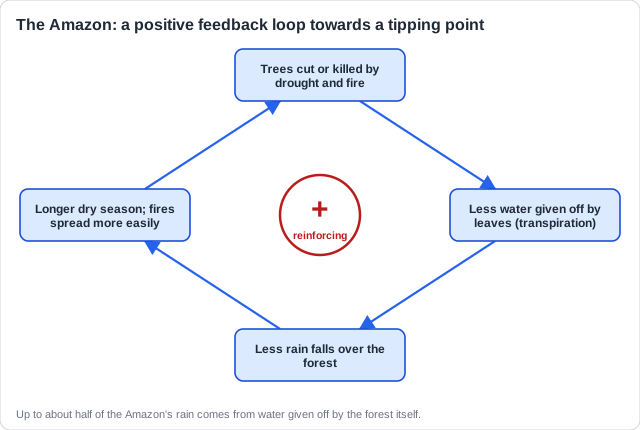
Remember it as: Fewer trees, less rain, more fire, fewer trees.
Real example: about 17 % of the Amazon had been cleared by 2018, close to the 20-25 % that scientists warn could tip it. Air samples show the south-east Amazon already gives out more carbon than it takes in (Gatti and others, 2021). Parts may turn into savanna like the Cerrado: the Amazon-Cerrado transition.
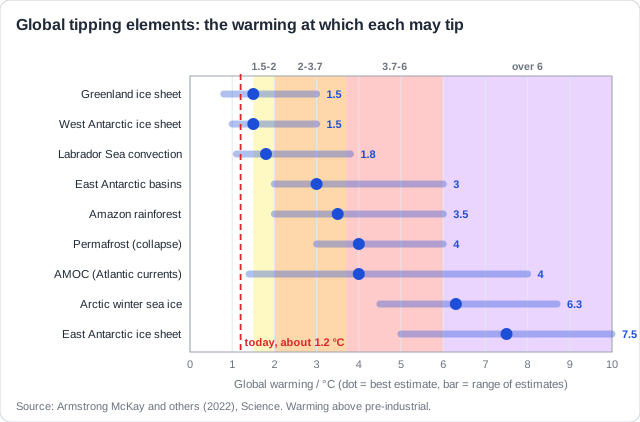
The ice sheets of Antarctica and Greenland have some of the lowest thresholds of all. Read the chart: the closer a dot is to today's warming, the nearer that element is to tipping.
Ice sheets at the threshold: the points to remember
- The West Antarctic and Greenland ice sheets may tip at only about 1.5 °C (range 0.8-3 °C).
- West Antarctica sits on rock below sea level: warm water melts it from below, so more ice floats away.
- Greenland: as the ice surface melts lower, it sits in warmer air and melts faster.
- Melting ice exposes darker rock and sea: lower albedo, more warming, more melting.
- Past the threshold, ice loss accelerates and continues for centuries: sea level rises by metres.
Real example: Thwaites Glacier in West Antarctica is melting where warm sea water reaches its grounding line. On its own it holds enough ice to raise the sea by about 65 cm; the whole West Antarctic ice sheet, about 3.3 m. Greenland lost about 270 billion tonnes of ice a year from 2002 to 2023, measured from space.
Closest to tipping = the lowest threshold: On a tipping-point chart or map, the element closest to its tipping point is the one with the lowest temperature threshold: here the West Antarctic or Greenland ice sheet, or Labrador Sea convection.
Practice with exam-style questions
Answer exam-style questions and get AI feedback that shows you exactly what examiners want to see in a full-marks response.
What happens if an ice sheet passes its tipping point? Each impact is a chain: more melting, a darker surface with lower albedo, higher seas, and fresher, less salty water.
Impacts of an ice sheet tipping: the points to remember
- Ice loss speeds up, even if warming stops.
- Lower albedo: less sunlight reflected, so more global warming.
- Sea level rises (Greenland about 7 m in total), causing coastal flooding and erosion.
- Fresh meltwater lowers the salinity of the ocean and slows ocean currents.
- Habitats lost: tundra, coastal wetlands and marine ecosystems are disrupted.
On the ice
- Ice loss speeds up and goes on for centuries.
- Darker rock and sea absorb more sunlight: more warming.
On the coast
- Sea level rises: Greenland holds about 7 m.
- Coastal flooding and erosion; wetlands and low islands lost.
In the ocean
- Fresh meltwater lowers the salinity of the North Atlantic.
- Ocean currents slow; marine and tundra habitats are disrupted.
Predict means a consequence: A 'predict' question wants what will happen, not why the ice melts. Each impact needs its effect: not just 'melting', but 'faster ice loss raises sea level, flooding coasts'.
The guide's second example is the slowing of the Atlantic thermohaline circulation, the AMOC. It is driven by differences in heat and salinity, so melting ice and warming can switch it down.
The Atlantic circulation slows: the points to remember
- The AMOC carries warm, salty water north; there it cools, sinks and flows back south.
- Warming and fresh meltwater make the surface water lighter, so it sinks less.
- Less sinking slows the whole circulation: a positive feedback, as less salt is carried north.
- Past a threshold it could collapse to a weak new state, for centuries.
- Impacts: colder north-west Europe, shifted rain belts (drier Sahel, weaker monsoons), higher seas off North America.
North
The Gulf Stream carries warm, salty water from the tropics towards Greenland and Iceland.
Sink
There it cools, becomes dense and sinks, pulling more warm water north behind it.
Freshen
Greenland meltwater and rain make the surface fresher and lighter, so less of it sinks.
Slow
The circulation weakens; less salt and heat come north, so sinking weakens further.
Real example: studies of ocean records suggest the AMOC is weaker now than at any time in over 1,000 years (Caesar and others, 2021). A collapse would cool north-west Europe, push the tropical rain belt south, drying the Sahel, and raise the sea along the east coast of North America.
Feeling unprepared for exams?
Get a clear study plan, practice with real questions, and know exactly where you stand before exam day. No more guessing.
How this comes up: Paper 2, Section A (May 2026 HL): a map of tipping elements coloured by threshold. Identify the element closest to its tipping point [1]; predict two impacts of one element tipping [2].
A chart of climate tipping elements shows that the West Antarctic ice sheet may reach its tipping point at about 1.5 °C of global warming.
Predict two environmental impacts of the West Antarctic ice sheet reaching its tipping point.
Model answer plan
See the mark-by-mark plan — for / against / judgement, with marking guidance — in study mode.