Life and the changing atmosphere at Higher Level: This statement is Higher Level only. It tells how life changed the air, from a volcanic mix with no oxygen to today's 21% oxygen, and how the new air, with its ozone layer, changed life in return.
Practise this as you read
- Explain how photosynthesis led to iron ore and the ozone layer.
- Give one way the changed air shaped the evolution of life.
Free preview
This is the free notes preview
You're reading the free notes. Aimnova Pro unlocks the full study experience — and you can try it with your first topic free to keep:
- FlashcardsLock in vocabulary and key terms with spaced repetition.
- Practice questionsAnswer exam-style questions and get instant AI marking.
- Mock exams & past-paper vaultSit full mocks and see exactly how examiners award marks.
- Personalised study planA daily plan built around your exam date and weak areas.
Life made the air we breathe: The Earth's first atmosphere, the pre-biotic one, had almost no oxygen. Nearly all the oxygen in today's air was put there by living things.
The points to remember
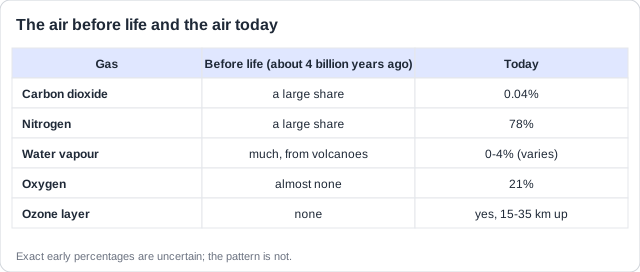
- The pre-biotic atmosphere came from volcanoes: mostly carbon dioxide, nitrogen and water vapour.
- It had almost no free oxygen.
- With no oxygen there was no ozone layer, so strong ultraviolet reached the surface.
- Today's air is very different: 78% nitrogen, 21% oxygen and only 0.04% carbon dioxide.
- The difference was made by life.
Real example: the gas that comes out of Kilauea volcano in Hawaii today is mostly water vapour, carbon dioxide and sulfur dioxide, with no oxygen. The early atmosphere was built from gases like these, given off by thousands of volcanoes.
Get feedback like a real examiner
Submit your answers and get instant feedback — what you did well, what's missing, and exactly what to write to score full marks.
The change began with cyanobacteria. They used sunlight to turn carbon dioxide and water into food, and released oxygen as a waste product.
How photosynthesis changed the air
- Cyanobacteria were the first living things to photosynthesise and release oxygen.
- Photosynthesis took carbon dioxide out of the air and put oxygen in.
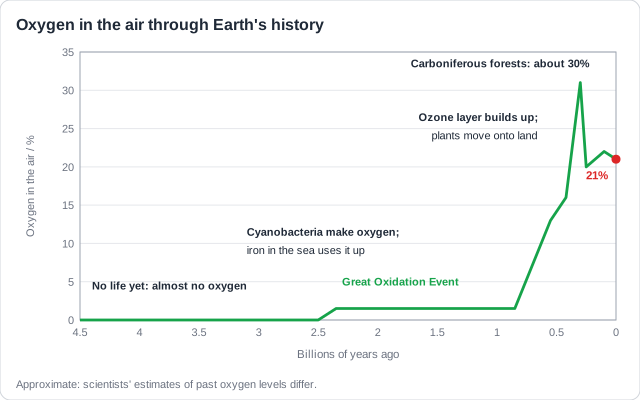
- Over very long times, CO2 fell and oxygen rose: the composition of the atmosphere changed.
- Carbon was locked away in limestone, organic matter and later fossil fuels.
- The oxygen built up in the air in the Great Oxidation Event, and rose again much later.
Remember it as: Life made the air; the air made life.
Real example: at Hamelin Pool in Shark Bay, Western Australia, living cyanobacteria still build stromatolites. Fossil stromatolites in the Pilbara region of the same state are about 3.5 billion years old, among the oldest signs of life on Earth.
Oxygen is very reactive. The first oxygen made by cyanobacteria did not stay in the air: it made iron in the oceans oxidise. Only after that could the Great Oxidation Event begin.
From oxygen to iron ore
- The first oxygen did not stay in the air: it reacted with iron dissolved in the oceans.
- The iron oxidised (rusted) and sank to the sea floor as iron oxide.
- Layer upon layer built banded iron formations: most of the world's iron ore today.
- Only when most of the iron was used up could oxygen build up in the air.
- Oxygen also oxidised rocks on land, turning some soils and rocks red.
Iron
- Ancient oceans held huge amounts of dissolved iron, from volcanoes and rocks
Oxygen
- Cyanobacteria near the surface released oxygen into the water
Rust
- The iron oxidised into iron oxide, which sank and settled on the sea floor in red layers
Ore
- These banded iron formations now form the Hamersley Range, mined at Mount Whaleback near Newman, one of the largest iron-ore mines in the world
Link it to the air: Do not stop at 'iron ore formed'. Say why it matters for the atmosphere: the iron soaked up the oxygen, so oxygen could build up in the air only once the banded iron formations had used up most of the iron.
Learn what examiners really want
See exactly what to write to score full marks. Our AI shows you model answers and the key phrases examiners look for.
More oxygen in the air meant something new high above the Earth: an ozone layer. It shields the surface from ultraviolet light, and that opened the land to life.
Oxygen, ozone and life on land
- Once there was oxygen in the air, ultraviolet light split O2 in the stratosphere and ozone (O3) formed.
- The ozone layer absorbs most of the Sun's harmful ultraviolet.
- Before it formed, ultraviolet damaged DNA, so life could survive only under water.
- With the shield in place, plants and then animals moved onto land.
- So oxygen made by life made the land habitable.
Oxygen rises
Photosynthesis builds up O2 in the air.
Ozone forms
Ultraviolet splits O2; the atoms join O2 to make O3.
A shield
The ozone layer absorbs most harmful ultraviolet.
Life on land
Plants, then animals, can survive out of the water.
Real example: the oldest spores of land plants, small plants like today's liverworts, are about 470 million years old. Water had protected life from ultraviolet for billions of years before that; the ozone layer let it leave the water.
The story runs both ways. Once life had changed the air, the new air changed which kinds of life could evolve and thrive.
How the atmosphere changed life
- The new atmosphere changed which life could evolve: it worked both ways.
- Oxygen poisoned many anaerobic microbes; they survive only where there is no oxygen.
- Aerobic respiration releases far more energy, so large, active animals could evolve.
- High oxygen in the Carboniferous let insects grow huge; land forests also drew down CO2.
- Today humans are changing the air again: CO2 from fossil fuels, the carbon life stored long ago.
| Change in the air | Effect on life | Real example |
|---|---|---|
| Oxygen appears | oxygen is a poison to many anaerobic microbes | methane-making microbes now live only in oxygen-free mud and guts |
| More oxygen | aerobic respiration gives more energy: large animals | the first large, active animals in the seas |
| Oxygen about 30% | insects can grow very large | Meganeura, wingspan about 70 cm (fossils in France) |
Real example: the microbes that make methane in rice paddies and in cows' stomachs are anaerobic: they are descendants of the life that ruled before oxygen, pushed into the few places oxygen cannot reach. Large animals like us, which rely on aerobic respiration, could only evolve once oxygen was plentiful.
Never wonder what to study next
Get a personalized daily plan based on your exam date, progress, and weak areas. We'll tell you exactly what to review each day.
How this comes up: Paper 2, Section A: a graph of oxygen through Earth's history, or a table of the early and modern air, to describe and explain. Section B: explain how life and the atmosphere have changed each other.
In the Hamersley Range of Western Australia, red bands of iron ore more than 2 billion years old are mined on a huge scale. They formed in an ancient ocean.
Explain how the evolution of photosynthesis led to the formation of iron ore and changed the atmosphere.
Model answer plan
See the mark-by-mark plan — for / against / judgement, with marking guidance — in study mode.