Leaving the glacial cycle at Higher Level: This statement is Higher Level only. It shows how today's warming is taking the Earth out of the 2.5-million-year rhythm of ice ages, why the speed of the change is new, and how to test the effect of a gas or of albedo in a sealed bottle.
Practise this as you read
- Compare today's carbon dioxide with its natural range.
- Plan a closed-system investigation.
Free preview
This is the free notes preview
You're reading the free notes. Aimnova Pro unlocks the full study experience — and you can try it with your first topic free to keep:
- FlashcardsLock in vocabulary and key terms with spaced repetition.
- Practice questionsAnswer exam-style questions and get instant AI marking.
- Mock exams & past-paper vaultSit full mocks and see exactly how examiners award marks.
- Personalised study planA daily plan built around your exam date and weak areas.
2.5 million years of ice ages: For the whole Quaternary, the Earth has swung between glacial and interglacial periods, like a slow heartbeat. All of human history has happened inside one warm interglacial, the Holocene.
The points to remember
- The Quaternary period began about 2.5 million years ago: it is the age of the ice ages.
- Its climate has swung between glacials and interglacials, paced by Milankovitch cycles.
- Each cycle took about 41,000 years at first, and about 100,000 years in the last million years.
- Through it all, CO2 stayed between about 180 and 300 ppm.
- We live in an interglacial, the Holocene, which began about 11,700 years ago.
Remember it as: Ice, thaw, ice, thaw: a rhythm that has lasted 2.5 million years.
Real example: the Great Lakes of North America were dug out by the ice sheets of the last glacials, and filled with meltwater as the ice retreated about 15,000 to 10,000 years ago. The fjords of Norway were carved by glaciers in the same way.
Feeling unprepared for exams?
Get a clear study plan, practice with real questions, and know exactly where you stand before exam day. No more guessing.
For 800,000 years, carbon dioxide rose and fell between about 180 and 300 ppm. In under 200 years, humans have pushed it far above that range.
How global warming breaks the cycle
- CO2 is now about 424 ppm (2024): far above the highest natural level of about 300 ppm.
- Humans added it in under 200 years, mainly by burning fossil fuels and clearing forests.
- The extra CO2 keeps trapping heat, so the Earth is warming instead of slowly cooling.
- The next glacial was not due for about 50,000 years; the carbon we emit could delay it by 100,000 years or more.
- So the Earth is leaving the glacial-interglacial cycle, towards new, hotter conditions.
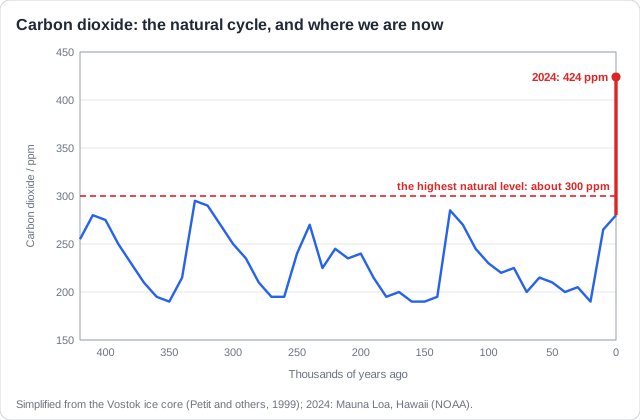
Real example: in 2016, scientists at the Potsdam Institute in Germany (Ganopolski and others) found that the next glacial was unlikely for 50,000 years anyway, and that emitting 1,000 to 1,500 billion tonnes of carbon would delay it by at least 100,000 years. Humans have already emitted about 700 billion tonnes.
The climate has always changed. What is new is the speed. The changes of the last 150 years are faster than any natural change in the ice-core record.
Natural change, and today's change
- Climate has changed without humans before: ice ages, and much warmer times.
- But natural changes were slow: thousands of years.
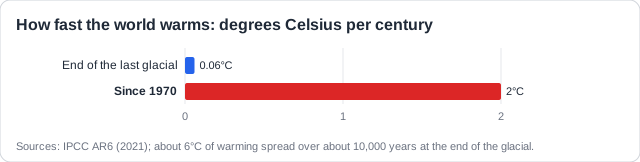
- At the end of the last glacial, the world warmed about 6°C in about 10,000 years: about 0.06°C a century.
- Since 1970 it has warmed about 0.2°C a decade: about 2°C a century, more than 20 times faster.
- This unprecedentedly rapid change is why many scientists call our time the Anthropocene.
Real example: 56 million years ago, long before humans, a huge release of carbon warmed the Earth by 5-8°C. Scientists call it the PETM. It is the closest natural match to today, but it took thousands of years.
Memorize terms 3x faster
Smart flashcards show you cards right before you forget them. Perfect for definitions and key concepts.
Where is the climate going? Not back into the next glacial, but towards conditions the Quaternary has never seen. Many scientists call this new epoch the Anthropocene.
Towards new, hotter conditions
- The last time CO2 was about 400 ppm was about 3 million years ago, before the Quaternary began.
- The world then was about 3°C warmer and the seas 5-25 m higher.
- Today's climate is heading out of the range of every glacial and interglacial in 2.5 million years.
- Feedbacks such as melting ice and thawing permafrost could push it further: a 'hothouse Earth'.
- The Anthropocene is the proposed epoch for this time, when humans drive the Earth's changes.
| Last glacial (21,000 years ago) | Pre-industrial (1850) | Today | Pliocene (3 million years ago) | |
|---|---|---|---|---|
| CO2 | about 190 ppm | about 280 ppm | 424 ppm (2024) | about 400 ppm |
| World temperature | about 6°C colder | the baseline | about 1.2°C warmer (2015-2024) | about 3°C warmer |
| Sea level | about 120 m lower | the baseline | about 0.2 m higher | 5-25 m higher |
Real example: on Ellesmere Island in the Canadian Arctic, where there is now tundra, scientists have found the remains of a forest and a beaver dam from the Pliocene, when CO2 was about as high as today. At Crawford Lake in Canada, mud layers holding plutonium from 1950s bomb tests were proposed in 2023 as the marker of the Anthropocene; the scientists who decide such names voted not to adopt it in 2024, but the term is still widely used.
You can test the idea in the lab with a closed system: a sealed bottle under a lamp. Change the gas inside, or the albedo of the surface, and record the temperature. Keep the control variables the same.
Investigating a closed system
- Model the atmosphere with a closed system: a sealed bottle or jar under a lamp (the Sun).
- Change one thing: the gas inside (air or CO2) or the surface (dark or white) for albedo.
- Measure the temperature inside every few minutes with a thermometer or probe.
- Keep the same: bottle size, lamp, distance, starting temperature, time. Repeat to check.
- Limits: a bottle is not the real atmosphere: far more CO2, no wind, no oceans, and the plastic absorbs heat too.
Question
- Does carbon dioxide make a sealed bottle warm up more than air?
Method
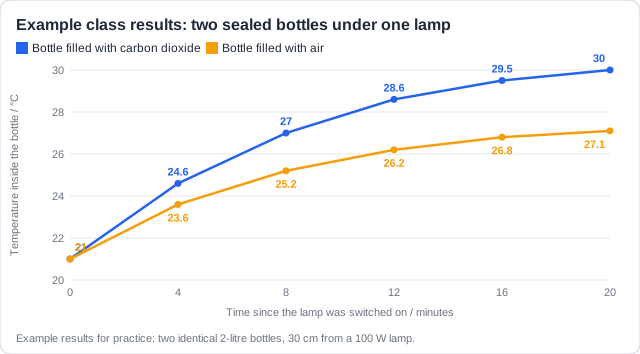
- Two 2-litre bottles, 30 cm from one 100 W lamp; one filled with CO2 from vinegar and baking soda; temperature read every 4 minutes
Result
- CO2: 21 to 30°C. Air: 21 to 27.1°C. CO2 traps more heat
Limits
- Nearly 100% CO2, not 0.04%; no wind or oceans; one trial only; repeat it three times
Know your predicted grade
Take timed mock exams and get detailed feedback on every answer. See exactly where you're losing marks.
How this comes up: Paper 2, Section A: an ice-core graph with today's carbon dioxide, or the results of a bottle investigation. Section B: explain or discuss how today's change differs from the natural cycle.
Over the last 800,000 years, carbon dioxide in the air has stayed between about 180 and 300 ppm. At Mauna Loa, Hawaii, it reached 424 ppm in 2024.
Explain why current global warming is moving the Earth away from the glacial-interglacial cycle.
Model answer plan
See the mark-by-mark plan — for / against / judgement, with marking guidance — in study mode.