Milankovitch cycles at Higher Level: This statement is Higher Level only. It explains the three slow changes in the Earth's orbit and axis, how positive feedback turns them into glacials and interglacials, and why they do not explain current warming.
Practise this as you read
- Draw and name the three cycles with their periods.
- Explain the feedback loop from a cool summer to a glacial.
Free preview
This is the free notes preview
You're reading the free notes. Aimnova Pro unlocks the full study experience — and you can try it with your first topic free to keep:
- FlashcardsLock in vocabulary and key terms with spaced repetition.
- Practice questionsAnswer exam-style questions and get instant AI marking.
- Mock exams & past-paper vaultSit full mocks and see exactly how examiners award marks.
- Personalised study planA daily plan built around your exam date and weak areas.
The orbit sets the rhythm of the ice ages: The Earth's orbit and the tilt of its axis change slowly and regularly. These changes move sunlight between the seasons and between north and south, and they set the rhythm of glacial and interglacial periods.
The points to remember
- Milankovitch cycles are slow, regular changes in the Earth's orbit and axis.
- They change how much sunlight reaches each part of the Earth in each season.
- What matters most is summer sunshine in the far north, where the big ice sheets grow.
- Cool northern summers let snow survive, so ice sheets grow: a glacial. Warm ones melt them: an interglacial.
- They work over tens to hundreds of thousands of years.
Remember it as: Shape, tilt, wobble: about 100, 41 and 23 thousand years.
Real example: the Serbian scientist Milutin Milanković worked out the cycles by hand in the 1920s and 1930s. In 1976, Hays, Imbrie and Shackleton found his rhythms of about 100,000, 41,000 and 23,000 years in sediment cores from the Indian Ocean, the proof that the orbit paces the ice ages.
Get feedback like a real examiner
Submit your answers and get instant feedback — what you did well, what's missing, and exactly what to write to score full marks.
The first cycle is the shape of the orbit, its eccentricity. The Sun is not at the centre of the orbit, so the Earth is closer to it at one time of year than at another.
Orbit shape (eccentricity)
- The shape of the orbit changes from nearly circular to more elliptical and back.
- One cycle takes about 100,000 years.
- In a more elliptical orbit the Earth is much closer to the Sun at one point than at another.
- So the difference between seasons grows: one season gets far more sunlight than the opposite one.
- Today the orbit is nearly circular: only about 7% more sunlight in January than in July.
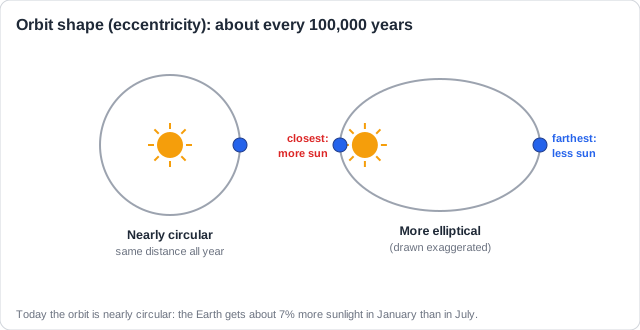
Real example: the Earth is closest to the Sun around 3 January, about 147 million km away, and farthest around 4 July, about 152 million km away. That small difference already gives about 7% more sunlight in January.
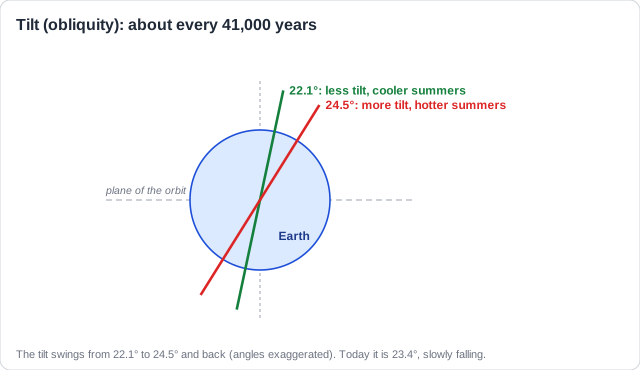
The second cycle is the tilt, or obliquity, of the axis. The tilt is what gives us seasons at all, so a bigger tilt makes the seasons stronger.
Tilt (obliquity)
- The tilt of the axis swings between 22.1° and 24.5°.
- One cycle takes about 41,000 years. Today it is 23.4° and slowly falling.
- More tilt: hotter summers and colder winters, especially near the poles.
- Less tilt: cooler summers, so winter snow near the poles survives the summer.
- So low tilt helps ice sheets grow; high tilt helps them melt.
Real example: the Arctic Circle is set by the tilt. As the tilt slowly falls from 23.4°, the Arctic Circle in Norway and Finland creeps north by about 14 m a year, and the Arctic's summer sunshine slowly weakens.
Learn what examiners really want
See exactly what to write to score full marks. Our AI shows you model answers and the key phrases examiners look for.
The third cycle is the wobble, or precession, of the axis. It does not change the tilt; it changes where in the orbit each season happens.
Wobble (precession)
- The axis wobbles slowly, like a spinning top, tracing a circle.
- One cycle takes about 23,000 years.
- The wobble decides which season falls when the Earth is closest to the Sun.
- If northern summer comes at the closest point, northern summers are stronger: ice melts.
- Today northern summer comes at the farthest point, so northern summers are milder.
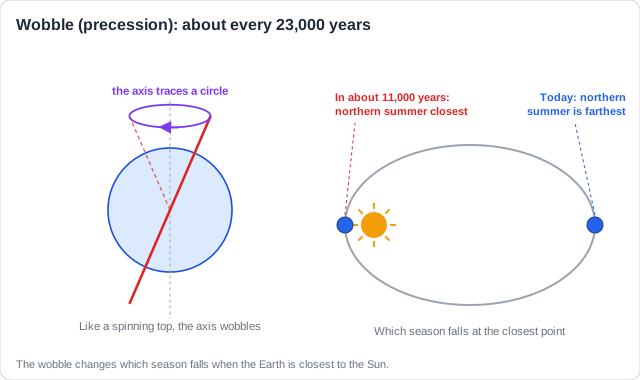
Real example: about 11,000 years ago, northern summer came at the closest point to the Sun. Strong summer sunshine helped melt the last great ice sheet over Canada, and North Africa was wetter: the Sahara had lakes, hippos and grassland.
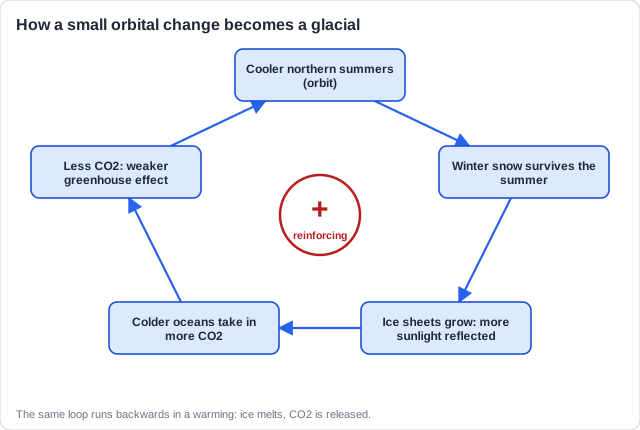
On their own the cycles change the sunlight only a little. Positive feedback turns that small push into a glacial or an interglacial. The proof is in ice cores from Antarctica.
From a small push to an ice age
- The orbital change itself is small; positive feedback makes it big.
- Ice feedback: more ice reflects more sunlight (higher albedo), so it cools further and more ice grows.
- CO2 feedback: colder oceans dissolve more CO2, so less CO2 in the air means a weaker greenhouse effect.
- Cooling → falling CO2 → more cooling: a glacial (CO2 about 180-190 ppm).
- Warming → rising CO2 → more warming: an interglacial (CO2 about 280-300 ppm).
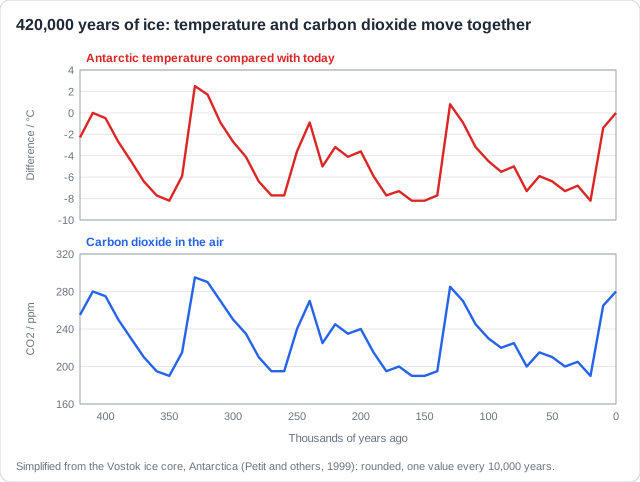
- So temperature and CO2 rise and fall together in the ice-core record.
The Vostok ice core, drilled by Russian, French and American scientists in Antarctica, holds air bubbles up to 420,000 years old. It shows four glacial cycles, with temperature and carbon dioxide rising and falling together.
Real example: at the peak of the last glacial, about 21,000 years ago, ice up to 3 km thick covered Canada and reached New York, and the sea was about 120 m lower, so Britain was joined to Europe by dry land.
Never wonder what to study next
Get a personalized daily plan based on your exam date, progress, and weak areas. We'll tell you exactly what to review each day.
Milankovitch cycles explain the ice ages, but not today's warming. Compare the speed and the direction of the change.
Why they do not explain current warming
- Milankovitch cycles take thousands of years; today's warming happened in under 200 years.
- Today's orbit should be slowly cooling the north: low eccentricity, falling tilt, summer at the farthest point.
- The Sun's output, measured by satellites since 1978, has not risen.
- Yet the world has warmed by about 1.1°C since 1850-1900, as CO2 rose from about 280 to 424 ppm.
- So current warming is caused by human greenhouse gases, not by the orbit.
Milankovitch cycles
- Work over thousands of years
- Today pushing the north slowly cooler
- Move sunlight between seasons
- CO2 follows the orbit's push
Warming since 1850
- Under 200 years
- The whole world warming fast
- The Sun's output has not risen
- CO2 from burning fossil fuels leads
A common mistake: Do not say that today's warming could be 'just a natural cycle'. The orbit changes far too slowly, and right now it points the other way.
How this comes up: Paper 2, Section A: an ice-core graph or a drawing of the three cycles, to identify and explain. Section B: outline the three cycles, or explain why they cannot explain current warming.
Air bubbles in the Vostok ice core, Antarctica, show that carbon dioxide fell from about 280 ppm to about 190 ppm as the last glacial began.
Explain how Milankovitch cycles and positive feedback can turn a small orbital change into a glacial.
Model answer plan
See the mark-by-mark plan — for / against / judgement, with marking guidance — in study mode.