Gravity and the atmosphere at Higher Level: This statement is Higher Level only. It explains why the air is thickest near the ground and thins with height, and how fast the temperature falls as you climb: the lapse rate.
Practise this as you read
- Explain why air density and pressure fall with height.
- Use the lapse rate: about 1°C per 100 m.
Free preview
This is the free notes preview
You're reading the free notes. Aimnova Pro unlocks the full study experience — and you can try it with your first topic free to keep:
- FlashcardsLock in vocabulary and key terms with spaced repetition.
- Practice questionsAnswer exam-style questions and get instant AI marking.
- Mock exams & past-paper vaultSit full mocks and see exactly how examiners award marks.
- Personalised study planA daily plan built around your exam date and weak areas.
Gravity holds the air down: Air is made of molecules, and gravity pulls them all towards the Earth. That is why most of the air is close to the ground, and why the atmosphere gets thinner as altitude increases.
The points to remember
- Gravity pulls every molecule of the air towards the Earth's surface.
- Gravity is weaker further away from the Earth, so molecules are held most strongly close to the ground.
- So most of the air's molecules are found low down, and the atmosphere thins with altitude.
- There is no sharp edge: the air just gets thinner and thinner until it fades into space.
- A body with weak gravity cannot hold much air: the Moon has almost none.
Remember it as: Gravity pulls down, so the air piles up at the bottom.
| Body | Gravity (Earth = 100%) | Air at the surface |
|---|---|---|
| Earth | 100% | a thick atmosphere: about 1013 hPa |
| Mars | 38% | very thin: under 1% of Earth's |
| Moon | 17% | almost none |
Real example: the Moon's gravity is only one-sixth of the Earth's, too weak to hold on to a layer of gas, so the Apollo astronauts needed spacesuits for every step. Mars, with weaker gravity than Earth, has kept only a very thin atmosphere (partly also because the solar wind stripped much of it away).
Know your predicted grade
Take timed mock exams and get detailed feedback on every answer. See exactly where you're losing marks.
Think of a pile of pillows: the bottom one is squashed flat by the weight of the others. Air works the same way. The air at the bottom has the highest density and the highest air pressure.
Why air is densest near the ground
- The air near the ground carries the weight of all the air above it, so it is squeezed together.
- So air is densest and pressure is highest at the surface.
- Going up, there is less air above to press down, so density and pressure fall.
- They fall quickly at first, then more slowly: a curve, not a straight line.
- About half of all the air lies below 5.5 km, and about 90% below 16 km.
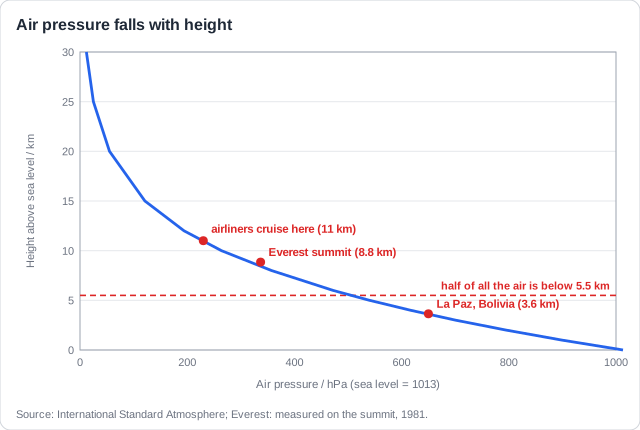
Describe the curve, not just the trend: Say both parts: pressure falls as height rises, AND it falls fastest near the ground, then levels off. You will not be asked to work out the pressure at a given height.
Thin air matters for life. Every breath holds fewer molecules, so less oxygen reaches the body, even though the air is still about one-fifth oxygen. Climbing too fast causes altitude sickness.
What thin air means
- The air is still about 21% oxygen at every height in the troposphere.
- But thin air has fewer molecules in each breath, so the body gets less oxygen.
- People who climb fast get altitude sickness; the highest peaks need bottled oxygen for most climbers.
- Aircraft cabins are pumped full of air, because the air outside at cruising height is far too thin.
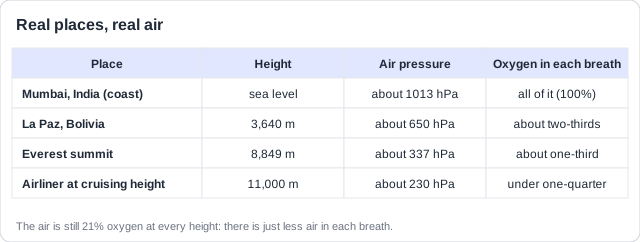
Real example: on the summit of Everest each breath holds only about a third of the oxygen it would at sea level. Most climbers carry bottled oxygen; the first to reach the top without it were Reinhold Messner and Peter Habeler in 1978. Airliners are pumped full of air so the cabin feels like about 2,000 m, not the 11,000 m outside.
Get feedback like a real examiner
Submit your answers and get instant feedback — what you did well, what's missing, and exactly what to write to score full marks.
Climb a mountain and it gets colder. The lapse rate tells you how much: about 1°C for every 100 m. Learn the formula first, then use it.
The lapse rate
- The temperature falls with height in the troposphere: the lapse rate.
- Use about 1°C cooler for every 100 m you go up (10°C for every 1,000 m).
- Why: the air is heated from the ground, and rising air expands and cools in the lower pressure.
- Thin air holds less heat, so high places lose heat quickly, especially at night.
- Moist air cools more slowly as clouds form; the average measured is nearer 0.65°C per 100 m.
The formula: Temperature at the top = temperature at the bottom - (height climbed in m ÷ 100) × 1°C
The facts
Cape Town, South Africa, is at sea level and 20°C. Table Mountain above it is 1,085 m high.
Height climbed
1,085 m ÷ 100 = 10.85, so about 11 steps of 100 m.
Cooling
11 × 1°C = 11°C cooler.
Answer
20°C - 11°C = about 9°C on the top of Table Mountain.
Real example: Kilimanjaro in Tanzania stands only 3 degrees south of the equator, yet its summit, 5,895 m up, is below freezing and still holds glaciers. At its foot, in the town of Moshi, it is usually above 20°C.
How this comes up: Paper 2, Section A: a graph of air pressure or density against height to describe and explain, or a temperature to work out with the lapse rate. Section B (a): outline why the atmosphere thins with height.
Climbers on Aconcagua in Argentina, 6,961 m high, find that the air near the summit is very thin and that they breathe much faster than at their base camp.
Explain why the air near the summit is so thin.
Model answer plan
See the mark-by-mark plan — for / against / judgement, with marking guidance — in study mode.